
KI-Erkenntnisse in konkrete Maßnahmen überführen

Trends
Categories
Forged in innovation: The Wright Brothers’ legacy and the rise of the Flying Tigers
Forged in Innovation: The Wright Brothers’ Legacy and the Rise of the Flying Tigers
The Dawn of Aviation and Its Military Implications
More than 120 years ago, Orville and Wilbur Wright initiated a transformative chapter in human history with their brief but groundbreaking 12-second flight on the dunes of Kitty Hawk, North Carolina. This pioneering achievement not only marked the birth of powered flight but also established a foundation of innovation and relentless pursuit of knowledge that would influence generations of aviators. The Wright Brothers’ legacy extended beyond technological breakthroughs, shaping the strategic mindset of American airpower and setting the stage for the evolution of military aviation.
As the 20th century progressed and global tensions intensified, the United States began to reassess the role of aircraft in warfare. The rapid development of aviation technology after World War I prompted significant expansion of the U.S. Army Air Corps throughout the 1930s. By the outbreak of World War II, airpower had become a central pillar of American military strategy, underscoring the importance of innovation and adaptability—principles deeply rooted in the Wright Brothers’ pioneering spirit.
The Emergence of the Flying Tigers
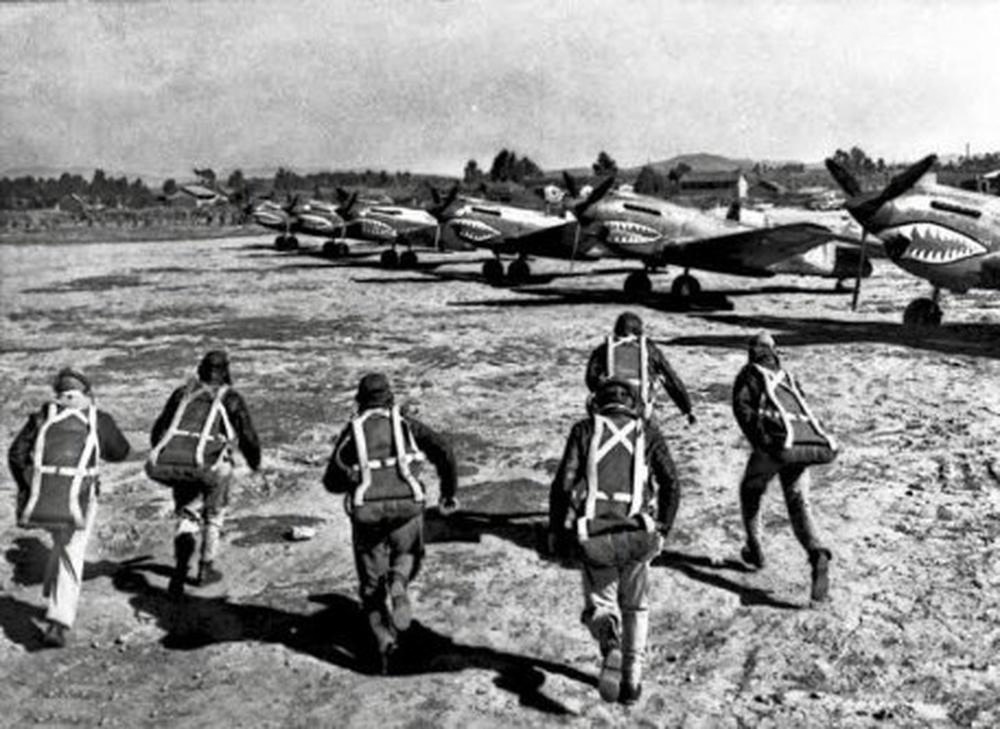
The escalating conflict in Asia during the early 1940s, particularly the mounting pressure on China from Japanese forces, highlighted the urgent need for new combat tactics and rigorous pilot training. The concept of air superiority as a decisive factor in warfare gained traction, leading to the development of a skilled cadre of aviators prepared to serve in critical theaters. In response to China’s request for assistance, retired U.S. Army Air Corps officer Claire Lee Chennault proposed the creation of an American fighter unit to support Chinese forces. This initiative gave rise to the American Volunteer Group (AVG), famously known as the Flying Tigers.
Historian Mark Godwin of the 23d Wing emphasizes Chennault’s pivotal role in challenging the prevailing U.S. Army Air Forces doctrine, which at the time favored high-altitude bombers over pursuit aviation. Chennault’s fighter-centric strategy, initially dismissed by military leadership, advocated for the essential role of fighters in defending bases, protecting bombers, and attacking enemy airfields. His innovative approach ultimately reshaped combat tactics and proved instrumental in the success of the AVG.
After his departure from the military in 1937, Chennault became a key advisor to Chiang Kai-shek, contributing to the modernization of the Chinese Air Force. Upon returning to Washington in 1939, he secured support for the AVG, which was equipped with 100 P-40 aircraft—considered by some to be outdated. Employing tactics overlooked by the Army Air Forces, Chennault trained both Chinese pilots and the AVG, achieving remarkable combat effectiveness that solidified the Flying Tigers’ legendary reputation.
Enduring Influence on Modern Aviation
The intertwined legacies of the Wright Brothers and the Flying Tigers highlight the lasting impact of early aviation pioneers on contemporary technological and military landscapes. Their shared emphasis on knowledge, innovation, and adaptability continues to inform modern aviation and strategic doctrines. In today’s competitive and rapidly evolving environment, organizations draw inspiration from these historical narratives to drive technological advancement and data-driven decision-making. The story of the Wright Brothers and the Flying Tigers remains not only a significant historical account but also a guiding framework for navigating the complexities of innovation in the modern world.

Etihad Airways Suspends Airbus A380 Flights on Key Route

Aditya Birla Group Seeks Approval for Aircraft Leasing in GIFT City

Qatar Airways Highlights Innovation and Connectivity at Arabian Travel Market 2026

Hong Kong's Five-Year Plan Includes Andrew Fan's Aircraft Parts Processing Hub Proposal

ACIA Aero Leasing Delivers ATR72-600 to Air Nostrum

RTX Appoints Jill Albertelli as Head of Pratt & Whitney

TAT Technologies Joins Beyond Aero Hydrogen Aircraft Program

AURAK Study Highlights Barriers to Air Taxi Adoption in Emerging Economies

Xiamen Air Selects Altitude for 787 Maintenance at Heathrow

Etihad and Swissport Extend Global Partnership
