Bild

AeroGenie — Ihr intelligenter Copilot.

Fragen Sie alles. Analysieren Sie alles. Handeln Sie sofort.

Trends

Categories

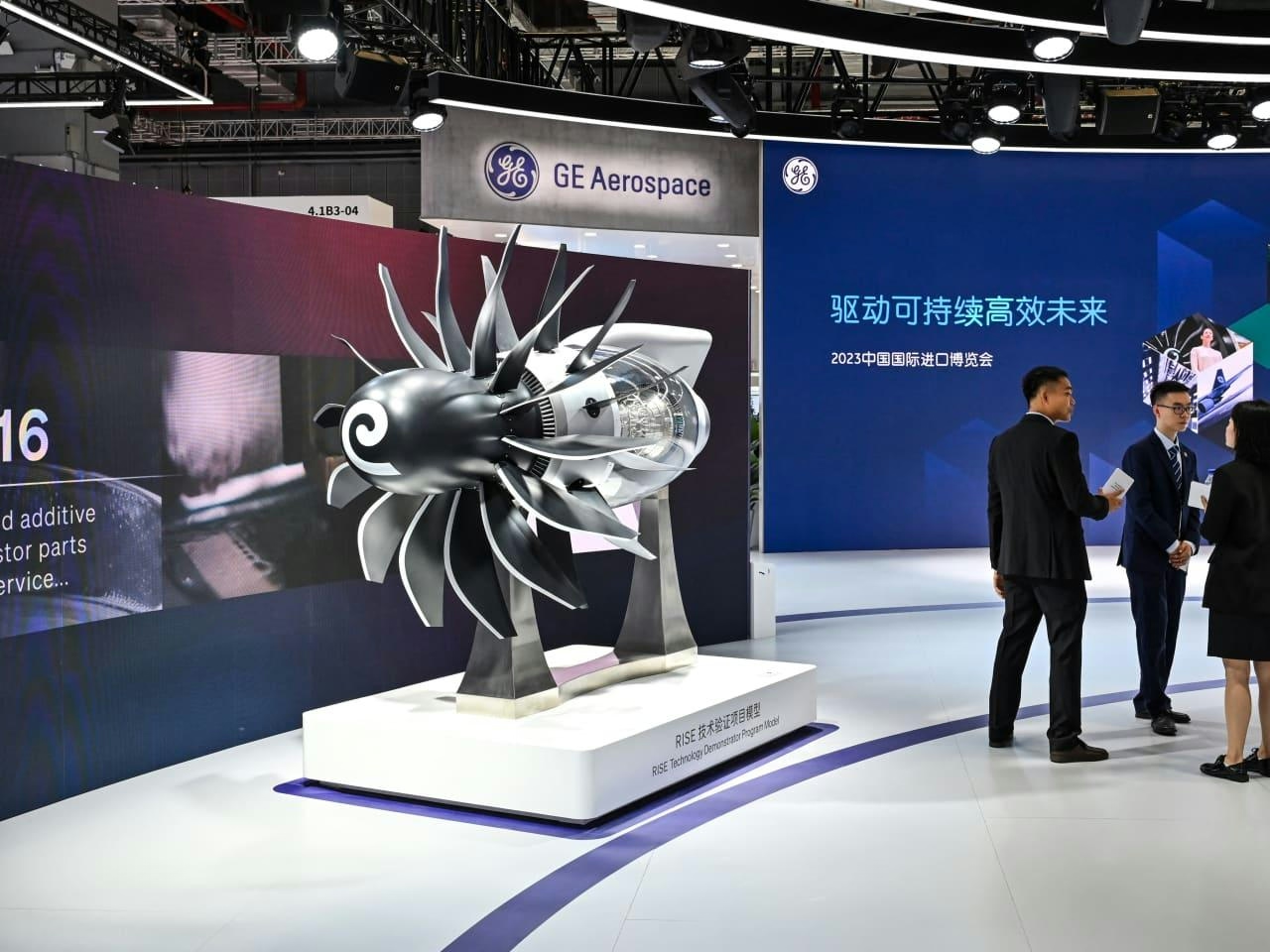
GE Aerospace Raises Profit Forecasts Amid Tariff Concerns
July 17, 2025By ePlane AI
GE Aerospace Raises Profit Forecasts Amid Tariff Concerns
0
0
GE Aerospace
Engine Deliveries
Tariff Concerns

GE Aerospace Raises Profit Forecasts Amid Tariff Concerns

Strong Financial Performance Drives Upward Revision

GE Aerospace has revised its profit forecasts upward for 2025 and beyond, buoyed by a robust operational and financial performance in the second quarter. The company’s improved outlook comes despite growing concerns over global tariffs that threaten to disrupt the aviation sector. Central to this optimism is the sustained demand for aftermarket maintenance services and a significant increase in engine deliveries, as GE continues to address ongoing supply chain challenges.

During the company’s second-quarter earnings call on July 17, GE CEO Lawrence Culp highlighted the strength of the commercial services segment as a key factor underpinning the revised guidance. “Our operating performance and robust commercial services outlook underpins our increased guidance,” Culp stated, adding that the company expects this momentum to continue through 2028.

GE reported a net profit of $2.0 billion for the quarter, a substantial rise from $1.3 billion in the same period last year. Revenue surged 21 percent year-on-year to reach $11 billion, driven predominantly by the commercial engines division, which generated $8 billion—a 30 percent increase. The defense segment also contributed to growth, with revenues climbing 7 percent to $2.6 billion.

Chief Financial Officer Rahul Ghai emphasized the company’s strong performance across all key metrics, noting that the 2025 guidance has been raised across the board. GE’s order backlog has reached a record $175 billion, up from $140 billion at the end of the first quarter. In the most recent quarter alone, the company secured orders for 1,049 aircraft engines, including 860 CFM International Leap engines, which power popular models such as the Airbus A320neo family and Boeing 737 Max.

Revised Outlook and Tariff Challenges

Reflecting the sustained business momentum, GE now anticipates an operating profit between $8.2 billion and $8.5 billion in 2025, up from the previous estimate of $7.8 billion to $8.2 billion. The company also projects adjusted revenue growth in the mid-teens percentage range year-on-year, a notable increase from its earlier forecast of low double-digit growth. Looking further ahead, GE expects operating profits to reach $11.5 billion by 2028, surpassing the prior estimate of $10 billion. Additionally, the company forecasts that annual revenues from its commercial engine services business will double to $20 billion by 2030, compared to $10 billion in 2024.

Despite this positive trajectory, GE faces significant headwinds from newly imposed global tariffs, which the company estimates will cost approximately $500 million in 2025. These tariffs introduce considerable policy uncertainty and pose a risk to the U.S. aviation industry’s $1 trillion economic footprint by potentially altering trade flows. Competitors in the industry may respond by reevaluating their vendor networks and seeking alternative suppliers in countries less affected by tariffs, which could reshape parts sourcing and aircraft acquisition strategies.

In response, GE is actively working to mitigate the impact of these tariffs through stringent cost controls and pricing adjustments, according to CFO Rahul Ghai. While these challenges persist, GE Aerospace’s strong order book and growing demand for both new engines and aftermarket services position the company for continued growth in the years ahead.

More news
American Airlines donates APU to AIM Chicago for student training

American Airlines donates APU to AIM Chicago for student training

American Airlines Donates APU to AIM Chicago to Enhance Student Training American Airlines has donated an auxiliary power unit (APU) to the Aviation Institute of Maintenance (AIM) in Chicago, offering students critical hands-on experience with authentic aircraft equipment. The APU, which powered American’s McDonnell Douglas MD-80 fleet for 29 years and supported over 74,000 take-offs and landings, will serve as a vital training tool for AIM’s more than 400 students. Many of these students aspire to become aviation maintenance technicians and will benefit from working on the same systems they are likely to encounter in their professional careers. Mark Miner, American Airlines’ vice president of technical services, highlighted the significance of the donation, stating, “This APU served American and our customers well over the years and we know it will serve students just as well for many more years to come.” He emphasized the airline’s role as Chicago’s leading global carrier and expressed pride in supporting local students on their path to becoming aviation maintenance professionals. Strengthening Industry Partnerships and Workforce Development The APU donation builds on an ongoing partnership between American Airlines and AIM Chicago, which began in 2022. Previously, the airline contributed a Pratt & Whitney JT8D engine and has supported AIM students at annual Aerospace Maintenance Council Competitions. Several American Airlines frontline employees are currently enrolled at AIM Chicago, pursuing their FAA Airframe and Powerplant licenses, further illustrating the airline’s commitment to workforce development. Jason Pfaff, chief executive of Cotulla, AIM’s parent company, underscored the value of such collaborations. He noted that training on industry-standard equipment enhances student confidence, deepens learning, and bridges the gap between education and employment. Pfaff expressed gratitude for American Airlines’ continued investment in both the students and the future of Chicago’s aviation workforce. Challenges Amidst Competitive and Internal Pressures American Airlines’ investment in local workforce development occurs against a backdrop of intensified competition and internal challenges. United Airlines, a key competitor, has been expanding aggressively at Chicago O’Hare International Airport. United’s CEO recently reported earnings of approximately $500 million in Chicago for 2025, while American Airlines posted a comparable loss, with projections indicating losses could reach $1 billion this year. This competitive pressure is straining American’s market position and financial performance in the region. Internally, American Airlines faces turbulence, including a recent no-confidence vote by its flight attendants against CEO Robert Isom. Such developments may impact operational stability and employee morale, potentially influencing perceptions of the airline’s community initiatives, including the APU donation. Despite these challenges, American Airlines continues to invest in Chicago’s aviation workforce. The airline recently hired over 100 aviation maintenance technicians for its ORD Line Maintenance organization, contributing to more than 10,000 jobs in the Chicagoland area. Its ongoing support for AIM Chicago reflects a sustained commitment to cultivating the next generation of aviation professionals amid a competitive and evolving industry landscape.
Steer Appointed Base Maintenance Manager at Caerdav

Steer Appointed Base Maintenance Manager at Caerdav

Steer Appointed Base Maintenance Manager at Caerdav Independent UK maintenance, repair, and overhaul (MRO) provider Caerdav has appointed Alan Steer as its new base maintenance manager. Steer will oversee the company’s four maintenance lines, with a mandate to enhance operational efficiency and maintain high service standards. Bringing over 40 years of experience in the aviation sector, Steer’s background includes two decades at Thomas Cook Aircraft Engineering and a recent base management role at BCT Aviation Maintenance at East Midlands Airport. Navigating Industry Challenges Steer’s appointment arrives amid significant challenges facing the aviation maintenance industry, including ongoing supply chain disruptions and broader sector instability. These pressures are compounded by trends such as increased CEO turnover in related industries like automotive, which underscore the need for resilient and adaptive leadership within maintenance operations. In this context, Steer’s role will be critical in ensuring Caerdav continues to deliver consistent, high-quality maintenance services while responding to evolving operational demands. Upon joining Caerdav, Steer expressed strong confidence in the company’s vision and culture. He remarked on the positive attitude and shared commitment he observed among staff, emphasizing the importance of building on this foundation to advance the company’s objectives. Steer also praised the existing programmes and procedures, noting their effectiveness in supporting hangar floor operations and customer service—attributes he described as uncommon in many MROs. Leadership and Future Direction In his new capacity, Steer is tasked with quickly adapting to Caerdav’s operational environment and sustaining the company’s rigorous standards. He intends to leverage his extensive expertise to refine current systems, drive further efficiencies, and elevate overall performance. “I want to use my experience and expertise to develop these systems, to drive further efficiencies and to push the company on to the next level,” Steer stated. Industry analysts will be closely monitoring how Steer’s leadership impacts Caerdav’s reputation and operational results. His approach may prompt competitors to reevaluate their maintenance strategies in order to remain competitive amid ongoing industry pressures. Steer’s career began as an apprentice at Dan Air Manchester, where he earned his full A and C Licences by the age of 21. His appointment underscores Caerdav’s commitment to experienced leadership as it navigates a complex and rapidly evolving maintenance landscape.
New Il-96 Wide-Body Aircraft Built in Russia; Customer Remains Undisclosed

New Il-96 Wide-Body Aircraft Built in Russia; Customer Remains Undisclosed

New Il-96 Wide-Body Aircraft Completed in Russia Amid Uncertainty Over Customer The United Aircraft Corporation (UAC) has announced the completion of a new Il-96 series wide-body aircraft, currently undergoing final painting at the VASO branch of the "Il" aircraft factory in Voronezh. While UAC has withheld details regarding the specific modification and the identity of the customer, industry analysts speculate that the aircraft is likely an Il-96-300 model destined for the "Russia" Special Flight Detachment, the primary operator of this variant. Production Context and Facility Developments Production of the Il-96-300 has been notably limited in recent years, with only five units manufactured over the past decade and no deliveries from the Voronezh facility in the last two years, according to the Technosphere Russia publication. Local reports indicate that VASO intends to expand its test runway, a development that may signal plans to increase production capacity for the Il-96 series. This potential expansion comes at a critical juncture as Russian aviation seeks to bolster its domestic manufacturing capabilities amid growing geopolitical challenges. Market Challenges and Strategic Implications The introduction of a new Il-96 aircraft occurs against a backdrop of heightened geopolitical tensions that have complicated Russia’s position in the global aviation market. Western sanctions have restricted access to foreign aircraft and components, prompting Russian manufacturers to pursue domestically produced alternatives. This strategy may appeal to countries seeking non-Western aircraft options, particularly in Asia, where demand for wide-body jets remains robust. Nevertheless, the Il-96 faces significant competition from established wide-body aircraft such as the Boeing 777X and Embraer KC-390, both of which are expected to intensify their marketing and production efforts to maintain or expand their market share. While the Il-96’s advanced technology and potential cost advantages could attract some buyers, experts remain cautious about its ability to compete effectively on a global scale. Expert Perspectives and Future Outlook Despite the rollout of the new aircraft, aviation experts emphasize that the limited scale of Il-96 production is unlikely to address Russia’s broader challenges in the long-haul aviation sector. Andrey Patrakov, head of the RunAvia flight safety service, highlighted the growing shortage of long-haul aircraft in Russia and expressed skepticism that incremental production of the Il-96 series will provide a comprehensive solution. The undisclosed identity of the latest Il-96’s customer adds an element of uncertainty to the program’s trajectory. Nonetheless, the completion of this aircraft underscores ongoing efforts by Russian manufacturers to adapt to a shifting global landscape and to position the Il-96 as a viable alternative within the international wide-body market.
SESAR JU and Canary Islands Sign Agreement to Advance Air Traffic Management

SESAR JU and Canary Islands Sign Agreement to Advance Air Traffic Management

SESAR JU and Canary Islands Sign Agreement to Advance Air Traffic Management Strengthening Research and Innovation in Air Traffic Management In March 2026, the Gobierno de Canarias (Canary Islands Regional Government) and the SESAR Joint Undertaking (SESAR JU) formalized a memorandum of cooperation (MoC) designed to enhance research and innovation (R&I) in air traffic management (ATM). This partnership aims to accelerate the development of smarter, more sustainable skies across Europe, aligning with the continent’s broader objectives of environmental leadership and competitiveness within the aviation sector. This agreement marks the third collaboration between SESAR JU and a European region, underscoring the growing role of regional innovation ecosystems in shaping the Digital European Sky. The initiative is guided by the European ATM Master Plan, which envisions Europe as the world’s most efficient and environmentally friendly airspace. Strategic Importance of the Canary Islands The MoC also supports the Canary Islands Aerospace Strategy, positioning the archipelago as a global hub for aerospace research, technological development, and experimental validation. The region’s strategic geographic location, favorable climate, advanced airport infrastructure, and expanding R&I ecosystem make it an ideal environment for testing pioneering ATM solutions. The cooperation will focus on joint research initiatives to develop and validate new ATM technologies, experimental projects that leverage the Canary Islands’ unique geographic and operational environment, and efforts to align regional innovation with Europe-wide ATM modernization goals. Challenges and the Path Forward The partnership emerges amid challenges faced by the SESAR project in securing sustained funding. European aviation stakeholders have emphasized the need for continued investment to maintain the momentum of modernization efforts. Concurrently, airlines and airports are adapting to new management contracts and modernization initiatives, exemplified by the recent $1.5 billion contract awarded by the U.S. Federal Aviation Administration to overhaul its air traffic control system. These developments highlight the critical role of regional involvement in managing strategic infrastructure, as regions like the Canary Islands seek to mitigate increased costs and preserve competitiveness. Through this enhanced collaboration, SESAR JU and the Canary Islands aim to reinforce Europe’s leadership in ATM innovation, addressing both the opportunities and challenges presented by a rapidly evolving aviation landscape.
Contaminated Fuel Injector Causes Emergency Landing

Contaminated Fuel Injector Causes Emergency Landing

Contaminated Fuel Injector Forces Emergency Landing in Alabama A Cessna 172 was compelled to execute an emergency landing near Opelika, Alabama, following a partial loss of engine power attributed to a contaminated fuel injector, according to a recent report by the National Transportation Safety Board (NTSB). Incident Overview and Pilot Account The pilot, who sustained minor injuries, reported conducting a thorough preflight inspection without detecting any irregularities. Although the engine initially sounded “slightly rough” at startup, it stabilized within seconds. Subsequent engine run-up and magneto checks were normal, and all instrument readings remained within acceptable limits during the takeoff roll. Despite these indications, the pilot observed that the aircraft’s airspeed increased more slowly than usual, and the engine appeared unable to deliver full power. At rotation speed of 55 knots, the aircraft struggled to accelerate, maintaining only 60 to 65 knots during the initial climb. Engine revolutions per minute (RPM) were limited to between 1,700 and 1,750, despite the throttle and mixture controls being fully advanced. The pilot described the engine’s performance as “constant but sluggish,” noting no fluctuations in RPM throughout the flight. Recognizing the compromised power output, the pilot lowered the aircraft’s nose and aimed for a forced landing site near the airport. The aircraft subsequently collided with trees and came to rest inverted, sustaining substantial damage to both wings, the fuselage, and the engine mount. Investigation Findings Post-accident examination revealed that the engine’s crankshaft and valvetrain remained intact, with proper compression and suction observed across all cylinders. Both magnetos were securely mounted and timed at 28 degrees before top dead center, slightly advanced compared to the manufacturer’s recommended 25 degrees. The investigation concentrated on the fuel injector assembly, which, upon disassembly, exhibited contamination by a mixture of fuel and oil between the air diaphragm and regulator cover. Photographic evidence showed greenish-blue oily deposits within the fuel servo, consistent with issues outlined in a manufacturer’s service bulletin. The NTSB concluded that the probable cause of the incident was a partial loss of engine power resulting from contamination in the fuel injector assembly. Broader Implications Beyond immediate safety concerns, incidents involving contaminated fuel injectors carry significant financial and reputational consequences for operators. Emergency landings often incur direct costs including fuel loss, landing fees, ground handling charges, rebooking expenses, and passenger compensation. Such events also attract heightened regulatory scrutiny, potentially triggering investigations into maintenance and safety practices. Competitors may leverage these incidents to emphasize their own safety records, thereby amplifying reputational damage to the affected operator. The March 2024 accident highlights the critical importance of rigorous maintenance and inspection protocols, demonstrating how even minor contamination in essential engine components can jeopardize flight safety and operational reliability. **NTSB Identification:** 193982
Sahar Group Adopts Ramco Aviation Software to Support Growth

Sahar Group Adopts Ramco Aviation Software to Support Growth

Sahar Group Adopts Ramco Aviation Software to Support Growth Ramco Systems Limited, a prominent enterprise software provider based in India, has announced that Sahar Group will implement its aviation software platform to facilitate the company’s ongoing expansion. Ramco is known for its comprehensive Enterprise Resource Planning (ERP) solutions across various sectors, including aviation maintenance, repair and overhaul (MRO), logistics, human resources, and payroll. The company’s software leverages advanced technologies such as artificial intelligence, machine learning, robotic process automation (RPA), and blockchain to drive digital transformation for clients spanning industries from defense and airlines to energy, utilities, and third-party logistics. Modernizing Operations with Advanced Technology The adoption of Ramco’s aviation software represents a significant milestone for Sahar Group as it aims to modernize its operations and improve efficiency. Ramco’s cloud-based VirtualWorks platform supports the development of scalable, multi-tenant web solutions, while its DecisionWorks suite offers robust information and decision support systems tailored to the complex demands of the aviation sector. This integration is expected to enhance Sahar Group’s operational capabilities and support its growth trajectory. Challenges and Industry Dynamics Despite the potential benefits, the transition to Ramco’s cloud-based subscription model and the integration of AI-driven tools pose certain challenges for Sahar Group. Industry precedents highlight the risks associated with such shifts; for instance, Dassault Systèmes recently experienced a decline in market value following its own move toward cloud and AI solutions. These transitions often attract heightened scrutiny from investors and stakeholders concerned about the software provider’s ability to sustain near-term revenue growth and ensure seamless technology integration. The competitive landscape within aerospace and technology is also undergoing rapid transformation. As firms increasingly adopt AI-driven business models, the sector has seen a surge in large-scale mergers and acquisitions, particularly in the United States. This consolidation trend is intensifying competition among aerospace and AI solution providers, compelling companies like Ramco to continuously innovate and differentiate their offerings to maintain market relevance. For Sahar Group, the partnership with Ramco presents both an opportunity to leverage cutting-edge digital tools and a challenge in managing the complexities of technological transformation. As the aviation industry embraces cloud and AI technologies, the success of such initiatives will depend on effective implementation, adaptability, and the ability to deliver tangible business outcomes.
Deucalion Leases Three A330 Aircraft to Wamos Air

Deucalion Leases Three A330 Aircraft to Wamos Air

Deucalion Leases Three A330 Aircraft to Wamos Air Amid Shifting Widebody Market Deucalion Aviation has secured three Airbus A330 aircraft, currently leased to the Spanish carrier Wamos Air, marking a significant expansion of its managed widebody portfolio. Acting as arranger and servicer on behalf of institutional investors, Deucalion sourced these Rolls-Royce Trent-powered jets through its extensive global origination network. Although financial details remain confidential, the transaction underscores Deucalion’s strategic focus on mid- to end-of-life widebody aircraft, which offer resilient lease profiles and operational flexibility. Market Context and Industry Trends This deal emerges amid heightened scrutiny of widebody fleet strategies across the aviation sector. Industry leaders, including AerCap CEO Aengus Kelly, have recently drawn attention to reliability challenges and increased aircraft downtime, prompting airlines to seek additional capacity and diversify their fleets. This trend is evident in moves such as Brazilian carrier GOL’s exploration of new fleet types and Thai Airways’ recent lease agreement for ten Boeing 787-8 aircraft. These developments reflect a competitive environment where operators are broadening their aircraft mix to enhance operational resilience and mitigate risks associated with aging fleets. Deucalion’s Chief Commercial Officer, Nate Riggs, highlighted the importance of the Wamos Air transaction within this evolving landscape. He stated, “Our team focuses not only on identifying attractive relative value opportunities, but also on actively managing aircraft throughout their lifecycle — including lease transitions, extensions, and end-of-life strategies. The A330 remains a highly versatile variant, and this transaction reflects our continued conviction in this segment of the market.” Operational Expertise and Asset Versatility The versatility of the A330 platform is further emphasized by growing interest in specialized variants such as the Airbus A330 Multi-Role Tanker Transport (MRTT), which has attracted attention from both commercial and government operators. This rising demand for the A330 platform could influence asset values and leasing dynamics, as lessors and airlines consider the aircraft’s adaptability for both passenger and non-passenger roles. Karl Trowbridge, Chief Operating Officer of Deucalion Aviation, underscored the operational demands involved in managing mid- to end-of-life aircraft in today’s market. He explained, “Mid- to end-of-life aircraft require hands-on operational oversight, deep technical capability and market knowledge to preserve and enhance value. Our platform is built around active servicing — from detailed technical management and lease compliance to transition planning and remarketing. This transaction demonstrates how Deucalion integrates sourcing discipline with operational execution to deliver consistent outcomes for our capital partners.” As airlines and lessors navigate a market shaped by reliability concerns, fleet diversification, and evolving asset demand, Deucalion’s latest A330 transaction with Wamos Air highlights both the challenges and opportunities inherent in managing widebody aircraft portfolios through changing industry cycles.
Acron Aviation Opens Global Headquarters in St. Petersburg, Florida

Acron Aviation Opens Global Headquarters in St. Petersburg, Florida

Acron Aviation Establishes New Global Headquarters in St. Petersburg Acron Aviation has officially opened its new global headquarters in downtown St. Petersburg, Florida, marking a pivotal moment in the company’s trajectory of growth and resilience. The inauguration ceremony, held on March 2 at City Center, brought together employees, industry partners, and members of the local community to celebrate the launch of the advanced facility. A State-of-the-Art Facility Replacing Previous Site The new headquarters spans 242,115 square feet and is prominently located on the waterfront at City Center. This facility replaces Acron Aviation’s original St. Petersburg site, which was shuttered in October 2024 following extensive damage caused by Hurricane Milton. Despite the disruption, the company sustained its global operations and customer support from a temporary location before transitioning to the permanent headquarters. Alan Crawford, Chief Executive Officer of Acron Aviation, described the opening as a significant milestone. He emphasized the company’s commitment to St. Petersburg, stating, “This world-class head office is a clear representation of our ongoing commitment to investing in St. Petersburg. We remain focused on supporting both the local community and the region’s economic growth as we deepen our roots here and continue to develop the safety-critical intelligence that will define the future of flight.” The headquarters functions as the operational center for Acron Aviation’s 1,500 employees worldwide, with 80 staff members from executive leadership and customer support teams based on-site. The facility includes an Engineering Centre of Excellence, an Innovation Lounge, four research and development laboratories, expanded conference facilities, a customer training center, and modern collaboration spaces. These features are designed to foster innovation, engineering excellence, and enhanced customer engagement across the company’s aviation technology portfolio. Navigating Industry Challenges Amid Expansion The opening of the new headquarters coincides with a period of heightened complexity within the aviation industry. The International Air Transport Association has highlighted ongoing supply chain disruptions that continue to affect global airlines, presenting challenges that Acron Aviation must address as it scales operations in its new facility. Furthermore, the relocation is expected to attract increased scrutiny from competitors and stakeholders, who may question the strategic benefits of the St. Petersburg location and respond with intensified local competition or operational adjustments. Broader geopolitical tensions also persist as a factor influencing the aviation sector, potentially affecting Acron Aviation’s market positioning and operational stability. Industry leaders have noted that such external pressures can create indirect challenges for companies expanding their global presence. Despite these headwinds, the establishment of the new headquarters underscores Acron Aviation’s long-term dedication to St. Petersburg and its resolve to enhance global operational capabilities. The company intends to leverage the facility to drive innovation and growth while contributing to the economic vitality of the region.
Will Uber and Joby Aviation Stocks Rise After Recent Announcements?

Will Uber and Joby Aviation Stocks Rise After Recent Announcements?

Uber and Joby Aviation Forge Partnership to Launch Air Taxi Service in Dubai Uber Technologies (NYSE: UBER) has announced a strategic partnership with Joby Aviation (NYSE: JOBY) to introduce an Uber Air taxi service in Dubai later this year, marking Uber’s entry into the emerging air taxi market. This collaboration has generated considerable interest among investors, prompting speculation about potential stock gains for both companies. However, a detailed analysis suggests a more measured outlook given the complexities involved. Uber will not own the electric vertical takeoff and landing (eVTOL) aircraft but will act as the booking platform, leveraging its extensive experience in mobility, delivery, and freight services. In 2025, these core segments collectively generated $52 billion in revenue, reflecting an 18% increase year over year. Uber also reported a net income of $10 billion, slightly higher than the previous year, though this figure excludes earnings from outside investments. Despite the high-profile nature of the partnership, the immediate financial impact on Uber’s revenue is expected to be limited, as the air taxi initiative remains in its nascent stages. Regulatory and Market Challenges Temper Optimism The air taxi sector is subject to stringent regulatory oversight, and obtaining the necessary approvals for commercial operations poses a significant hurdle. These regulatory challenges could delay the widespread adoption of air taxi services. Furthermore, competition within the sector is intensifying, with multiple companies pursuing similar partnerships or developing proprietary services to capture market share. Following the announcement, Uber’s stock experienced a modest increase of approximately 2%, yet it remains below critical support levels, reflecting investor caution. Over the past year, Uber’s shares have shown limited movement, and its price-to-earnings (P/E) ratio has declined to 16, potentially enhancing its appeal as it explores new revenue avenues such as air taxis. Joby Aviation, responsible for manufacturing and operating the eVTOL aircraft, is at an earlier stage of commercial development. The company began generating revenue in 2025, reporting $53 million, a substantial increase from $136,000 in 2024. Nevertheless, Joby posted a net loss of $930 million last year, underscoring the significant challenges ahead on the path to profitability. With $1.4 billion in liquidity, Joby may need to secure additional funding through equity or debt issuance to sustain its operations. Joby’s stock has been notably volatile, rising 58% over the past year. However, the absence of earnings means the company lacks a P/E ratio, and its revenue base remains small relative to its losses. Like Uber, Joby faces considerable regulatory and competitive pressures as the air taxi market continues to evolve. While the Uber-Joby partnership represents a significant milestone toward the commercialization of air taxi services, both companies confront substantial regulatory, financial, and competitive obstacles. Investors should approach the prospects of immediate stock gains with caution, as the sector’s path to profitability and broad adoption remains uncertain.
Ramco Systems Secures Aviation Software Contract with Sahar Group for MRO Digital Transformation

Ramco Systems Secures Aviation Software Contract with Sahar Group for MRO Digital Transformation

Ramco Systems Secures Aviation Software Contract with Sahar Group for MRO Digital Transformation Ramco Systems has secured a significant contract with Sahar Group to implement advanced aviation software solutions aimed at transforming the Maintenance, Repair, and Overhaul (MRO) operations. Announced on March 4, 2026, this strategic partnership is designed to enhance operational efficiency and streamline processes for Sahar Group, a prominent aerospace services provider specializing in the UH-60 Black Hawk platform. Advancing Digital Transformation in MRO Operations Sahar Group is pursuing an ambitious expansion of its commercial activities, targeting new aviation segments such as Parts Manufacturer Approval, Supplemental Type Certificates, and helicopter sales and leasing. To manage the increasing operational complexity, the company is investing in a unified digital platform. Ramco’s next-generation Aviation Software will serve as the backbone of this transformation, integrating key functions including maintenance planning, component maintenance, supply chain management, MRO and parts sales, quality assurance, compliance, and financial operations. This integrated approach is expected to improve visibility and control across Sahar Group’s diverse business units, facilitating streamlined workflows, enhanced data accuracy, and accelerated decision-making processes. Leadership Insights on the Partnership Arnold Escobar, CEO of Sahar Group, emphasized the strategic importance of the collaboration, stating, “As part of our plan to scale and diversify our operations, we needed a platform that could support long-term growth without compromising operational discipline. Ramco Aviation Software stood out due to its established presence in the helicopter, defense, and component MRO spaces.” From Ramco Systems, Manoj Kumar Singh, Chief Customer Officer – Aviation, Aerospace & Defense, remarked, “Our selection by Sahar Group serves as further validation of Ramco's ability to support the complex needs of helicopter and defense MRO service providers. By combining deep aviation domain expertise with AI, we are helping organizations shift toward more predictive, data-driven maintenance services.” Market Position and Industry Challenges This contract reinforces Ramco Systems’ strong foothold in the specialized aviation software market, where its solutions are utilized by over 24,000 users managing more than 4,000 aircraft worldwide. Ramco’s clientele spans leading airlines, third-party MRO providers, major helicopter operators, defense organizations, and emerging urban air mobility companies. The partnership also strengthens Ramco’s presence within Miami’s established aviation MRO industrial base, showcasing the company’s capability to deliver customized solutions tailored to complex industry demands. Nonetheless, the digital transformation journey presents significant challenges. Integrating new technologies with legacy systems, ensuring compliance with rigorous aviation regulations, and facilitating workforce adaptation to digital tools remain critical hurdles. The rapid expansion of the MRO sector in the Middle East, coupled with a growing demand for skilled maintenance technicians, is intensifying competition and driving the need for innovation. Investor sentiment toward digital initiatives in MRO has been positive, with increased interest in companies pursuing such transformations. Competitors, including ST Engineering—which recently secured a $372 million MRO contract in Qatar—are likely to accelerate their digital offerings to maintain market competitiveness. As the aviation MRO sector continues to evolve, the Ramco-Sahar partnership exemplifies the industry’s shift toward integrated, data-driven solutions designed to meet the demands of a rapidly changing environment.
line










