
KI-Erkenntnisse in konkrete Maßnahmen überführen

Trends
Categories
German Researchers Begin Flight Campaign to Study Contrails
German Researchers Launch Flight Campaign to Investigate Contrails and Climate Impact
German scientists have initiated a comprehensive flight campaign to deepen understanding of contrails produced by modern aircraft engines and their influence on climate change. Spearheaded by the German Aerospace Center (DLR), this effort forms part of the broader A4CLIMATE project, which unites 17 partners across nine countries to address aviation’s non-CO2 environmental effects.
Investigating Contrail Formation and Mitigation Strategies
The research focuses on several approaches to mitigate contrail formation and their associated warming effects. These include the advancement of engine technologies, optimization of flight routes, and the adoption of alternative fuels. A central question guiding the study is whether the latest generation of “low-soot, lean-burn” engines—engineered to emit fewer particulate matter—actually lead to a reduction in contrail frequency or persistence. Since soot and other particles in aircraft exhaust act as nuclei for ice crystal formation, which is essential to contrail development, understanding this relationship is critical. However, as DLR emphasizes, “It is still unclear whether less soot automatically means fewer contrails.”
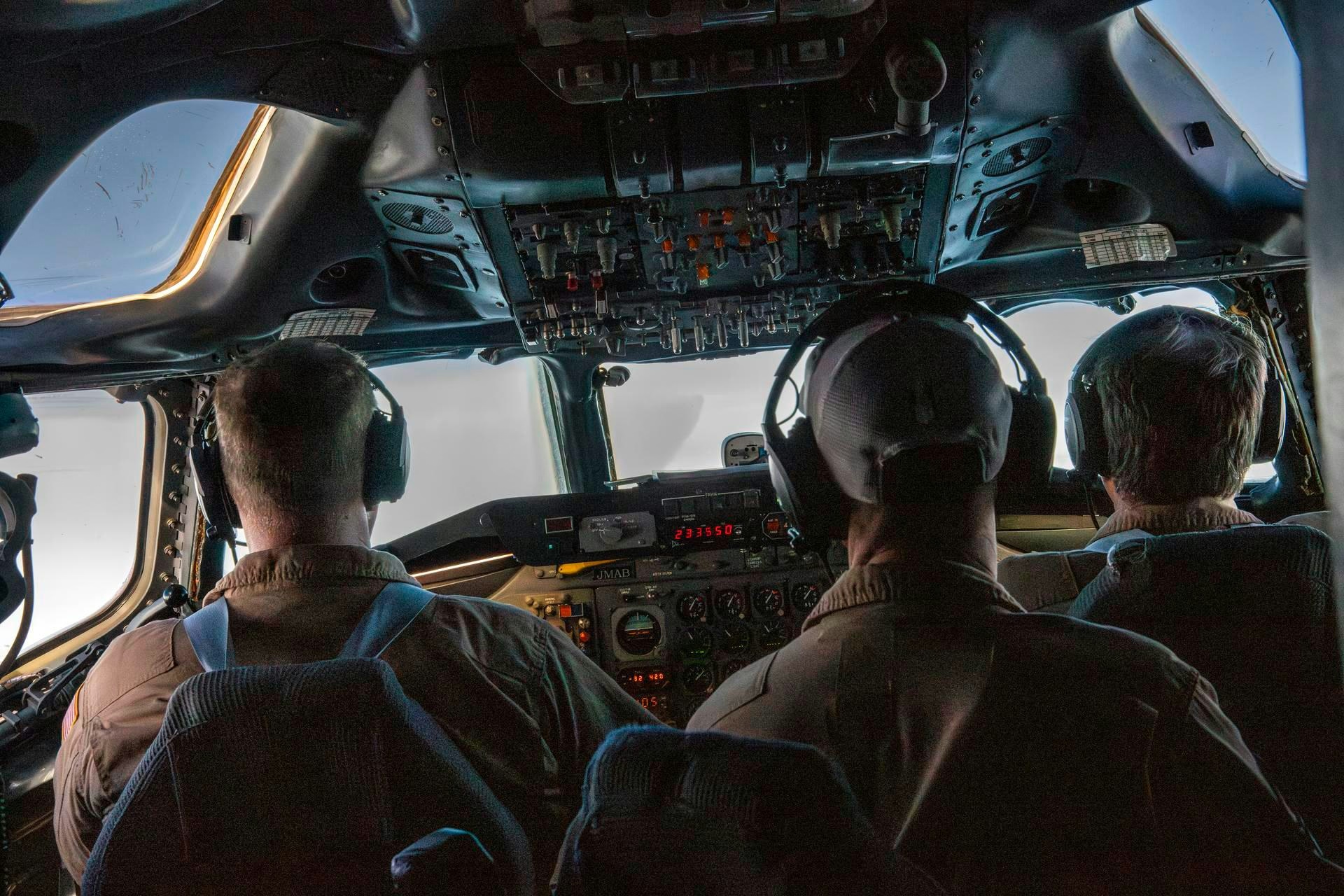
To explore this, DLR is deploying its Dassault Falcon 20E research aircraft from Oberpfaffenhofen to trail TUIfly passenger jets on routes between Germany and Egypt, regions known for frequent contrail formation. Over a two-week period, the Falcon 20E will fly approximately 10 kilometers behind selected TUIfly flights, gathering detailed measurements of contrail characteristics and monitoring the evolution of soot particles within the exhaust plume for up to 30 minutes. The collected data will contribute to refining engine and contrail models and improving forecasting accuracy.
Christiane Voigt, project manager at the DLR Institute of Atmospheric Physics, stated, “We want to understand how much global warming can be reduced when aircraft are more modern and smarter.” While specific aircraft under observation have not been disclosed, TUIfly’s newest jet, the Boeing 737 Max equipped with CFM International Leap-1B engines, is likely among those studied.
Towards Real-Time Climate-Friendly Flight Planning
Beyond data collection, the project aims to develop a fully automated data feed capable of delivering real-time route recommendations. This system would provide immediate guidance on whether flights can be planned to minimize climate impact. Satellite observations will subsequently verify the effectiveness of these strategies in reducing contrail formation. However, rerouting flights to avoid contrail-prone areas may lead to longer journeys, increased fuel consumption, and higher CO2 emissions. To address this trade-off, the project will assess the net climate impact of any route adjustments, striving to balance reductions in contrail-induced warming against potential increases in carbon emissions.
The campaign faces several challenges, including variable weather conditions, technical constraints in measurement and modeling, and regulatory complexities related to airspace management and flight operations. This initiative emerges amid growing industry momentum toward sustainable aviation fuels (SAF), exemplified by British Airways’ recent efforts to deploy SAF strategically to prevent contrail formation. Such developments are encouraging competitors to explore similar technologies and strategies, potentially accelerating a shift toward more environmentally responsible aviation practices worldwide.

Etihad Airways Suspends Airbus A380 Flights on Key Route

Aditya Birla Group Seeks Approval for Aircraft Leasing in GIFT City

Qatar Airways Highlights Innovation and Connectivity at Arabian Travel Market 2026

Hong Kong's Five-Year Plan Includes Andrew Fan's Aircraft Parts Processing Hub Proposal

ACIA Aero Leasing Delivers ATR72-600 to Air Nostrum

RTX Appoints Jill Albertelli as Head of Pratt & Whitney

TAT Technologies Joins Beyond Aero Hydrogen Aircraft Program

AURAK Study Highlights Barriers to Air Taxi Adoption in Emerging Economies

Xiamen Air Selects Altitude for 787 Maintenance at Heathrow

Etihad and Swissport Extend Global Partnership
