
KI-Erkenntnisse in konkrete Maßnahmen überführen

Trends
Categories
Honeywell Charts a New Course Through Corporate Restructuring and Innovation
Honeywell Charts a New Course Through Corporate Restructuring and Innovation
Honeywell, the global industrial conglomerate, is embarking on a significant transformation as it prepares to divide into three independent publicly traded companies. This strategic restructuring coincides with major technological advancements in aviation and defense, positioning each future business unit for focused growth and enhanced market leadership.
Dividend Stability Amid Corporate Transition
Amid the complexities of this separation, Honeywell has reaffirmed its commitment to shareholder value by confirming a dividend payment of $1.19 per share, scheduled for March 13, 2026. This assurance provides a measure of stability for investors during a period of operational change. The market has responded positively, with Honeywell shares trading near a 52-week high at 204.55 euros and year-to-date gains surpassing 22%. Nonetheless, the stock’s Relative Strength Index (RSI) of 81.6 indicates potential short-term overbought conditions.
Advancing Sustainable Aviation Fuel Initiatives
Central to Honeywell’s forward-looking strategy is its expansion into sustainable aviation fuel (SAF). In partnership with Verso Energy, Honeywell plans to deploy its proprietary “eFining” technology across seven production facilities in Europe and the United States. This initiative aims to enable large-scale manufacturing of low-carbon fuels by utilizing captured carbon dioxide. The adoption of standardized plant designs is expected to reduce capital expenditures and accelerate market entry. Regulatory support for these projects is robust, with initiatives such as “DEZiR” and “ReSTart” already securing funding from the European Union’s Innovation Fund.
Strengthening the Defense Portfolio
Concurrently, Honeywell is intensifying its focus on the defense sector. The U.S. Air Force recently awarded the company a prototype contract for the “SkyShot 1600” propulsion system, designed to serve as the core engine for autonomous combat aircraft. Employing advanced digital modeling techniques, this new engine is anticipated to significantly shorten development timelines, directly benefiting Honeywell’s forthcoming standalone Aerospace business.
Navigating Competitive and Market Challenges
Honeywell’s restructuring unfolds within a dynamic competitive landscape. Industry rivals are advancing their own strategic initiatives, including ST Engineering’s defense modernization partnerships and LIG Nex1’s memorandum of understanding to explore unmanned aerial vehicle (UAV) development and commercialization. Honeywell’s record backlog, now exceeding $37 billion, alongside an accelerated timeline for the aerospace spin-off, has contributed to a recent surge in its share price.
However, the company faces a range of market-specific and internal challenges that could impact its growth trajectory. The ongoing reshoring trend in U.S. manufacturing has led to labor shortages and intensified the drive toward industrial automation. While this trend presents opportunities for Honeywell’s automation business, it also raises concerns regarding the company’s capacity to manage higher domestic production costs and evolving workforce demands.
Progress Toward a Three-Way Corporate Split
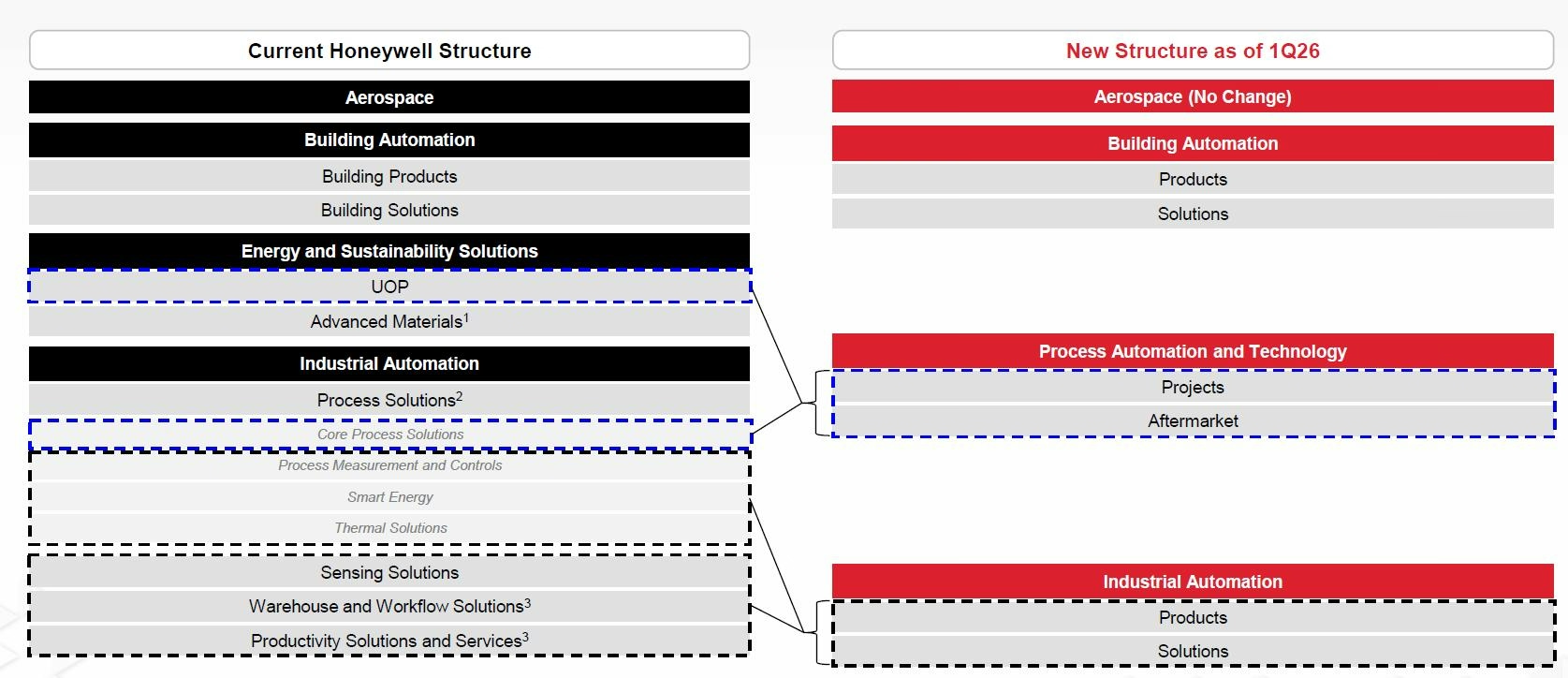
Honeywell aims to complete its separation into three distinct listed entities—Aerospace, Automation, and Specialty Materials—by the second half of 2026. Management remains focused on maintaining operational strength throughout the transition, with immediate priorities including scaling sustainable aviation fuel production and advancing autonomous propulsion technologies. Preparations for the triple stock market listing are proceeding according to plan.
As Honeywell navigates this ambitious restructuring, its success will depend on its ability to balance innovation, operational execution, and responsiveness to shifting market dynamics.

Etihad Airways Suspends Airbus A380 Flights on Key Route

Aditya Birla Group Seeks Approval for Aircraft Leasing in GIFT City

Qatar Airways Highlights Innovation and Connectivity at Arabian Travel Market 2026

Hong Kong's Five-Year Plan Includes Andrew Fan's Aircraft Parts Processing Hub Proposal

ACIA Aero Leasing Delivers ATR72-600 to Air Nostrum

RTX Appoints Jill Albertelli as Head of Pratt & Whitney

TAT Technologies Joins Beyond Aero Hydrogen Aircraft Program

AURAK Study Highlights Barriers to Air Taxi Adoption in Emerging Economies

Xiamen Air Selects Altitude for 787 Maintenance at Heathrow

Etihad and Swissport Extend Global Partnership
