
KI-Erkenntnisse in konkrete Maßnahmen überführen

Trends
Categories
House Subcommittee Reviews Michigan Aviation Funding, Flags Parking Tax Sunset as Risk
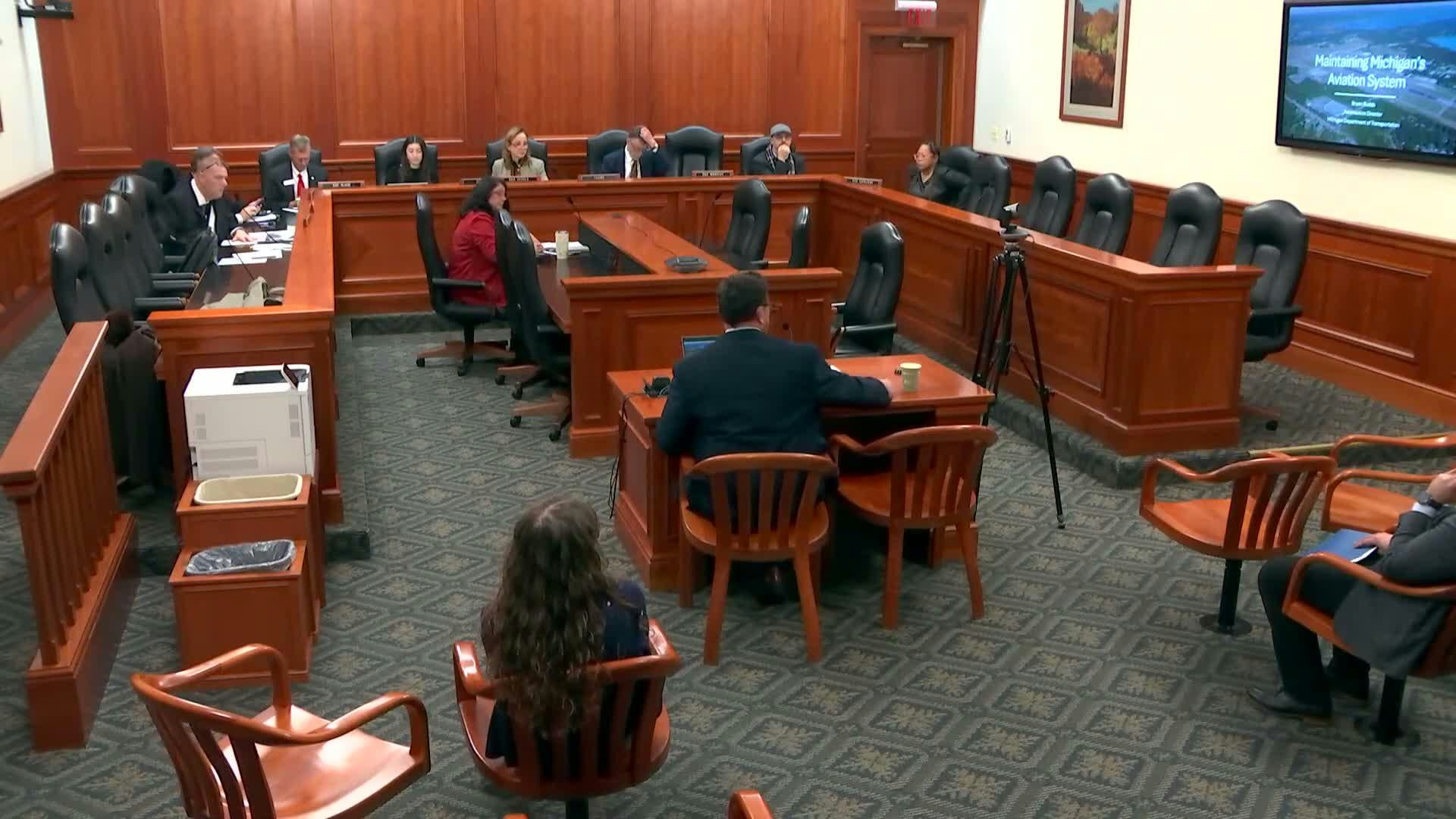
House Subcommittee Reviews Michigan Aviation Funding, Flags Parking Tax Sunset as Risk
Overview of Michigan’s Aviation Budget
The House Appropriations Subcommittee on Transportation convened this week to examine the current state of Michigan’s aviation funding. State officials and airport executives collectively warned of an impending financial shortfall as a critical revenue source approaches its scheduled expiration. William Hamilton provided a comprehensive budget overview, noting that Michigan’s transportation budget totals approximately $7.8 to $7.9 billion. Of this, $2.3 billion derives from federal sources, while $5.4 billion comes from state-restricted revenues. Within this framework, roughly $330 million is allocated to aeronautics programs, with nearly 96 percent—about $317.1 million—earmarked for capital outlay grants that support publicly owned, public-use airports.
Funding Administration and Revenue Concerns
Lynn Smith, representing the Michigan Department of Transportation’s (MDOT) Office of Aeronautics, outlined the department’s role in managing both federal and state aviation funds through the Michigan Aeronautics Commission. She explained that MDOT administers Airport Improvement Program grants under federal law and oversees newer funding initiatives introduced by the Infrastructure Investment and Jobs Act. State-restricted revenues for the State Aeronautics Fund include aviation fuel taxes, a sales-and-use tax earmark, and notably, an airport parking tax linked to Detroit Metropolitan Wayne County Airport.
Smith emphasized the critical importance of the parking tax, which provides the state match required for federal grants. However, this tax is scheduled to sunset in 2030, posing a significant risk to Michigan’s ability to meet federal matching obligations unless the legislature acts to extend or replace the revenue source. She also highlighted Michigan’s status as a federal block-grant state for aviation, which grants MDOT discretion to allocate federal funds to general aviation airports based on state priorities.
Infrastructure Needs and Industry Perspectives
Craig Williams, representing the Michigan Association of Airport Executives, underscored the substantial infrastructure demands facing Michigan’s airports. He cited a projected $2.9 billion in infrastructure needs between 2025 and 2029. According to Williams, the Federal Aviation Administration (FAA) is expected to cover approximately half of these costs, with state funding accounting for about 10 percent and airports themselves responsible for the remaining 40 percent. He criticized the state’s modest $50,000 air-carrier recruitment budget as inadequate to compete with neighboring states and called for sustained support of air-service development programs. Williams also urged lawmakers to extend the Detroit Metro parking-tax authority beyond its 2030 expiration to maintain critical funding streams.
Broader Aviation Sector Challenges
The discussion extended to broader challenges confronting the aviation sector. Some Republican lawmakers expressed skepticism regarding federal funding for advanced air mobility (AAM) initiatives and voiced concerns about the FAA’s certification process for electric aircraft. These uncertainties have contributed to investor caution surrounding government support for AAM projects. Industry stakeholders are advocating for enhanced FAA expertise to expedite certification processes and are pressing for ethical oversight of battery supply chains. Additionally, there is a growing call for improved federal coordination with state aviation officials to facilitate the integration of emerging aviation technologies.
Regulatory and Staffing Matters
Committee members inquired about MDOT’s staffing and regulatory responsibilities. Smith reported that the aeronautics division employs 48 full-time staff members, with some positions currently vacant. She also described the Michigan Tall Structures Act, which mandates an annual review of between 6,000 and 7,200 applications for structures that could potentially impact airspace safety.
Following the adoption of minutes from a previous meeting, the subcommittee adjourned. Presenters submitted written materials and expressed willingness to return for further discussions as lawmakers deliberate future funding structures and strategies to address the anticipated revenue gap.

Etihad Airways Suspends Airbus A380 Flights on Key Route

Aditya Birla Group Seeks Approval for Aircraft Leasing in GIFT City

Qatar Airways Highlights Innovation and Connectivity at Arabian Travel Market 2026

Hong Kong's Five-Year Plan Includes Andrew Fan's Aircraft Parts Processing Hub Proposal

ACIA Aero Leasing Delivers ATR72-600 to Air Nostrum

RTX Appoints Jill Albertelli as Head of Pratt & Whitney

TAT Technologies Joins Beyond Aero Hydrogen Aircraft Program

AURAK Study Highlights Barriers to Air Taxi Adoption in Emerging Economies

Xiamen Air Selects Altitude for 787 Maintenance at Heathrow

Etihad and Swissport Extend Global Partnership
