
KI-Erkenntnisse in konkrete Maßnahmen überführen

Trends
Categories
How The Airbus A220’s Engine Efficiency Is Changing Regional Travel
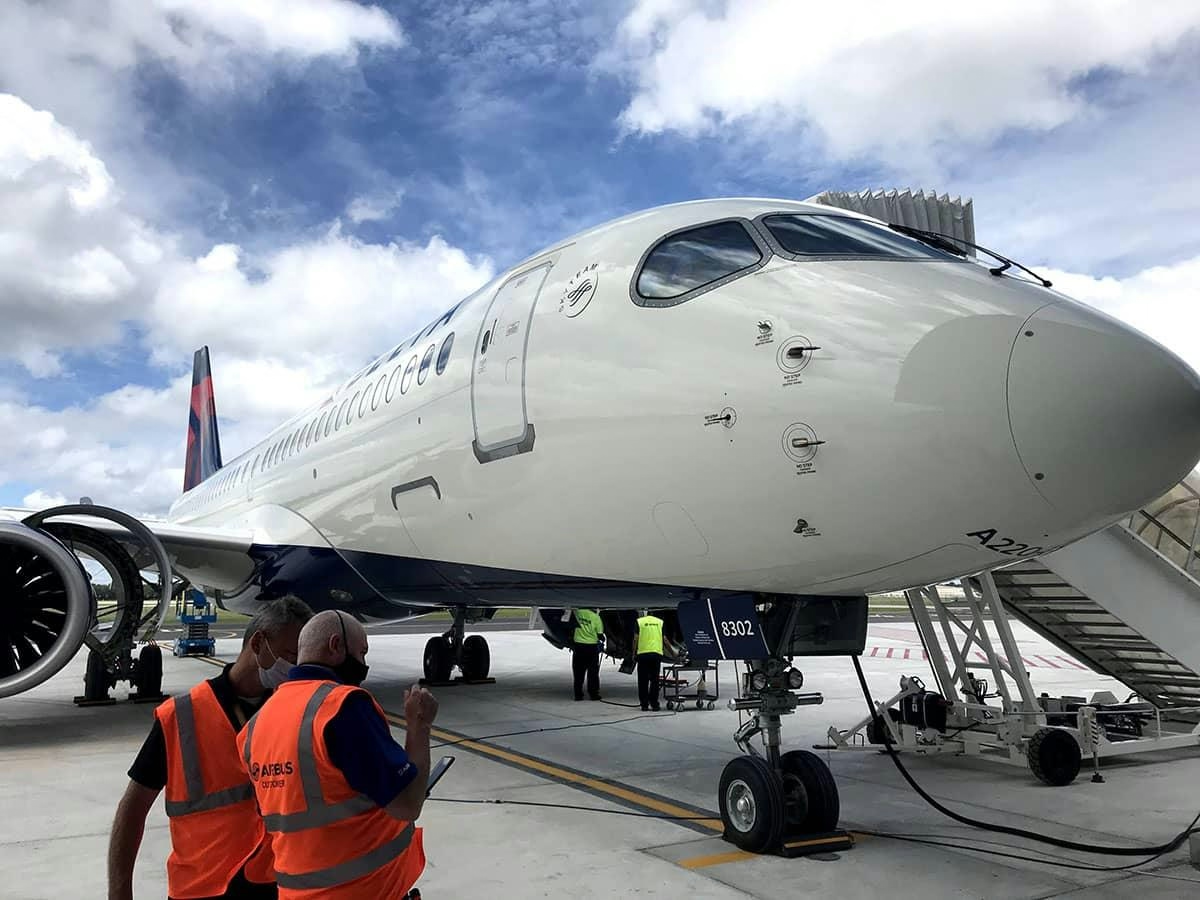
How The Airbus A220’s Engine Efficiency Is Changing Regional Travel
The Rise of the Pratt & Whitney GTF Engine in Regional Jets
The Pratt & Whitney geared turbofan (GTF) engine has emerged as a transformative force in the 100-150 seat regional jet market, powering both the Airbus A220 and Embraer E-Jet E2 families. Its efficiency significantly surpasses that of older engines, such as the Rolls-Royce BR700 used on the Boeing 717, delivering substantial fuel savings and reduced emissions. While the GTF engine has generally demonstrated strong reliability, recent operational challenges prompted Pratt & Whitney to implement enhancements to the PW1900G variant. These improvements have led to a reduction in aircraft-on-ground (AOG) incidents and improved spare parts availability, both critical factors in maintaining airline schedules and operational reliability.
The Airbus A220’s Market Evolution and Competitive Position
Originally developed by Bombardier as the CSeries, the Airbus A220 was conceived as a clean-sheet regional airliner designed to compete directly with Embraer’s E-Jet series. Early investment from Delta Air Lines played a pivotal role in bringing the aircraft to market. However, Bombardier’s high development costs eventually led to the sale of the program to Airbus in 2018. This transition bolstered airline confidence, as carriers generally prefer established manufacturers when placing large fleet orders. Since the acquisition, Airbus has accelerated A220 sales, securing nearly 1,000 firm orders—941 in total, comprising 118 A220-100s and 823 A220-300s—with approximately half already delivered. By comparison, Embraer’s E-190 E2 and E-195 E2 models, introduced around the same time, have recorded 308 orders and 181 deliveries.
The A220’s engine efficiency is reshaping airline fleet strategies. JetBlue, for instance, is restructuring its regional fleet by phasing out Embraer 190s while retaining its A220s, signaling a broader industry shift toward more efficient aircraft. Positioned within the 100-150 seat segment, just below the capacity of the Boeing 737 MAX and Airbus A320neo, the A220 often matches or slightly outperforms the Embraer E-Jet E2 in fuel burn per seat. Additionally, the larger A220-300 offers greater capacity than Embraer’s E195-E2, enhancing its appeal on higher-demand routes.
Operational Benefits and Production Outlook
Designed to replace aging regional jets such as the Boeing 717-200, Airbus A319, McDonnell Douglas MD-80/90, and Fokker 100, the A220 delivers a 25% reduction in fuel burn per seat compared to previous-generation aircraft, according to Airbus. It also features a noise footprint that is half that of its predecessors, making it particularly attractive for airlines operating in noise-sensitive airports.
Reflecting strong market demand and the impact of engine efficiency, Airbus has revised its A220 production target to 12 aircraft per month by 2026. This production ramp-up aligns with airlines’ increasing preference for efficient regional jets and ongoing improvements in engine reliability. Concurrently, Pratt & Whitney is engaged in discussions with Airbus to ensure that engine supply can meet production demands beyond 2025, highlighting the critical role of continued innovation and support in the evolving regional travel market.
The Airbus A220’s advanced engine technology is thus driving significant reductions in operational costs and environmental impact, while also influencing airline fleet strategies and reshaping regional travel dynamics on a global scale.

Etihad Airways Suspends Airbus A380 Flights on Key Route

Aditya Birla Group Seeks Approval for Aircraft Leasing in GIFT City

Qatar Airways Highlights Innovation and Connectivity at Arabian Travel Market 2026

Hong Kong's Five-Year Plan Includes Andrew Fan's Aircraft Parts Processing Hub Proposal

ACIA Aero Leasing Delivers ATR72-600 to Air Nostrum

RTX Appoints Jill Albertelli as Head of Pratt & Whitney

TAT Technologies Joins Beyond Aero Hydrogen Aircraft Program

AURAK Study Highlights Barriers to Air Taxi Adoption in Emerging Economies

Xiamen Air Selects Altitude for 787 Maintenance at Heathrow

Etihad and Swissport Extend Global Partnership
