
KI-Erkenntnisse in konkrete Maßnahmen überführen

Trends
Categories
Identifying Peak Stress Points on Aircraft Engine Turbine Shafts
Identifying Peak Stress Points on Aircraft Engine Turbine Shafts
Advanced Analysis Reveals Concentrated Stress Zones
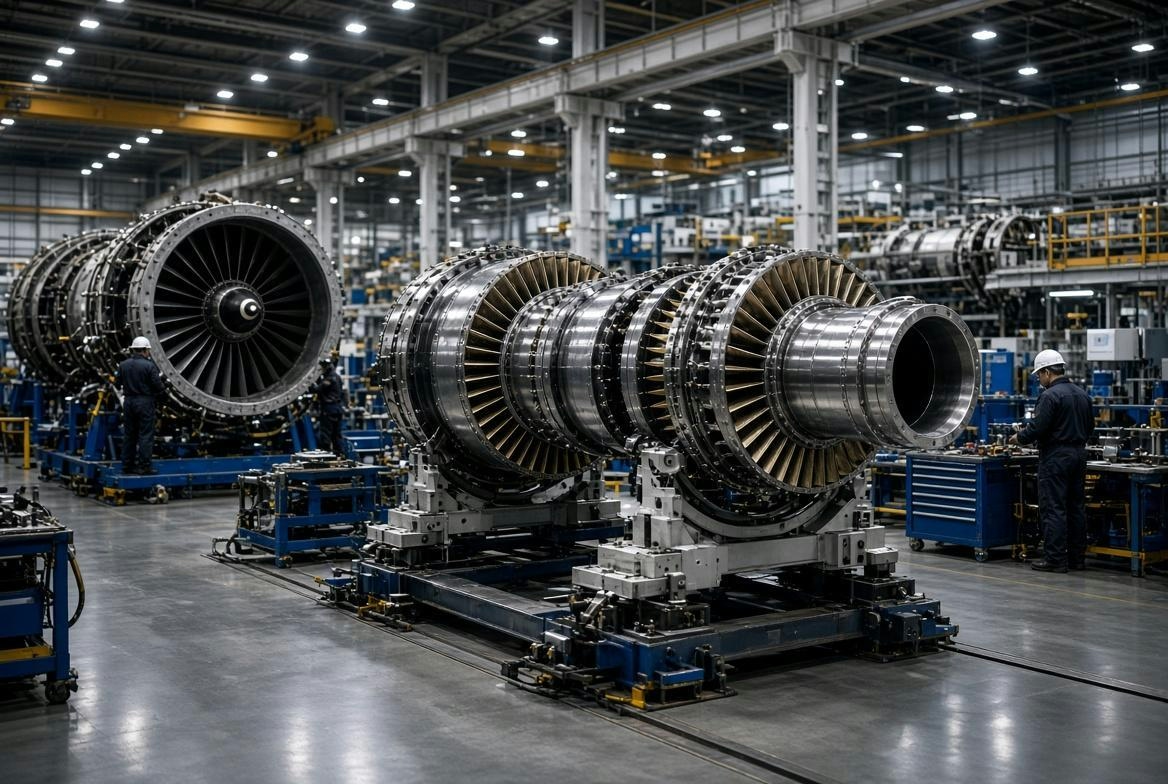
Researchers at Perm National Research Polytechnic University (PNRPU) have successfully identified the precise locations on aircraft engine turbine shafts where mechanical loads reach their maximum intensity. Contrary to the prevailing assumption that stress is evenly distributed along the shaft, the study reveals that peak stress points are concentrated in specific areas, notably at geometric transitions, fastening points, and interfaces between connected components.
Utilizing sophisticated digital modeling techniques, the PNRPU team simulated the operational conditions of turbine shafts across various flight phases, including takeoff, cruising, and landing. These simulations incorporated detailed parameters such as shaft dimensions, material characteristics, and fastening methods. The findings indicate that the highest stress concentrations occur at cross-sections where the shaft’s geometry changes, at contact interfaces between parts, and within fastening zones. Such localized stress peaks are often elusive to traditional analytical approaches, underscoring the importance of advanced computational methods.
Complex Load Dynamics and Optimization Strategies
The challenge of accurately identifying these critical stress points is compounded by the complex array of forces acting on the shaft during operation. The turbine shaft must simultaneously transmit torque, resist tensile forces, and withstand centrifugal loads, all of which vary dynamically with changing flight conditions. Additional stresses arise in fastening elements during transitions between flight modes. Furthermore, variations in fuel composition and engine operating parameters introduce additional layers of complexity to the stress analysis.
To address these multifaceted challenges, the researchers advocate for a holistic calculation approach that simultaneously considers all significant loads. They emphasize the application of topological optimization—a design methodology that enhances structural integrity by selectively removing material from low-stress regions. This approach not only reinforces critical areas but also reduces overall weight, thereby improving engine efficiency.
Implications for Industry and Future Developments
The accurate identification and management of peak stress points carry significant implications beyond engineering considerations. The global market for aircraft turbine engine flowmeters and pressure sensors is projected to expand at a compound annual growth rate of 4.8% from 2026, driven by increasing demand for advanced monitoring technologies. As manufacturers face mounting pressure to comply with stringent performance and safety standards—highlighted by recent U.S. Air Force reports citing production delays and quality control challenges in jet engine manufacturing—the capability to precisely monitor and optimize shaft stress emerges as a key competitive advantage.
In response, industry players are investing in the development of more sophisticated modeling techniques and sensor technologies to enhance the accuracy and reliability of stress detection. These innovations are poised to play a vital role in ensuring the safety, durability, and efficiency of next-generation aircraft engines.
By integrating advanced simulation tools, comprehensive load analysis, and topological optimization, researchers and manufacturers are addressing both technical and market challenges associated with turbine shaft stress. This integrated approach promises to advance the development of safer and more efficient aircraft propulsion systems.

Etihad Airways Suspends Airbus A380 Flights on Key Route

Aditya Birla Group Seeks Approval for Aircraft Leasing in GIFT City

Qatar Airways Highlights Innovation and Connectivity at Arabian Travel Market 2026

Hong Kong's Five-Year Plan Includes Andrew Fan's Aircraft Parts Processing Hub Proposal

ACIA Aero Leasing Delivers ATR72-600 to Air Nostrum

RTX Appoints Jill Albertelli as Head of Pratt & Whitney

TAT Technologies Joins Beyond Aero Hydrogen Aircraft Program

AURAK Study Highlights Barriers to Air Taxi Adoption in Emerging Economies

Xiamen Air Selects Altitude for 787 Maintenance at Heathrow

Etihad and Swissport Extend Global Partnership
