
KI-Erkenntnisse in konkrete Maßnahmen überführen

Trends
Categories
LATAM Selects SES for In-Flight Connectivity on 60 Airbus and Embraer Jets
LATAM Selects SES for In-Flight Connectivity on 60 Airbus and Embraer Jets
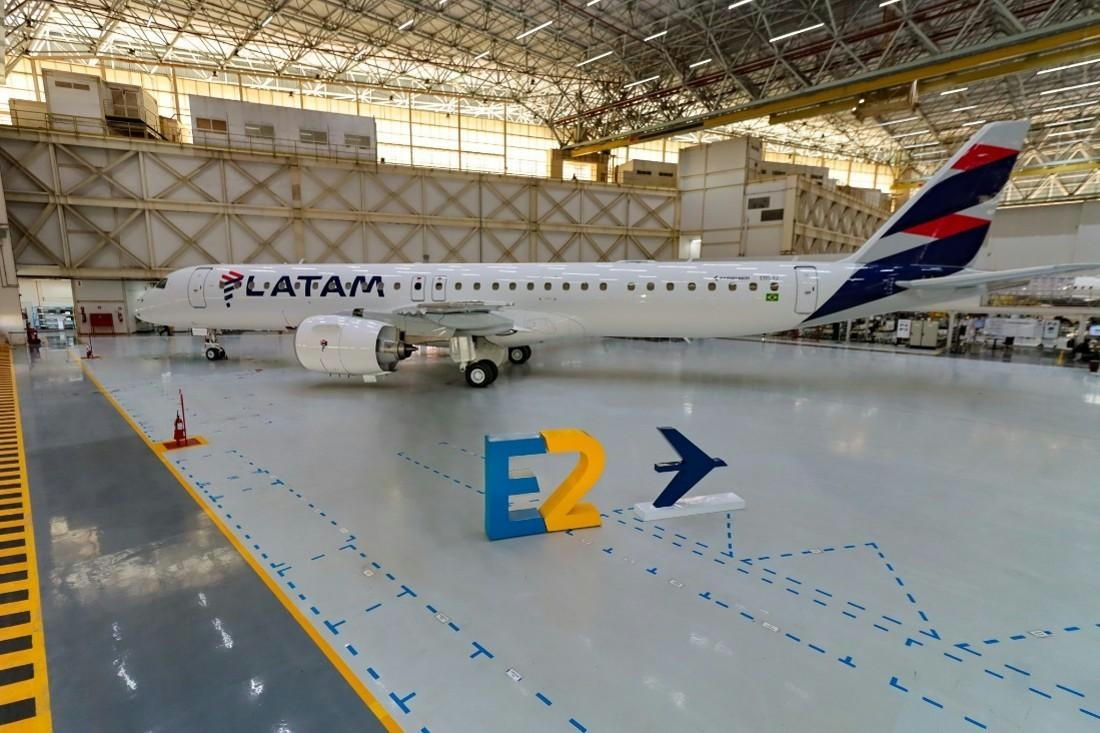
SES, South America’s leading provider of inflight connectivity, has announced a major expansion of its partnership with LATAM Airlines Group. The agreement will see over 60 Airbus and Embraer aircraft equipped with SES’s advanced multi-orbit inflight connectivity (IFC) solution, which utilizes electronically steerable antenna (ESA) technology. This installation program includes Airbus A320neo and A321XLR models, as well as Embraer E195-E2 jets, with deployments scheduled over the coming years.
Deployment Timeline and Technology Integration
The first Embraer E195-E2 aircraft fitted with the new connectivity system are expected to join LATAM Airlines Brazil’s domestic fleet in the fourth quarter of this year. Meanwhile, the initial Airbus A321XLRs covered by the agreement are anticipated to enter service in 2027. The IFC solution integrates Gilat Satellite Networks’ Stellar Blu Sidewinder ESA and operates through SES’s geostationary satellites, complemented by Eutelsat OneWeb’s Low Earth Orbit (LEO) satellite network. SES serves as a distribution partner for the LEO network within the aviation sector, enhancing the system’s global reach and performance.
Currently, SES supports inflight connectivity on more than 250 LATAM aircraft, primarily from the A320 Family, using its 2Ku technology. This latest contract further solidifies SES’s dominant position in the Latin American market amid intensifying competition. Notably, Viasat recently secured the contract to provide connectivity for LATAM’s widebody fleet, underscoring the competitive dynamics among satellite service providers.
Market Context and Industry Challenges
Paulo Miranda, vice president of customers at LATAM Airlines Group, emphasized the airline’s commitment to enhancing passenger connectivity. He stated, “By bringing next-generation multi-orbit connectivity to more of our fleet, we will offer our passengers a faster, more reliable onboard internet experience, helping them stay connected wherever they fly while continuing to raise the standard of travel across Latin America.”
SES’s multi-orbit IFC solution is gaining momentum across the region. The company recently signed an agreement with the Abra Group—which owns Avianca, GOL, and Wamos Air—to equip over 100 aircraft with its LEO/GEO connectivity system. GOL is already a customer of SES’s 2Ku technology. Additionally, SES announced plans last month for Mexican ultra-low-cost carrier Viva to install the ESA-based system on 100 A320 Family aircraft.
Despite these advances, SES and its airline partners face significant challenges. Regulatory issues such as spectrum clearance remain a critical hurdle, alongside the increasing risk of cyber-attacks targeting satellite networks and onboard systems. The rapid evolution of the inflight connectivity market is also driving competitors to accelerate fleetwide upgrades. For example, several U.S. carriers are intensifying retrofit programs for their narrow-body aircraft, while international airlines like Japan Airlines are adopting SES’s multi-orbit solutions, reflecting a broader global shift and heightened competition in the sector.
As LATAM and SES proceed with this ambitious rollout, their collaboration highlights both the promising opportunities and the complex challenges involved in delivering next-generation inflight connectivity to passengers throughout Latin America.

Etihad and Swissport Extend Global Partnership

Sepehran Airlines B737 Returns to Mashhad After Tyre and Engine Issues

Etihad Deploys Widebody Fleet to Meet Strong Demand

Korean Air Finalizes $36.2 Billion Deal with Boeing

Australia’s RFDS Queensland Section Orders Six King Air 260Cs

Korean Air Finalizes Order for 103 Boeing Jets and Engines

Embraer E195-E2 Features Distinctive Engine Placement Among Regional Jets

What Passengers Can Expect on Boeing’s New 777X Jet

How Ethiopian Airlines Became Africa’s Leading Carrier Amid Gulf Competition

Joby Aviation Extends Autonomous Flight Capabilities with Cross-Country Tour
