
KI-Erkenntnisse in konkrete Maßnahmen überführen

Trends
Categories
MH370: What Is Known Twelve Years Later
MH370: What Is Known Twelve Years Later
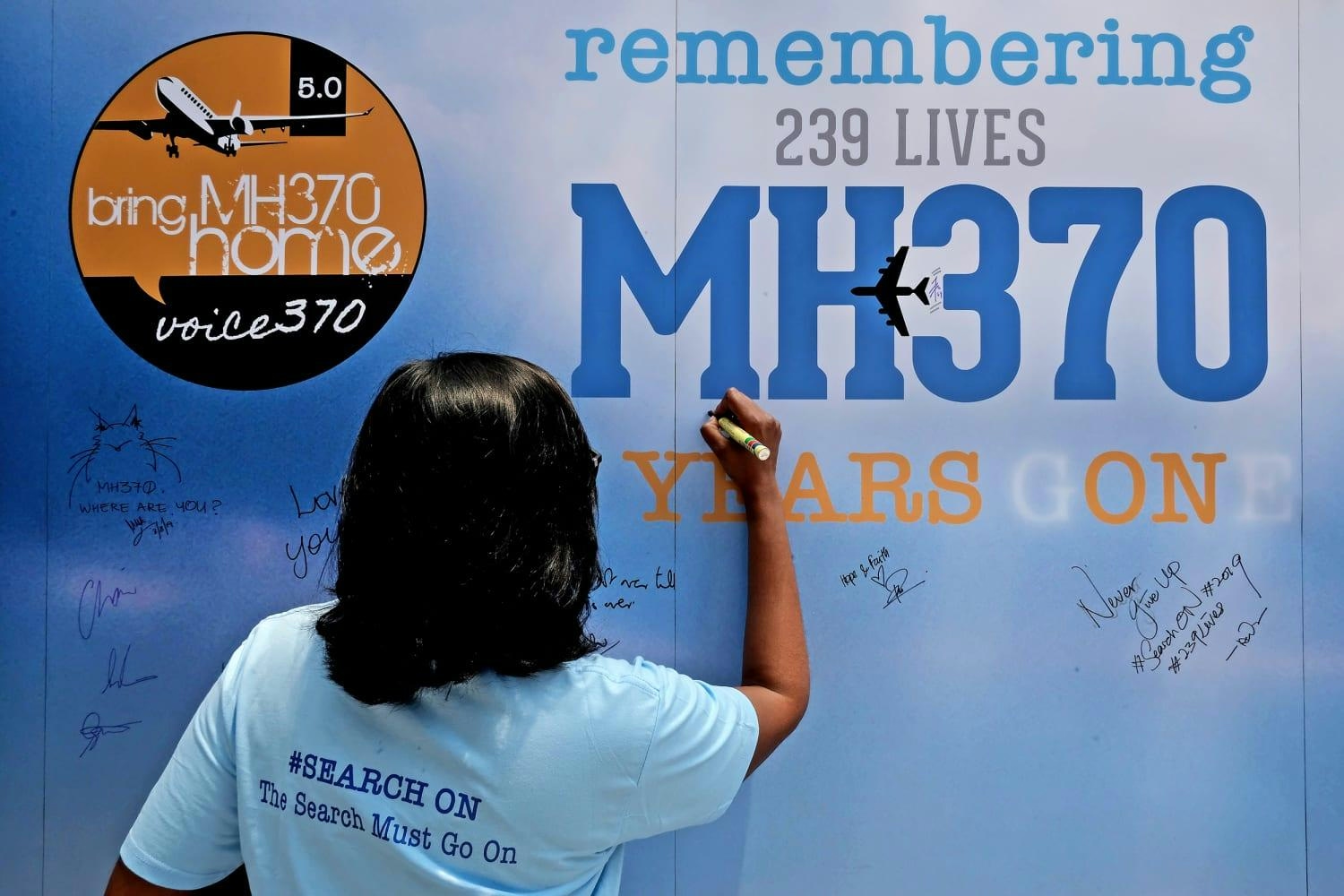
Twelve years after the disappearance of Malaysia Airlines Flight MH370, the fate of the Boeing 777 and its 239 occupants remains one of the most enduring mysteries in aviation history. Despite the most extensive and costly underwater search ever conducted—covering over 200,000 square kilometers of seabed—no definitive wreckage site has been located. The facts and inferences surrounding the flight are limited, and much of the public discourse remains speculative. Although the search has been scaled back, efforts continue amid evolving challenges.
Established Facts and Flight Timeline
MH370 departed Kuala Lumpur International Airport at 00:42 local time on 8 March 2014, bound for Beijing, with sufficient fuel for approximately seven and a half hours of flight. The aircraft’s ACARS datalink ceased transmitting at 01:06. At 01:19:30, Captain Zaharie Ahmad Shah made the final radio contact with air traffic control, signing off with the words, “Good night. Malaysian three seven zero.” Two minutes later, near the waypoint IGARI, the aircraft’s transponder was switched off as it approached the boundary between Malaysian and Vietnamese airspace.
Military radar tracked the plane making a sharp turn and flying back across the Malay Peninsula at altitudes between 31,000 and 33,000 feet. It passed near Penang at 01:52 and continued northwest over the Andaman Sea before disappearing from radar at 02:22.
Satellite data played a crucial role in reconstructing the flight’s path after radar contact was lost. The aircraft’s satellite terminal briefly lost power but reconnected at 02:25. For the next six hours, it responded to hourly “handshakes” from an Inmarsat satellite. Although these signals did not provide precise location data, their timing and frequency enabled investigators to plot a probable flight path along an arc across the southern Indian Ocean. The final ground-initiated handshake occurred at 08:10, followed by a log-on request from the aircraft at 08:19:29, possibly indicating fuel exhaustion and subsequent power restoration. No further communications were received after this point.
Debris Recovery and Identification
The first confirmed piece of debris linked to MH370 was a right flaperon, which washed ashore on Réunion Island on 29 July 2015. French investigators definitively identified this component as belonging to the missing aircraft. Additional fragments, including an outboard flap section discovered on Pemba Island, were confirmed by Malaysian authorities in 2016. By 2017, a total of 20 pieces of debris had been recovered, with 18 almost certainly originating from MH370.
Ongoing Challenges in the Search
The search for MH370 remains complicated not only by the vast expanse of the Indian Ocean but also by geopolitical and economic factors. Regional tensions, such as Iran’s missile attacks on US bases, have implications for global trade routes and aviation safety standards, potentially influencing international cooperation and resource allocation for the search.
Furthermore, shifts in market dynamics, including the entry of new competitors like North African oil giant Sonatrach into markets traditionally dominated by firms such as Dangote, may affect fuel supply logistics and aviation operations in the region. These developments could have indirect consequences for the coordination and execution of search efforts.
Unresolved Questions
Despite extensive investigations and international collaboration, the precise location of MH370 and the circumstances surrounding its disappearance remain unknown. The search continues, shaped by advances in technology and the broader context of global security and economic changes. For the families of those lost and the aviation community, the quest for answers endures.

Etihad Airways Suspends Airbus A380 Flights on Key Route

Aditya Birla Group Seeks Approval for Aircraft Leasing in GIFT City

Qatar Airways Highlights Innovation and Connectivity at Arabian Travel Market 2026

Hong Kong's Five-Year Plan Includes Andrew Fan's Aircraft Parts Processing Hub Proposal

ACIA Aero Leasing Delivers ATR72-600 to Air Nostrum

RTX Appoints Jill Albertelli as Head of Pratt & Whitney

TAT Technologies Joins Beyond Aero Hydrogen Aircraft Program

AURAK Study Highlights Barriers to Air Taxi Adoption in Emerging Economies

Xiamen Air Selects Altitude for 787 Maintenance at Heathrow

Etihad and Swissport Extend Global Partnership
