
KI-Erkenntnisse in konkrete Maßnahmen überführen

Trends
Categories
Republic Airways Pilots Test Electric Aircraft in Florida
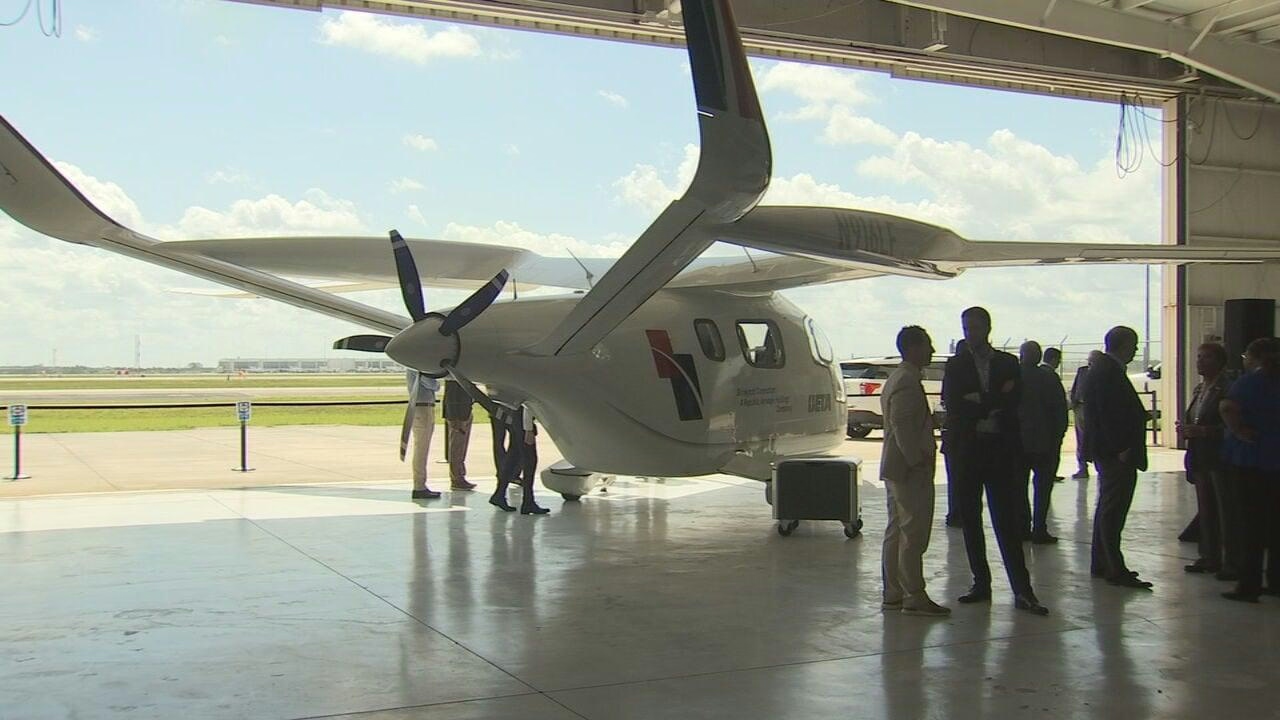
Republic Airways Pilots Test Electric Aircraft in Florida
Pioneering Electric Aviation in South Florida
Republic Airways pilots recently took to the skies over South Florida to operate Beta Technologies’ Alia CX300, a cutting-edge electric aircraft designed for diverse applications including passenger transport, cargo delivery, medical missions, and military use. In collaboration with FBO Signature Aviation, Beta and Republic conducted a series of intensive demonstration flights last week, culminating in a significant arrival at Orlando International Airport (KMCO) on Sunday. Orlando is among the first U.S. airports actively developing an electrified vertiport to support next-generation electric vertical takeoff and landing (eVTOL) aircraft.
These demonstration flights represent an early phase in a broader initiative to advance electric aviation. Over the coming months, Beta and other manufacturers plan to expand operations across Florida and 25 additional states as part of the Federal Aviation Administration’s (FAA) eVTOL Integration Pilot Program (eIPP). This program will facilitate operational testing for at least three years. Earlier this year, Beta and Republic completed cold-weather trials in Plattsburgh, New York, and at Beta’s headquarters in Burlington, Vermont, conducting 34 flights over four days to assess performance under varying conditions.
Technical Capabilities and Operational Testing
Matt Koscal, president of Republic Airways, highlighted the importance of these tests, stating, “They’re helping illuminate what’s possible as we explore new ways to expand local air services in Florida and beyond.” In 2025, Republic took delivery of a “precertified” CX300, equipped with Beta’s H500A electric motor—currently undergoing type certification—and Hartzell’s FAA-certified electric propeller. The CX300 offers a demonstrated range of 336 nautical miles, a projected top speed of 135 knots, and can accommodate a pilot plus five passengers or up to 1,250 pounds of cargo. The aircraft can recharge in under an hour and is projected to be significantly more cost-effective to operate than traditional jet-fueled planes.
To prepare for real-world deployment, Beta delivered the CX300 to Republic for route studies, pilot training, and use-case testing that spans passenger shuttles to cargo delivery. Three pilots from Republic’s Brickyard Connection unit completed coursework, simulator sessions, and check rides before flying up to nine legs daily during the demonstration period. Each flight incurred approximately $16.80 in energy costs. According to FlightAware data, the aircraft—tail number N916LF—completed 27 out-and-back flights at Kissimmee Gateway Airport (KISM) over three days, followed by flights to Orlando International, Daytona Beach, Jacksonville, and further north to Georgia and North Carolina.
Challenges and Industry Implications
Despite the promise of electric aviation, Republic Airways faces several challenges. Regulatory approval for electric aircraft remains a significant obstacle, alongside the need to develop robust charging infrastructure at airports. Comprehensive pilot training programs will be critical to ensuring safety and operational efficiency. The growing market interest in sustainable aviation has prompted competitors to accelerate their own electric aircraft initiatives or invest in related technologies. Some industry players may pursue favorable regulatory frameworks through lobbying or form strategic partnerships to share the substantial costs associated with development and deployment.
Beta Technologies continues to expand its fleet, which includes N214BT, recently involved in a European test campaign with Bristow Group, and N401NZ, formerly a test aircraft for Air New Zealand and now operating in Japan. The company’s first type-conforming aircraft, N889CD, along with N336MR, remain in testing phases in Burlington and Plattsburgh, reflecting the rapid progress in electric aviation.
As Republic and Beta advance their efforts, they are laying the groundwork for a new era of cleaner, more efficient air travel—one that has the potential to transform the aviation industry and inspire innovation among competitors worldwide.

Etihad Airways Suspends Airbus A380 Flights on Key Route

Aditya Birla Group Seeks Approval for Aircraft Leasing in GIFT City

Qatar Airways Highlights Innovation and Connectivity at Arabian Travel Market 2026

Hong Kong's Five-Year Plan Includes Andrew Fan's Aircraft Parts Processing Hub Proposal

ACIA Aero Leasing Delivers ATR72-600 to Air Nostrum

RTX Appoints Jill Albertelli as Head of Pratt & Whitney

TAT Technologies Joins Beyond Aero Hydrogen Aircraft Program

AURAK Study Highlights Barriers to Air Taxi Adoption in Emerging Economies

Xiamen Air Selects Altitude for 787 Maintenance at Heathrow

Etihad and Swissport Extend Global Partnership
