
KI-Erkenntnisse in konkrete Maßnahmen überführen

Trends
Categories
Thales' Yannick Assouad on aviation's most critical decade
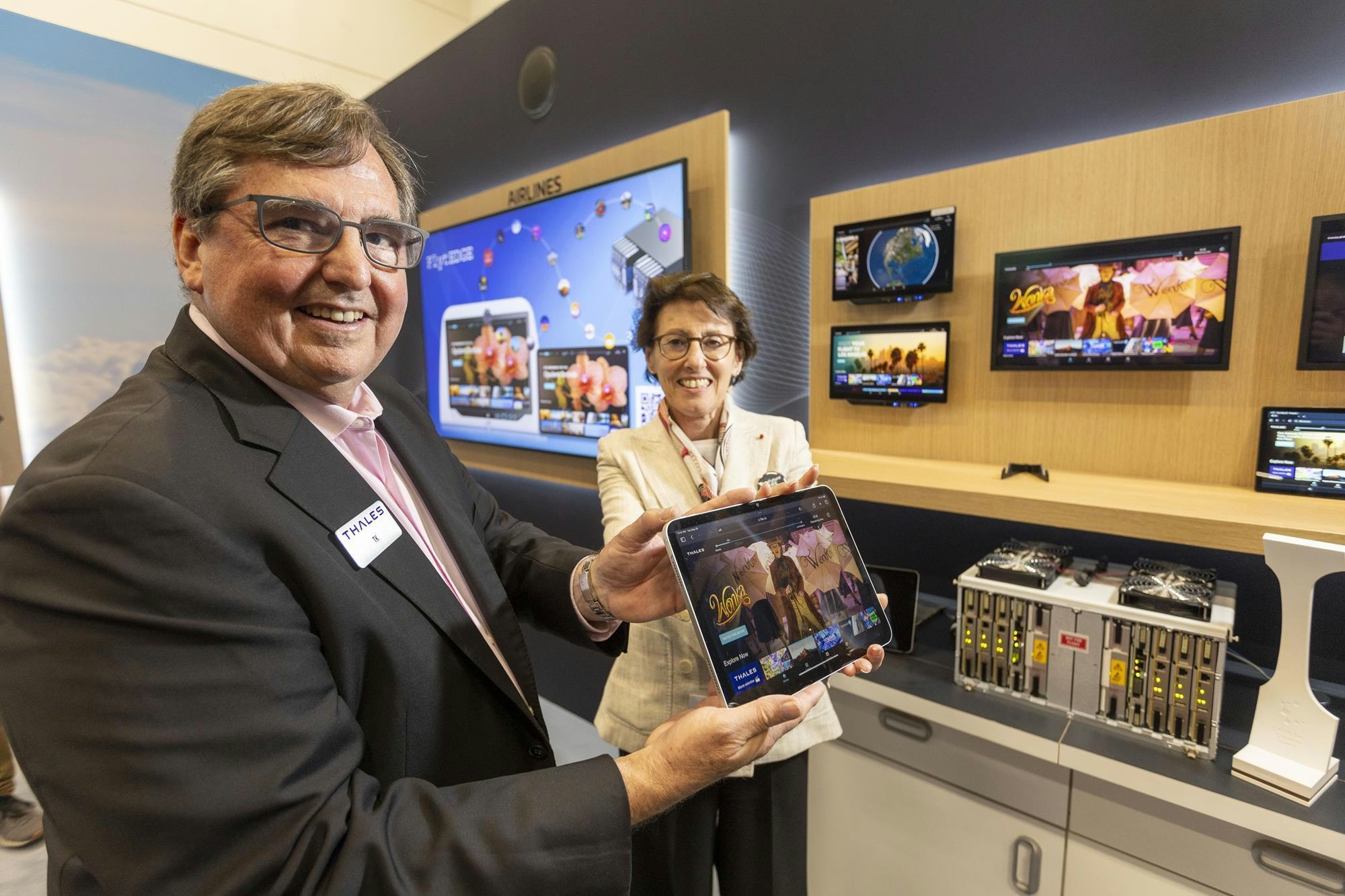
Thales’ Yannick Assouad on Aviation’s Most Critical Decade
Yannick Assouad, Executive Vice-President of Avionics at Thales, asserts that the aviation industry is poised to undergo its most transformative period since the advent of the jet age. Charged with overseeing the systems that ensure pilot awareness and flight safety, Assouad identifies the coming decade as crucial, driven by advancements in artificial intelligence, digital connectivity, and sustainability initiatives.
Speaking at the Singapore Airshow 2026, Assouad articulated a comprehensive vision for the future of aviation. She highlighted the pressing need for decarbonization, the evolving role of AI-assisted cockpits, and the increasing risks posed by GPS interference. Additionally, she addressed the ongoing challenge of enhancing female representation within aerospace leadership.
Singapore: A Strategic Hub for Avionics Innovation
In May 2025, Thales, in partnership with the Civil Aviation Authority of Singapore (CAAS), inaugurated the International Avionics Lab in Singapore, marking the company’s first such facility outside France. This lab is dedicated to developing and testing cutting-edge avionics solutions aimed at improving air traffic management and airport operations throughout the Asia-Pacific region and beyond. Assouad described Singapore’s dense and complex airspace as an “ideal sandbox” for pioneering technologies that could shape the future of air traffic control.
A central objective of this initiative is to transcend the traditional voice-based communication between pilots and air traffic controllers. Thales aims to establish direct digital links between aircraft and ground systems, thereby streamlining operations and enabling global optimization. Assouad explained, “Today, the connection between those two bodies—the onboard system and the on-ground system—is the voice of the pilot and the controller. We need to change that to really make it seamless, much more efficient, and optimize more globally.”
AI in the Cockpit: Support, Not Replacement
Assouad offered a candid assessment of artificial intelligence’s role in aviation, acknowledging both its potential and current limitations. While the integration of AI into safety-critical onboard systems remains a long-term objective, she emphasized the immediate advantages of AI as a support tool for pilots. AI can assist in diagnosing and troubleshooting system failures during flight by rapidly analyzing data without the emotional biases that can affect human judgment. She noted, “Emotion-less, of course, which is very important to have a good troubleshooting of anything happening.”
Another significant application lies in trajectory optimization. AI systems, trained on millions of flight scenarios and real-time data, can calculate more efficient routes than traditional pilot-controller coordination. Assouad envisions AI agents working alongside flight crews and controllers, with humans retaining ultimate decision-making authority.
Navigating Industry Challenges
Despite these forward-looking ambitions, Thales confronts considerable challenges. The company’s avionics technology, largely derived from existing platforms such as those used in Airbus’s next-generation narrowbody aircraft, requires rapid innovation to maintain a competitive edge amid intensifying market competition. Rival avionics providers are simultaneously advancing their systems, heightening the pressure on Thales to evolve.
Structural obstacles remain, particularly in emerging markets like Brazil, where underdeveloped infrastructure and financial limitations hinder growth. Furthermore, the rise of autonomous and drone technologies introduces both opportunities and regulatory complexities for avionics manufacturers, necessitating agile and forward-thinking strategies.
As the aviation sector approaches a period of profound change, Assouad remains committed to harnessing technology to enhance flight safety, efficiency, and sustainability, while navigating the intricate realities of a rapidly evolving industry.

Etihad Airways Suspends Airbus A380 Flights on Key Route

Aditya Birla Group Seeks Approval for Aircraft Leasing in GIFT City

Qatar Airways Highlights Innovation and Connectivity at Arabian Travel Market 2026

Hong Kong's Five-Year Plan Includes Andrew Fan's Aircraft Parts Processing Hub Proposal

ACIA Aero Leasing Delivers ATR72-600 to Air Nostrum

RTX Appoints Jill Albertelli as Head of Pratt & Whitney

TAT Technologies Joins Beyond Aero Hydrogen Aircraft Program

AURAK Study Highlights Barriers to Air Taxi Adoption in Emerging Economies

Xiamen Air Selects Altitude for 787 Maintenance at Heathrow

Etihad and Swissport Extend Global Partnership
