
KI-Erkenntnisse in konkrete Maßnahmen überführen

Trends
Categories
The Engineering Challenges Behind the Boeing 777X’s Folding Wingtips
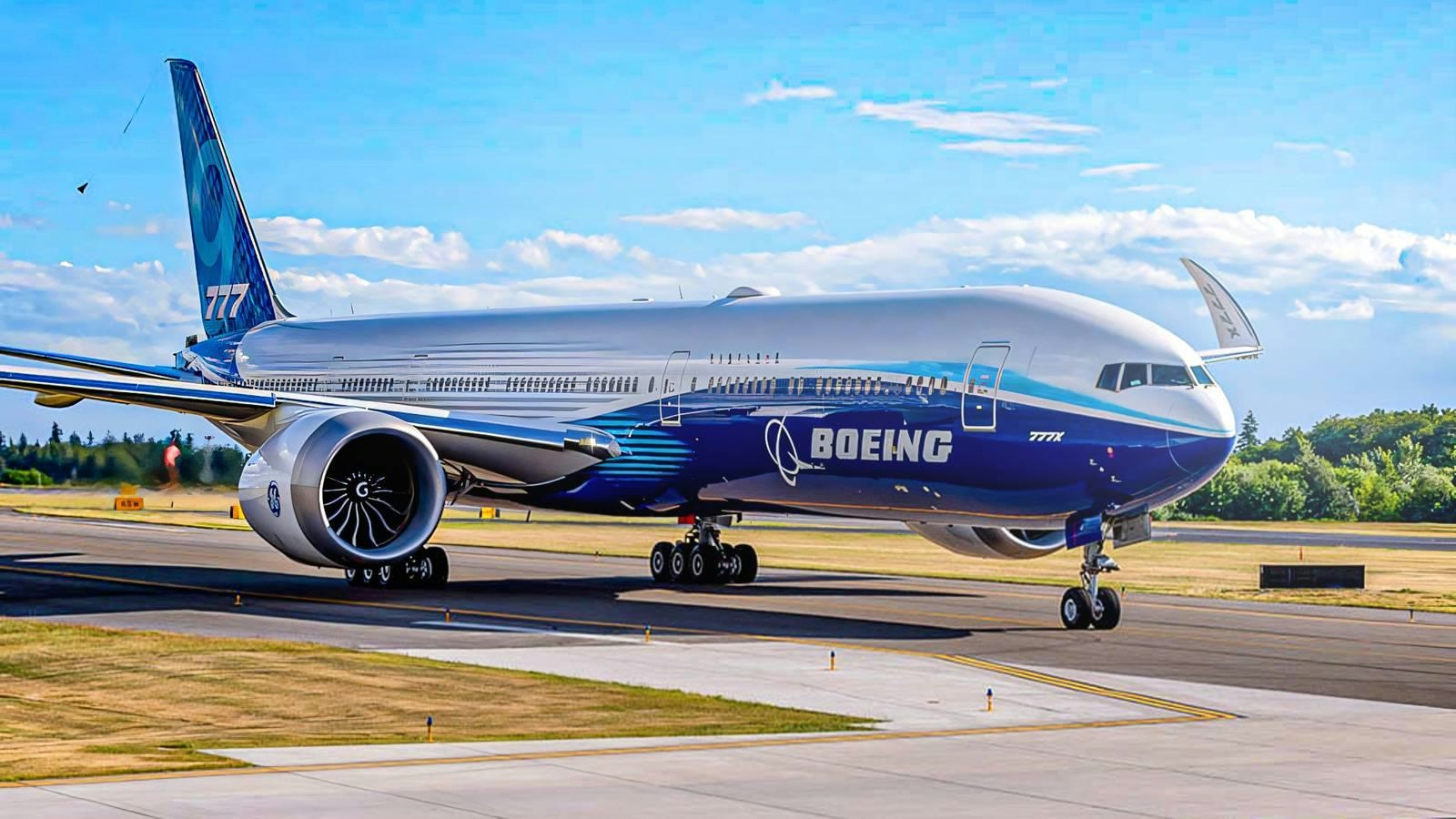
The Engineering Challenges Behind the Boeing 777X’s Folding Wingtips
The commercial aerospace industry often treads a fine line between groundbreaking engineering and substantial financial risk. For manufacturers like Boeing, evolving an established widebody aircraft platform typically involves leveraging proven designs to contain development costs. However, the introduction of a novel mechanical feature can disrupt these assumptions, presenting a series of complex technical and regulatory challenges that rival the demands of developing an entirely new aircraft.
At the core of Boeing’s latest widebody, the 777X, is such an innovation: folding wingtips. Initially conceived as an elegant solution to a persistent operational problem, this feature has evolved into a rigorous test of structural integrity, software reliability, and regulatory compliance. By departing from the conventional fixed-wing design, Boeing’s engineers ventured into uncharted territory, where each advancement required the establishment of new standards and proofs of safety.
Maximizing Efficiency While Navigating Infrastructure Constraints
Boeing’s objective with the 777X was to modernize the successful 777 family by significantly enhancing fuel efficiency. This ambition led to the design of a larger, higher-aspect-ratio wing constructed from lightweight carbon-fiber composites, increasing the wing surface area by approximately 15 percent. Such a design was intended to meet the range and payload requirements of international carriers.
However, the expanded wingspan introduced a critical challenge related to airport infrastructure. In flight, the 777X’s wingspan extends to an imposing 235 feet, five inches (71.75 meters), placing it within the International Civil Aviation Organization’s (ICAO) Code F category. Most major airports, however, are designed to accommodate Code E aircraft, meaning a fixed-wing 777X would be incompatible with existing gates, taxiways, and hangars.
To address this, Boeing engineered a folding mechanism for the outer 11.5 feet (3.5 meters) of each wingtip, allowing them to fold upward after landing. This innovation reduces the aircraft’s on-ground wingspan to 212 feet, nine inches (64.85 meters), enabling it to fit within standard gates alongside legacy widebody aircraft. Without this solution, the 777X would have faced the same infrastructural limitations that hindered the commercial viability of the Airbus A380.
Technical and Market Complexities
The folding wingtip system represents a sophisticated feat of actuation technology, developed in collaboration with Liebherr. The mechanism must endure repeated cycles and the aerodynamic stresses of flight while maintaining a lightweight and reliable profile. Integrating this system necessitated exhaustive structural and software testing to satisfy stringent safety standards.
Within the cockpit, Boeing installed a dedicated toggle switch for wingtip control, strategically positioned between the seat belt and lighting controls. This system combines automation with pilot oversight, ensuring that the wingtips cannot be folded during flight—a critical safety safeguard.
Despite its technical achievements, the innovation has faced intense scrutiny. Boeing’s broader challenges, including stock market volatility and NASA’s reevaluation of the company for future projects, have added pressure to the 777X program. Concurrently, the aerostructures market, driven by advances in materials and manufacturing techniques, is expected to grow rapidly, heightening competition and emphasizing the necessity for ongoing innovation.
A Calculated Risk for the Future of Aviation
The folding wingtips of the 777X embody the intricate balance between engineering ambition and operational practicality. By resolving a fundamental spatial constraint, Boeing has positioned the 777X to meet the evolving demands of modern air travel—provided the technology performs as intended. In an industry where every innovation undergoes rigorous examination, the success of the 777X’s folding wingtips may well shape the future trajectory of commercial aviation.

Etihad and Swissport Extend Global Partnership
Sepehran Airlines B737 Returns to Mashhad After Tyre and Engine Issues

Etihad Deploys Widebody Fleet to Meet Strong Demand
Korean Air Finalizes $36.2 Billion Deal with Boeing
Australia’s RFDS Queensland Section Orders Six King Air 260Cs
Korean Air Finalizes Order for 103 Boeing Jets and Engines
Embraer E195-E2 Features Distinctive Engine Placement Among Regional Jets
What Passengers Can Expect on Boeing’s New 777X Jet

How Ethiopian Airlines Became Africa’s Leading Carrier Amid Gulf Competition
Joby Aviation Extends Autonomous Flight Capabilities with Cross-Country Tour
