
KI-Erkenntnisse in konkrete Maßnahmen überführen

Trends
Categories
The History Behind Boeing's Folding Wingtip and Its Debut on the 777X
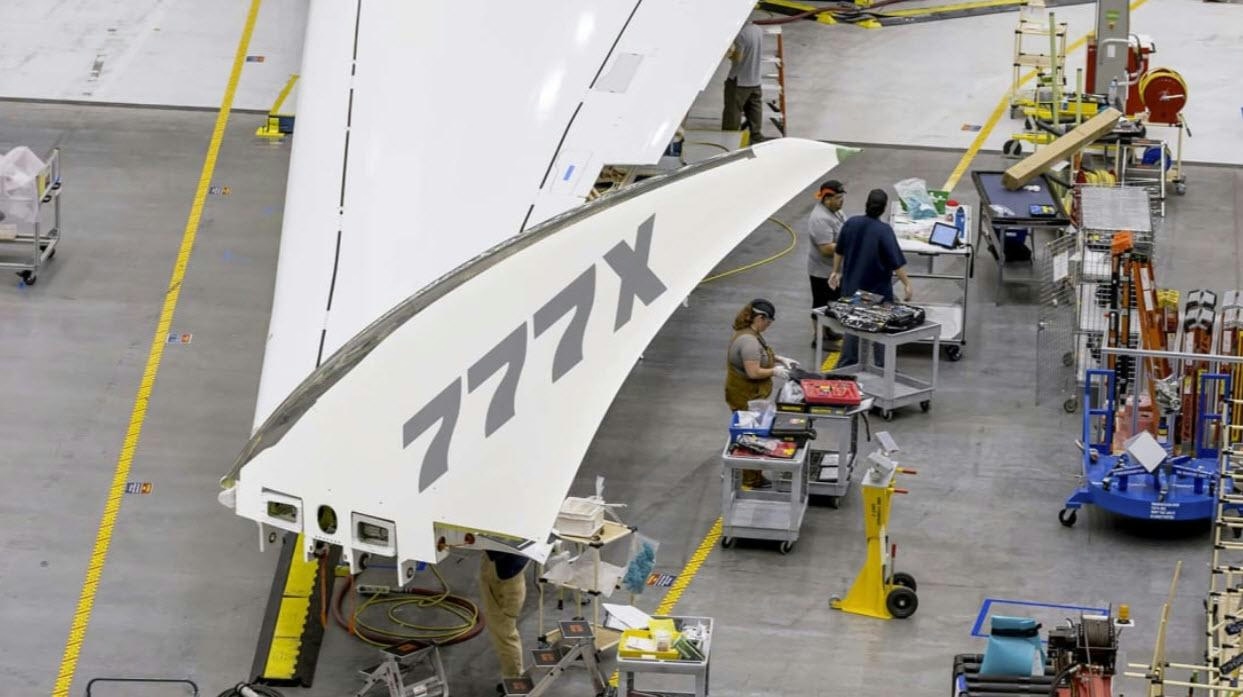
The History Behind Boeing's Folding Wingtip and Its Debut on the 777X
The Boeing 777X marks a significant advancement in the evolution of the renowned 777 family, which has long been a benchmark for long-range commercial aircraft. While the original 777 established industry standards for range and efficiency, subsequent models such as the Airbus A350 and Boeing 787 have surpassed it in fuel economy. This competitive landscape prompted Boeing to develop the 777X as a next-generation successor, featuring state-of-the-art engines, updated avionics, and a pioneering carbon-composite wing engineered for optimal cruise performance at heavy weights.
A defining characteristic of the 777X is its unprecedented wingspan of 235 feet, 5 inches (71.8 meters), the widest ever produced by Boeing. This expanded wingspan enhances aerodynamic efficiency, contributing to improved fuel performance and range. However, it also presents a significant logistical challenge: most airport gates designed for the current 777 accommodate wingspans up to approximately 213 feet (65 meters). To reconcile this disparity, Boeing introduced innovative folding wingtips that allow the 777X to fit within existing gate infrastructure without necessitating costly airport modifications.
This is not Boeing’s first consideration of folding wingtips for the 777. The concept had been explored previously but was never implemented until the pressing need to balance enhanced performance with airport compatibility became unavoidable.
How Airport Gates Shape Aircraft Design
Airport gates are categorized by the International Civil Aviation Organization (ICAO) into six classes based on wingspan dimensions. The majority of widebody jets—including the legacy 777, 787, A330, A350, and earlier variants of the 747—are designed to operate at Code E gates, which accommodate wingspans up to roughly 213 feet (65 meters). Larger aircraft such as the Airbus A380 and Boeing 747-8 require Code F gates, capable of handling wingspans up to 262 feet (80 meters). However, Code F gates are relatively rare worldwide, limiting the operational flexibility of these larger aircraft.
This limitation has had tangible commercial consequences. The Airbus A380, for example, faced challenges due to the scarcity of Code F gates, compelling airports to invest heavily in infrastructure upgrades to accommodate the aircraft. By contrast, the Boeing 747’s introduction in the 1960s and 1970s demanded less extensive and less costly airport modifications, facilitating broader adoption.
For the 777X, the folding wingtip represents a strategic engineering solution. It enables the aircraft to benefit from the aerodynamic advantages of a larger wing while maintaining compatibility with the more prevalent Code E gates. This innovation is critical for airlines aiming to maximize route flexibility and operational efficiency without incurring additional airport infrastructure expenses.
Challenges and Industry Impact
Despite its technological promise, the 777X program has encountered significant challenges. Boeing has faced design revisions and delays, including the scrapping of the first aircraft produced due to necessary adjustments. These setbacks underscore broader difficulties within Boeing, reflecting a need to address lessons from previous development missteps. Consequently, the 777X’s debut has become emblematic of a crisis that has unfolded over several years.
Nonetheless, Boeing remains optimistic, targeting a first delivery in 2027. The industry is closely monitoring the program’s progress, especially as competitors such as Bombardier and Dassault Aviation advance their own technological developments. As the 777X approaches its anticipated entry into service, its folding wingtip stands as both a symbol of innovation and a reminder of the complexities inherent in modern aircraft design.
Comments

Etihad and Swissport Extend Global Partnership

Sepehran Airlines B737 Returns to Mashhad After Tyre and Engine Issues

Etihad Deploys Widebody Fleet to Meet Strong Demand

Korean Air Finalizes $36.2 Billion Deal with Boeing

Australia’s RFDS Queensland Section Orders Six King Air 260Cs

Korean Air Finalizes Order for 103 Boeing Jets and Engines

Embraer E195-E2 Features Distinctive Engine Placement Among Regional Jets

What Passengers Can Expect on Boeing’s New 777X Jet

How Ethiopian Airlines Became Africa’s Leading Carrier Amid Gulf Competition

Joby Aviation Extends Autonomous Flight Capabilities with Cross-Country Tour
