
KI-Erkenntnisse in konkrete Maßnahmen überführen

Trends
Categories
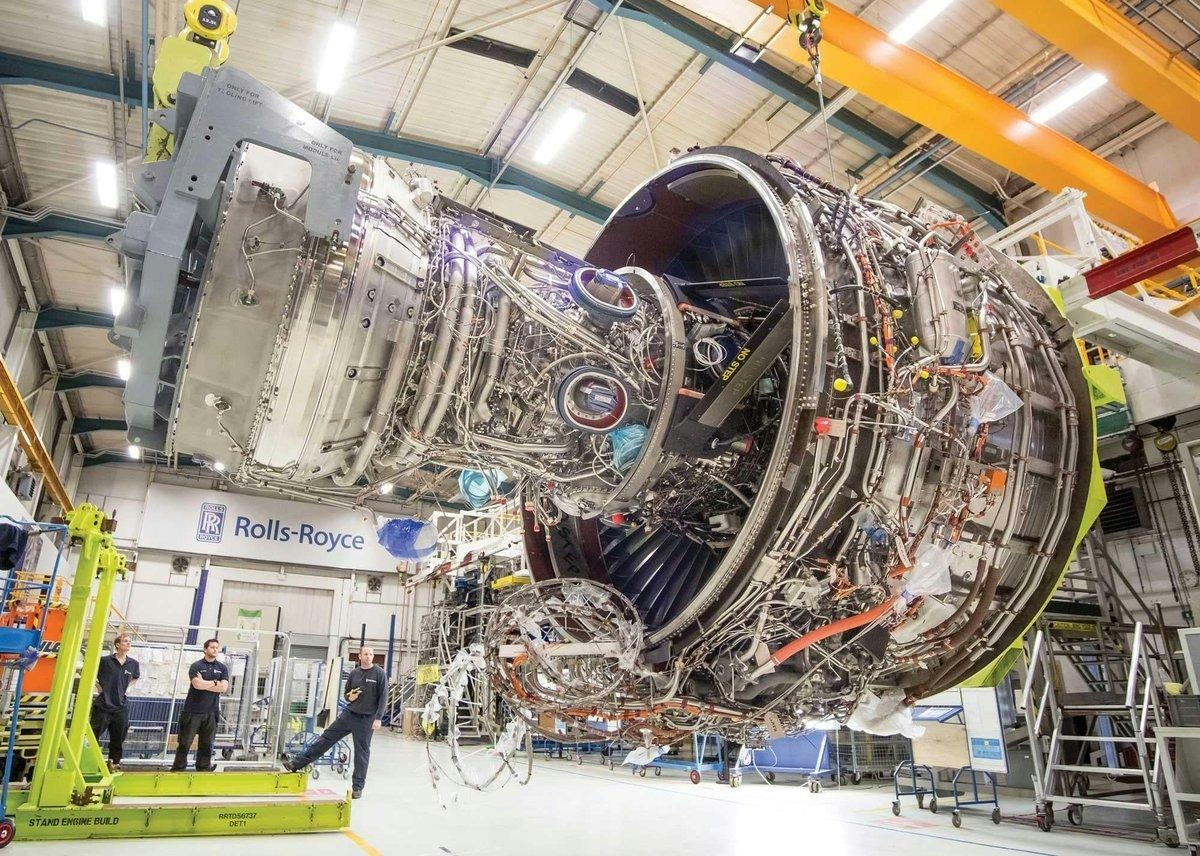
Trent XWB-97: Advancing the World’s Most Used Engine
Trent XWB-97: Advancing the World’s Most Used Engine
The Trent XWB-97 represents the most powerful iteration of the world’s leading large aero engine, widely recognised for its exceptional fuel efficiency and reliability. These attributes have established it as a preferred choice among major airlines worldwide, supporting high utilisation rates across diverse fleets. Despite its proven performance, Rolls-Royce remains committed to enhancing the engine’s capabilities, continually pushing the boundaries of durability and operational excellence.
Enhancing Durability in Challenging Environments
A significant challenge for the Trent XWB-97 has arisen in harsh operating conditions, particularly in the Middle East, where extreme desert environments place considerable strain on engine durability. In response, Rolls-Royce launched a comprehensive multi-phase enhancement programme, part of a broader £1 billion investment aimed at modernising the Trent engine family. The initial two phases have already been implemented, delivering extended time on wing and improved resilience. Currently, Phase 3 is underway, marking a critical advancement in prolonging engine life while preserving the high performance standards valued by operators.
Ben Williams, Vice President of Programmes for the Trent XWB-97, emphasises the importance of these improvements: “The engine is incredibly reliable and performs brilliantly in terms of fuel usage. But in desert environments, it’s not meeting the durability expectations of our customers – and we’re changing that.” With the latest enhancements, Rolls-Royce seeks to future-proof the Trent XWB-97, enabling airlines to operate with greater confidence and longer intervals between maintenance, even under the most demanding conditions.
Navigating a Competitive Aero Engine Market
This commitment to innovation unfolds amid intensifying competition within the aero engine sector. Key rivals such as GE Aerospace and Pratt & Whitney are also addressing durability challenges with their respective Leap and PW1000G engines. GE Aerospace, for instance, is advancing durability upgrade kits for its Leap engines to sustain its competitive position. The market dynamics are further influenced by high-profile demonstrations, including Qantas’s flight-testing of the first Airbus A350-1000 powered by Trent XWB-97 engines. These trials are anticipated to showcase the engine’s long-range operational capabilities, potentially shaping customer perceptions and influencing procurement decisions.
As airlines increasingly demand greater efficiency and reliability, engine manufacturers are responding with continuous technological innovation. Rolls-Royce’s ongoing enhancements to the Trent XWB-97 exemplify a broader industry trend focused on developing advanced solutions to meet evolving operational requirements and maintain leadership in a rapidly changing global market.

Etihad Airways Suspends Airbus A380 Flights on Key Route

Aditya Birla Group Seeks Approval for Aircraft Leasing in GIFT City

Qatar Airways Highlights Innovation and Connectivity at Arabian Travel Market 2026

Hong Kong's Five-Year Plan Includes Andrew Fan's Aircraft Parts Processing Hub Proposal

ACIA Aero Leasing Delivers ATR72-600 to Air Nostrum

RTX Appoints Jill Albertelli as Head of Pratt & Whitney

TAT Technologies Joins Beyond Aero Hydrogen Aircraft Program

AURAK Study Highlights Barriers to Air Taxi Adoption in Emerging Economies

Xiamen Air Selects Altitude for 787 Maintenance at Heathrow

Etihad and Swissport Extend Global Partnership
