
KI-Erkenntnisse in konkrete Maßnahmen überführen

Trends
Categories
UAE Airports Adopt AI to Manage Rising Passenger Traffic
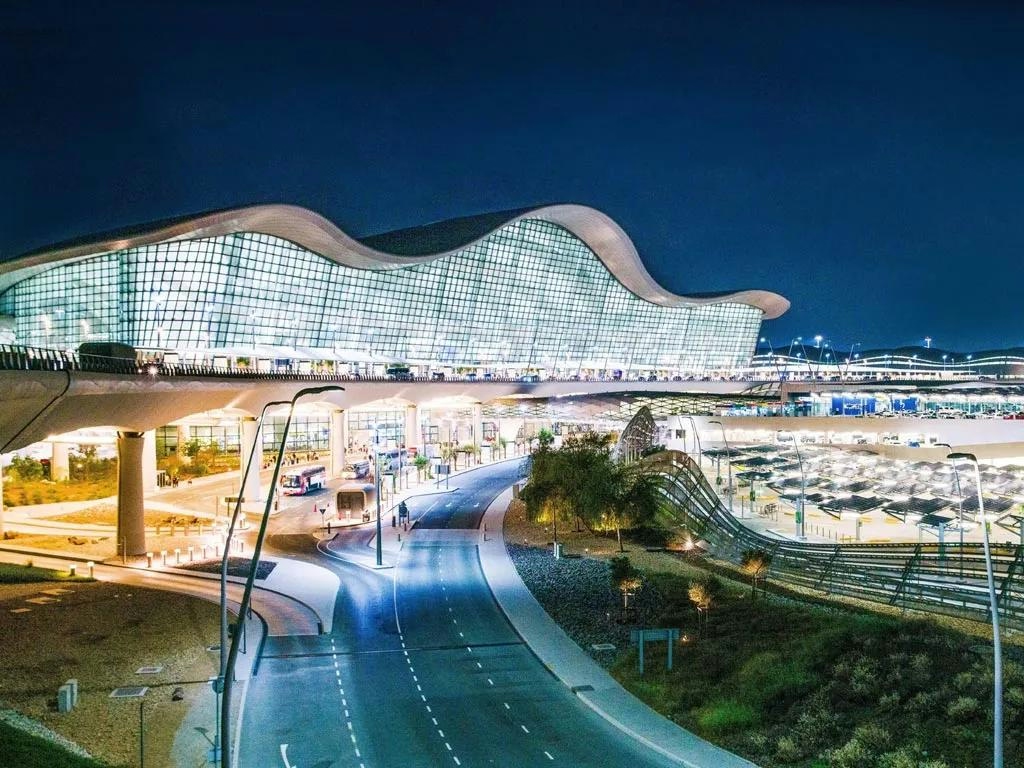
UAE Airports Embrace Artificial Intelligence to Address Rising Passenger Traffic
Airports across the United Arab Emirates are increasingly turning to artificial intelligence (AI) to manage surging passenger volumes, enhance operational efficiency, and reduce costs. This strategic shift comes amid record-breaking passenger numbers and evolving industry demands. However, experts caution that the integration of AI faces significant hurdles, including fragmented legacy systems and workforce adaptation challenges.
Advancing AI Integration in UAE Airports
In a recent development, Dubai Airports Company announced the deployment of an AI-powered turnaround solution at Dubai International Airport (DXB) in collaboration with Assaia, a technology provider with a presence in major global hubs such as New York JFK, Rome Fiumicino, and Seattle-Tacoma. This initiative aims to streamline aircraft movements and improve overall operational efficiency.
Similarly, Abu Dhabi Airports has partnered with technology firm SITA to explore AI-driven management systems at Zayed Airport. The objective is to anticipate operational disruptions and optimize resource allocation, thereby enhancing airport performance.
These initiatives coincide with a notable increase in passenger traffic. DXB recorded 24 million passengers in the third quarter of 2025, marking a 2% year-on-year growth. Meanwhile, Abu Dhabi Airports processed nearly 16 million passengers in the first half of 2025, reflecting a 13% increase compared to the previous year.
Potential Benefits and Industry Challenges
AI applications in airport operations are expected to deliver substantial efficiency improvements across various domains, including demand forecasting, biometric identification, autonomous baggage handling, and terminal maintenance. Usman Tahir, head of aviation at Roland Berger Middle East, emphasized that AI can significantly reduce gate taxi-in times, leading to lower fuel consumption and fewer delays. Supporting this, a Synaptic Aviation report highlighted that AI-driven gate readiness tracking reduced delays by 21% at a US airport, generating savings exceeding $40,000 per gate annually.
Sal Salman, president of Synaptic Aviation, remarked that these operational efficiencies can be realized immediately without necessitating major infrastructure overhauls.
Despite these promising prospects, global readiness for AI adoption remains limited. According to Roland Berger, only one-third of airport executives worldwide feel adequately prepared to implement AI solutions. In the Middle East and Africa, none of the surveyed executives rated their airports as having “very high readiness” for digital transformation. Leo Levit, chairman of ONVIF, pointed out that the absence of unified data models and shared standards complicates the integration of AI with existing legacy systems.
Workforce Implications and Market Dynamics
The transition to AI also presents significant workforce challenges. The UAE’s AI Strategy 2031 projects that nearly half of the national workforce will require upskilling by 2030 to keep pace with technological advancements. As AI automates an increasing number of airport functions, up to 30% of jobs could be at risk, underscoring the urgency of comprehensive retraining programs.
Investor interest in AI infrastructure has surged despite concerns over inflated valuations and the possibility of an AI bubble. Globally, technology giants such as Alphabet, Meta, and Oracle are intensifying their AI investments to maintain competitive advantage.
The UAE’s innovative approach to AI, exemplified by projects like AI-powered racecars for autonomous driving technology, is establishing new standards in safety, governance, and innovation. This leadership position may influence global benchmarks and encourage other nations to adopt similarly advanced AI strategies.
As UAE airports continue to integrate AI technologies, the sector confronts a complex landscape of opportunities and challenges. The successful navigation of these developments has the potential to reshape the global aviation industry.

Etihad Airways Suspends Airbus A380 Flights on Key Route

Aditya Birla Group Seeks Approval for Aircraft Leasing in GIFT City

Qatar Airways Highlights Innovation and Connectivity at Arabian Travel Market 2026

Hong Kong's Five-Year Plan Includes Andrew Fan's Aircraft Parts Processing Hub Proposal

ACIA Aero Leasing Delivers ATR72-600 to Air Nostrum

RTX Appoints Jill Albertelli as Head of Pratt & Whitney

TAT Technologies Joins Beyond Aero Hydrogen Aircraft Program

AURAK Study Highlights Barriers to Air Taxi Adoption in Emerging Economies

Xiamen Air Selects Altitude for 787 Maintenance at Heathrow

Etihad and Swissport Extend Global Partnership
