
KI-Erkenntnisse in konkrete Maßnahmen überführen

Trends
Categories
UK Airports Adopt Predictive AI Technology for Taxi Services
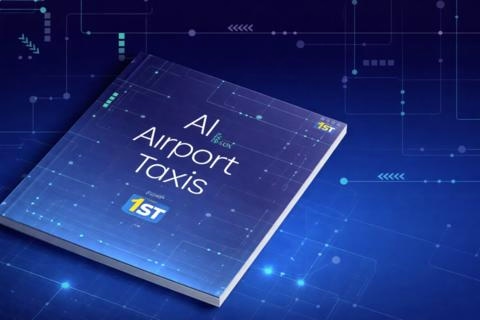
UK Airports Adopt Predictive AI Technology for Taxi Services
Rising Passenger Numbers Drive Innovation in Ground Transport
As UK airports approach pre-pandemic passenger volumes, artificial intelligence is playing an increasingly pivotal role in managing ground transport and taxi services amid growing demand and operational disruptions. Data from the Civil Aviation Authority (CAA) reveals that major hubs such as Heathrow, Gatwick, and Luton are operating near full capacity, heightening the need for more efficient coordination of flights and onward travel arrangements.
Industry analysts highlight that AI technologies are now central to predicting delays, tracking inbound flights, and streamlining passenger journeys, particularly during peak travel periods. Research in aviation technology suggests that AI-driven systems can reduce airport ground transport delays by up to 20% during disruptions. The most pronounced benefits are observed in airport mobility, where timing failures can rapidly escalate into significant operational challenges.
Deployment and Challenges of AI in Taxi Services
UK-based operator 1ST Airport Taxis is among the companies implementing proprietary AI-supported platforms that integrate real-time flight data with vehicle dispatch systems. These platforms enable the prediction of delays, continuous monitoring of live flight information, and dynamic adjustment of taxi dispatches. By keeping both drivers and passengers informed about road conditions and disruptions, the technology facilitates smoother and more reliable airport pickups, even during the busiest travel windows.
However, the swift adoption of predictive AI technology introduces new challenges. With cyberattacks expected to rise in 2026, cybersecurity has become a critical concern for airport operators and taxi firms alike. Ensuring robust internal governance and compliance with evolving regulatory standards for AI deployment in sensitive transport environments is essential to mitigate risks.
Competitive Pressures and Systemic Risks
The competitive landscape is also evolving rapidly. Companies such as Uber and Lyft are accelerating trials of autonomous taxi services in the UK, collaborating with technology firms like Baidu to test robotaxi solutions. This intensifies the race to integrate advanced AI into ground transport, raising the stakes for traditional operators.
Experts caution that the integration of multiple AI systems could introduce systemic risks. For instance, simultaneous actions by various AI agents—such as dispatching vehicles or reallocating resources—might inadvertently amplify disruptions. This phenomenon draws parallels to the increased likelihood of bank runs in financial systems managed by AI.
Despite these concerns, industry specialists agree that predictive AI technology is becoming indispensable for maintaining reliability at the UK’s busiest airports. As passenger numbers continue to rise, the capacity to anticipate and respond to disruptions in real time is poised to shape the future of airport mobility.

Daily Update on Miles, Points, and Premium Travel
Rolls-Royce Used Airbus A330neo Engine Technology to Address Boeing 787 Engine Issues

Manoj Chacko Compares Aviation to a Test Match Rather Than a T20
SITA says AI tool can save airlines $50,000 per aircraft a year

Kazakhstan Aims to Reduce Shadow Economy Using AI; SCAT Airlines to Start Cargo Flights
Farnborough News Summary, July 26, 2026

Anthem Cockpit System’s Hivemind Could Pave Way for Certified AI-Piloted Planes
Honeywell Aerospace and Shield AI Partner on Autonomous Aircraft Development
Bluebox Enhances ROI for Connected Jets
Tracep L410 Missing Near Kitshanga/Walikale After Engine Failure on July 24, 2026
