
KI-Erkenntnisse in konkrete Maßnahmen überführen

Trends
Categories
Why Airbus Designed the A340 with Four Engines Instead of Two
Why Airbus Designed the A340 with Four Engines Instead of Two
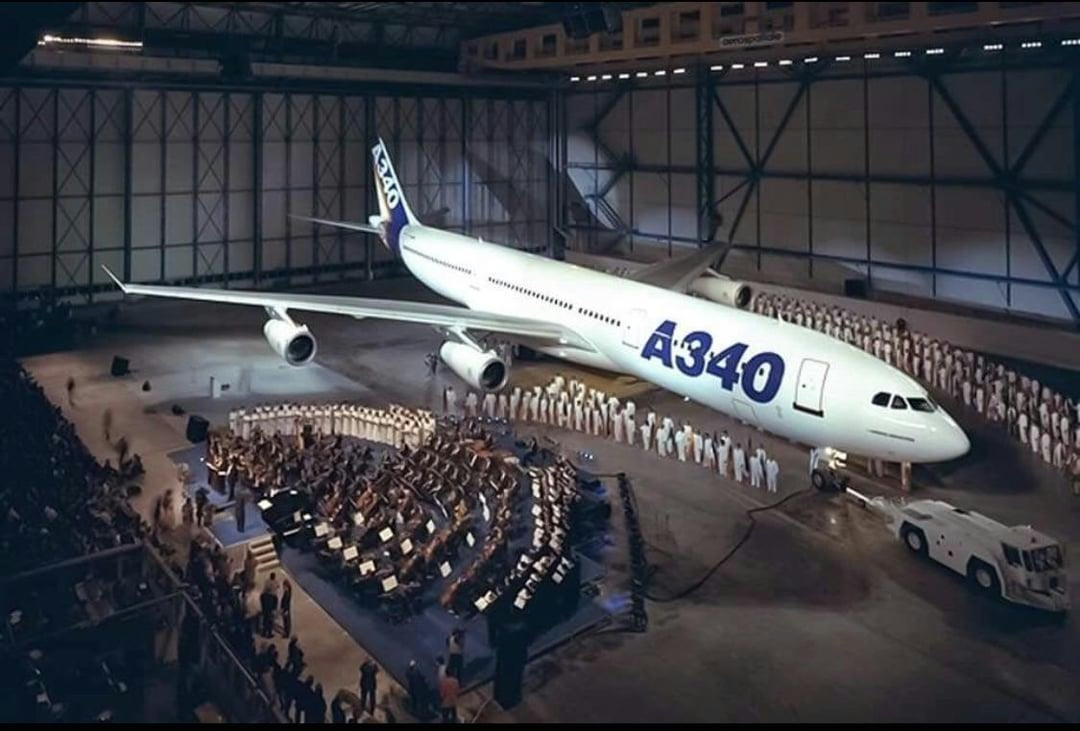
The Airbus A340, viewed from today’s aviation perspective, represents a design philosophy shaped by the technological and regulatory environment of the 1980s. Unlike modern long-haul aircraft such as the Airbus A350, Boeing 787 Dreamliner, and Boeing 777, which operate efficiently with two engines, the A340 was developed with four engines. This choice, now often regarded as outdated, was driven by factors that extended beyond mere preference, reflecting the constraints and priorities of its time.
Design Requirements and Regulatory Constraints
Aircraft design is fundamentally guided by performance objectives including range, payload, operational economics, airport compatibility, and certification requirements. For the A340, Airbus prioritized unrestricted long-haul capability, aiming to connect virtually any two major cities worldwide without the limitations imposed on twin-engine aircraft. During the 1980s, ETOPS (Extended-range Twin-engine Operational Performance Standards) regulations were stringent, generally restricting twinjets to routes within 120 minutes of a suitable diversion airport. Although this might appear sufficient, it effectively excluded many efficient transoceanic routes, particularly across the Pacific, southern Indian Ocean, and polar regions.
These ETOPS restrictions were not a reflection of inherent safety concerns with twin-engine aircraft but rather a cautious regulatory stance that required extensive operational data to demonstrate low in-flight engine failure rates before permitting extended overwater operations. Four-engine aircraft, by contrast, were exempt from these limitations due to their greater redundancy, making the quadjet configuration a practical and necessary solution for achieving global reach under the prevailing standards.
A Dual Aircraft Strategy
In 1987, Airbus introduced an innovative approach by simultaneously developing the A330 and A340 programs based on a shared engineering platform. This strategy allowed Airbus to address diverse market demands while controlling development costs. Airlines operating within ETOPS constraints could select the more economical twin-engine A330, whereas those requiring unrestricted range had the option of the four-engine A340. The two models shared significant commonality beyond their external design, facilitating streamlined production and operational efficiencies.
Changing Industry Dynamics
The A340’s four-engine design soon encountered significant challenges as engine technology advanced and ETOPS regulations evolved. More efficient twin-engine aircraft, such as the Boeing 777, gained regulatory approval for extended overwater flights, offering airlines lower fuel consumption and reduced emissions. These advantages rapidly shifted market preference away from quadjets like the A340.
Environmental considerations and increasing regulatory scrutiny over emissions further diminished the appeal of four-engine aircraft. The A340’s higher fuel consumption became a competitive disadvantage, a trend that was accelerated by the economic impacts of the COVID-19 pandemic. This shift ultimately contributed to Airbus’s decision to cease production of the A380, another four-engine aircraft facing similar market pressures.
In hindsight, the A340 was a product of its era, designed to meet the technical and regulatory realities of the 1980s. While its four-engine configuration is now viewed as a drawback, it was once essential for enabling global connectivity in a period when twinjets could neither safely nor legally operate on many long-haul routes.
Comments

Etihad Airways Suspends Airbus A380 Flights on Key Route

Aditya Birla Group Seeks Approval for Aircraft Leasing in GIFT City

Qatar Airways Highlights Innovation and Connectivity at Arabian Travel Market 2026

Hong Kong's Five-Year Plan Includes Andrew Fan's Aircraft Parts Processing Hub Proposal

ACIA Aero Leasing Delivers ATR72-600 to Air Nostrum

RTX Appoints Jill Albertelli as Head of Pratt & Whitney

TAT Technologies Joins Beyond Aero Hydrogen Aircraft Program

AURAK Study Highlights Barriers to Air Taxi Adoption in Emerging Economies

Xiamen Air Selects Altitude for 787 Maintenance at Heathrow

Etihad and Swissport Extend Global Partnership
