Imagen

Orquesta conocimientos de IA para convertirlos en acción

¡Únete hoy a la lista de espera de AeroGenie!

Tendencias

Categories

Airbus Delivers First NH90 Standard 2 Helicopter to France
July 31, 2026By ePlane AI
Airbus Delivers First NH90 Standard 2 Helicopter to France
0
0
Airbus Helicopters
NH90 Standard 2
French Army Aviation

Airbus Delivers First NH90 Standard 2 Helicopter to France

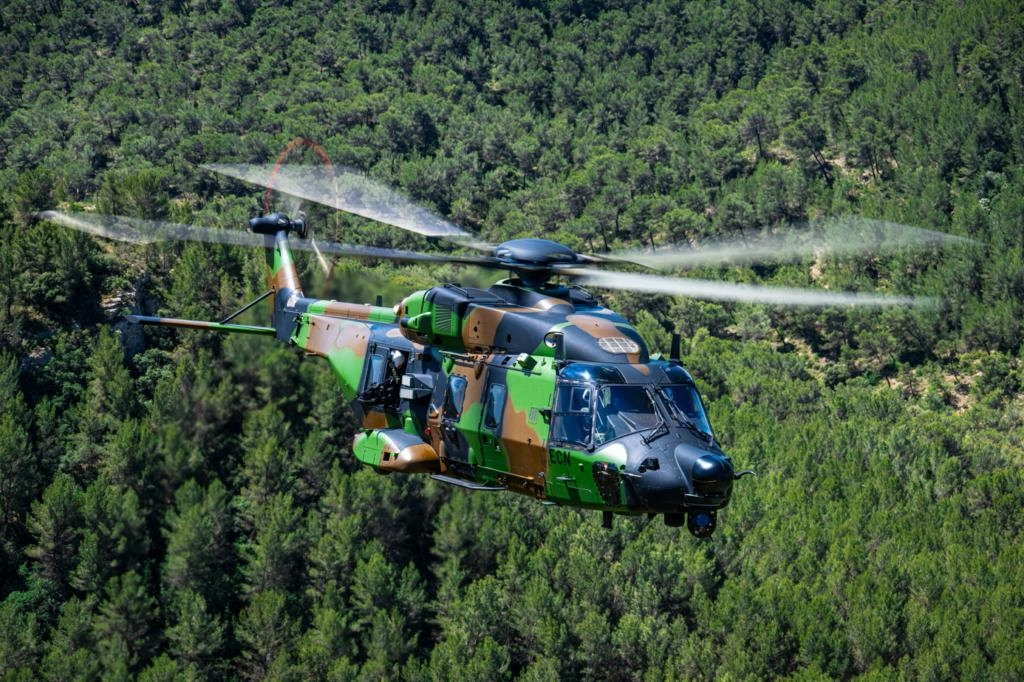
Airbus Helicopters has officially delivered the first NH90 Standard 2 helicopter to France’s Armament General Directorate (DGA), marking a significant milestone in the deployment of the special operations variant of the NH90 Tactical Transport Helicopter (TTH). This delivery initiates the rollout of France’s order for 18 NH90 Standard 2 helicopters, all slated for completion by mid-2029. The new fleet will be operated by the French Army Aviation’s special forces squadron stationed in Pau.

Enhanced Capabilities for Special Operations

The NH90 Standard 2 variant incorporates a range of enhancements specifically designed to meet the rigorous demands of special operations missions. Among its key features is the Safran Euroflir 410D electro-optical system, which provides advanced surveillance and targeting capabilities. The helicopter also includes a new digital map generator and provisions for a third crew member, enhancing operational flexibility. Enlarged rear sliding windows have been integrated to accommodate self-protection guns, further increasing the aircraft’s defensive capabilities.

Additionally, the NH90 Standard 2 is configured for the future integration of the Direct Aperture System (DAS), currently under development. This system is intended to improve pilot visibility in adverse conditions such as snow, dust, and fog, during both day and night operations. Planned upgrades also include the fully digital Thales TopOwl helmet, which will enable pilots to simultaneously view DAS and electro-optical imagery directly on their visor, significantly enhancing situational awareness.

Programme Development and Market Context

The NH90 Standard 2 programme was awarded in 2020 by the NATO Helicopter Management Agency (NAHEMA) to NHIndustries (NHI) and its industrial partners Airbus Helicopters, Leonardo, and Fokker. In a notable expansion of the programme, Spain joined in December 2025 with an order for 31 helicopters configured to the same specifications, underscoring growing international interest in this advanced platform.

As Airbus progresses with the delivery schedule, the company faces several challenges. Meeting the stringent operational requirements of special forces will be critical to the helicopter’s success, alongside maintaining production timelines to fulfill France’s order by the 2029 deadline. Airbus must also address any technical issues that arise during operational deployment to ensure the aircraft’s reliability and performance remain at the highest standards.

The introduction of the NH90 Standard 2 is likely to stimulate further interest from other military services evaluating advanced helicopter options for their fleets. At the same time, competitors in the military helicopter market are expected to highlight their own technological innovations and operational capabilities in response to Airbus’s latest offering.

With this initial delivery, Airbus reaffirms its commitment to supporting the evolving needs of special operations forces while navigating the operational and market challenges inherent in deploying next-generation military helicopters.

More news
Cybersecurity Risks Ground Aviation While Threats in the Air Remain Overlooked

Cybersecurity Risks Ground Aviation While Threats in the Air Remain Overlooked

Cybersecurity Risks Ground Aviation While Threats in the Air Remain Overlooked Ground Systems: The Primary Source of Cyber Incidents Eliran Almog, CEO of Cyviation, recently highlighted a critical disparity in aviation cybersecurity during an interview with Help Net Security. Contrary to popular belief, the most significant financial and operational damages from cyberattacks in aviation do not stem from dramatic in-flight hacking scenarios but rather from vulnerabilities in ground-based systems. These systems include reservations, ground handling, maintenance IT, crew scheduling, and airport operations. Almog emphasizes that ransomware and other cyber threats predominantly target these ground infrastructures, which remain the most likely origin of future incidents. Despite widespread public concern about the possibility of hacking an aircraft mid-flight, no such event has yet resulted in material losses for carriers. This fixation on airborne threats often diverts attention and resources away from the more pressing and frequent risks posed by ground systems. The Overlooked Risks Within Aircraft Systems While Almog cautions against dismissing aircraft cybersecurity entirely, he stresses that the nature of airborne threats is more subtle than the sensationalized versions portrayed in popular media. Aircraft continuously receive data from various ground sources, including navigation databases, performance data, Electronic Flight Bag (EFB) content, and loadable software. This creates a largely unmonitored supply chain that poses significant security challenges. Almog points out that the aircraft itself represents a "blind spot" in cybersecurity, where visibility into the software running across fleets is limited. He argues that understanding and monitoring this software environment is more critical than focusing solely on penetration testing of avionics systems. Emerging Vulnerabilities and Evolving Threats The increasing interconnectivity of aviation systems has amplified vulnerabilities, as legacy protocols often lack robust authentication mechanisms. Almog’s team recently disclosed a critical vulnerability (CVE-2026-1579) in the PX4 Autopilot software, widely used in drones and unmanned aerial vehicles (UAVs). This flaw, rated 9.8 in severity and detailed in a CISA advisory (ICSA-26-090-02), arises from the MAVLink command channels accepting unsigned messages, thereby exposing systems to unauthorized control. Another concerning development is the rise of GNSS (Global Navigation Satellite System) interference, including spoofing and jamming attacks. Unlike conventional cyber threats, these attacks leave no logs or alerts detectable by standard security monitoring tools. Almog reports that such interference has become routine in regions like the Eastern Mediterranean, Black Sea, and Persian Gulf over the past two years. Pilots have experienced false position fixes and degraded inertial navigation systems, with these issues often only identified after flights through crew reports. This lack of telemetry represents a significant challenge for security analysts accustomed to packet-level visibility. Industry Response and Strategic Recommendations In response to these evolving threats, the aviation industry is increasing investments in advanced analytics and incident response capabilities to counter sophisticated cyberattacks. Competitors are adopting proactive risk mitigation strategies and integrating cutting-edge technologies to strengthen their defenses. Almog advocates for a balanced and strategic allocation of cybersecurity resources. While prioritizing ground systems—where the majority of losses occur—is essential, the aircraft itself must not be neglected due to its status as a critical blind spot. He underscores the importance of securing the entire data loading chain, extending beyond visible endpoints such as the EFB. For carriers, particularly those with limited security personnel, gaining comprehensive visibility into software assets and ensuring supply chain integrity are vital steps toward enhancing cybersecurity resilience. In conclusion, although the aviation industry’s attention often gravitates toward airborne cyber threats, the most significant risks and losses remain firmly rooted in ground operations. Addressing these challenges demands a holistic and adaptive cybersecurity strategy that reflects the evolving threat landscape.
Aviation Needs Responsible Management, Not Government Bailouts

Aviation Needs Responsible Management, Not Government Bailouts

Aviation Needs Responsible Management, Not Government Bailouts The persistent challenges confronting Nigerian airlines stem largely from operational missteps, regulatory complexities, and ongoing debates over government intervention. Theodore Chikelu, Chief Executive Officer of Jet Afrique, offers a detailed analysis of these issues, emphasizing the critical need for responsible management over reliance on state support. Causes of Airline Failures in Nigeria According to Chikelu, the premature collapse of many Nigerian airlines can be attributed to a confluence of factors, chief among them poor management, insufficient understanding of airline operations, weak revenue strategies, and lax financial discipline. While each airline may have its unique structure and philosophy, a common denominator remains: a pervasive lack of responsible leadership. A significant operational challenge lies in the inappropriate deployment of aircraft. Chikelu explains that every aircraft is designed for specific routes and purposes, and misaligning aircraft types with route demands leads to inflated maintenance costs, particularly due to cycle penalties. The volatility of fuel prices, which are closely linked to exchange rate fluctuations, further complicates cost management. Airlines must therefore carefully match aircraft to routes and rigorously assess passenger demand before launching services. He highlights the imprudence of operating international routes with minimal passenger loads, describing such decisions as commercially unsustainable. Cash flow management also presents a formidable obstacle. Airlines are responsible for collecting statutory charges on behalf of regulatory bodies such as the Nigeria Civil Aviation Authority (NCAA), the Federal Airports Authority of Nigeria (FAAN), and the Nigerian Airspace Management Agency (NAMA). Delays in remitting these funds can trigger regulatory sanctions and result in grounded aircraft. Chikelu underscores the financial implications of idle planes, stating, “An aircraft is meant to fly, not sit idle. Every day on the ground is a financial loss.” Ultimately, he asserts that airlines which endure are those that exhibit strong management discipline and operational efficiency rather than those dependent on external financial support. Navigating Taxes and Regulatory Charges Chikelu advocates for a balanced approach to taxes and regulatory fees. From the perspective of operators, every additional charge increases operational costs. However, he acknowledges that regulatory agencies require adequate funding to fulfill their mandates effectively. He recalls a time when economy fares between Lagos and Abuja were as low as N2,000, contrasting this with the current higher prices driven by escalating costs across the sector. The financial needs of regulatory bodies, often underestimated, are sustained by revenues generated within the industry. Rather than fostering confrontation, Chikelu calls for constructive dialogue between airlines and regulators to establish fair and sustainable charges. Such collaboration, he argues, is essential to support both industry growth and effective regulatory oversight. The Role of Government Interventions While government initiatives, including domestic aircraft leasing schemes introduced by the Ministry of Aviation and Aerospace Development, present opportunities for the sector, Chikelu stresses that their success hinges on the responsible response of operators. He cautions that support mechanisms are only as effective as the management practices of those who utilize them. This viewpoint resonates with broader global aviation trends. Legal and regulatory uncertainties, exemplified by financial redress cases such as Barclays’, underscore the risks associated with dependence on external bailouts. Fiscal constraints faced by governments, as seen in South Africa, have led to diminished support for airlines, compelling companies to adopt more sustainable management models. Furthermore, market responses to climate policies, including ambitious measures like the Inflation Reduction Act, demonstrate that responsible management can align with market expectations without imposing undue financial strain. Chikelu concludes that the future of Nigerian aviation—and indeed the global industry—rests less on government bailouts and more on disciplined, responsible management. He affirms, “Sustainable growth comes from within the industry, not from external rescue.”
Choo Mi-ae Discusses Developing Northeastern Aerospace and Aviation Hub at Gyeonggi Briefing

Choo Mi-ae Discusses Developing Northeastern Aerospace and Aviation Hub at Gyeonggi Briefing

Choo Mi-ae Unveils Vision for Northeastern Gyeonggi as Aerospace and Aviation Hub Gyeonggi Province Governor Choo Mi-ae has presented an ambitious strategy to develop the northeastern region of Gyeonggi into a leading center for aviation, space, and Maintenance, Repair, and Operations (MRO) industries. During a departmental briefing held at the Northern Gyeonggi Provincial Government Building on the 31st, Governor Choo emphasized the region’s potential to spearhead Korea’s next phase of industrial advancement. In her opening remarks, Choo declared, “Our path is clear: Northeastern Gyeonggi is entering a new era of transformation.” She outlined three foundational pillars for the region’s future growth: the establishment of a high-tech base for aviation and space industries, leadership in climate-energy technology, and the development of an advanced smart farming complex aimed at ensuring food safety and reliability. Strategic Utilization of Military Sites and Regulatory Challenges A key component of the plan involves leveraging the region’s extensive land resources, particularly the 43.74 million pyeong of returned U.S. military sites, which include 8.78 million pyeong of idle military land. Governor Choo proposed designating these areas as institutional bases for special districts, such as peace economy zones and opportunity development zones, to stimulate economic activity. Despite the promising prospects, Choo acknowledged significant regulatory obstacles. She pointed to overlapping restrictions, including military facility protection zones and the Metropolitan Area Planning Law, which have historically impeded development in Northeastern Gyeonggi. Rather than accepting these barriers as insurmountable, she pledged to pursue alternative solutions, rational adjustments, and detailed roadmaps to engage and persuade the central government to support the region’s transformation. Addressing the concerns of local communities, Choo emphasized the importance of fair compensation, stating, “Special sacrifices must be accompanied by special compensation.” She urged public officials to advance the initiative with determination, recognizing that the realization of these bold plans will likely extend beyond her current four-year term. Industry Outlook and Regional Rebranding The governor’s announcement comes amid rapid global advancements in aerospace and defense industries, driven by innovations in aviation technology and defense modernization. This evolving landscape presents both opportunities and challenges for Northeastern Gyeonggi. While the region stands to attract increased investor interest and potentially emerge as a commercial aerospace hub, it must also contend with limited local manufacturing capacity, regulatory constraints, and a shortage of skilled labor. Market analysts anticipate a positive response from investors, who are expected to view the aerospace sector’s growth potential favorably. Regional competitors may intensify efforts to enhance their own capabilities, while global aerospace firms could seek to establish a stronger foothold in Gyeonggi, thereby reshaping the competitive environment. In a symbolic gesture reflecting a broader policy focus, Governor Choo announced a terminological shift, stating, “I will no longer refer to it simply as Northern Gyeonggi, but as Northeastern Gyeonggi from now on.” This change aims to encompass both the northern and eastern parts of the province, regions that have historically experienced slower development due to stringent regulations. Concluding her address, Governor Choo reaffirmed her commitment to the region’s transformation and expressed her readiness to assume full responsibility for the challenges ahead. She called on all stakeholders to embrace the vision for a revitalized Northeastern Gyeonggi.
At Farnborough, Technology and Geopolitics Shape Aviation Innovation

At Farnborough, Technology and Geopolitics Shape Aviation Innovation

At Farnborough, Technology and Geopolitics Shape Aviation Innovation A Showcase of Cutting-Edge Aviation Technology The opening day of last week’s Farnborough Airshow witnessed the debut flight of Vertical Aerospace’s electric vertical take-off and landing (eVTOL) “air taxi,” a striking aircraft distinguished by its upward-pointing propellers along the wings. As a biennial event that serves as a pivotal platform for both military and civilian aviation, Farnborough has long been synonymous with innovation and future trends. This year, however, the atmosphere was imbued with a heightened sense of urgency, as rapid advancements in materials science, battery technology, artificial intelligence, and semiconductor chips converged with escalating geopolitical tensions. Vertical Aerospace’s public demonstration highlighted the sector’s technological progress. The company’s eVTOL, which claims a range exceeding 100 miles (160 km), exemplifies recent breakthroughs in battery efficiency and lightweight airframe design. Despite these advances, the aviation industry continues to grapple with significant challenges. The aftermath of the Covid-19 pandemic left many firms struggling to secure investment, while workforce shortages and facility closures have impeded recovery efforts. Vertical Aerospace itself has managed to attract millions in government funding and growing military interest, particularly for special forces applications. Rising Demand Amid Persistent Challenges Since the pandemic-induced downturn in 2020, demand for new aircraft has rebounded sharply. Aviation and manufacturing companies are now engaged in a race to fulfill surging orders, especially as militaries seek enhanced capabilities in response to rising tensions across Europe, the Pacific, and ongoing conflicts in Ukraine and the Gulf. Matthew Pritchard, vice president for sales and customer engagement at Ontic—a major supplier of aviation equipment and services—observed that defence-related business has surged from about 30% a few years ago to over 50% today. He noted, however, that the sector as a whole is still struggling to keep pace with demand, citing workforce attrition and facility shutdowns during the pandemic as ongoing obstacles. This surge in demand has revealed several paradoxes within the industry. Leading manufacturers such as Boeing and Airbus are now contending with multi-year backlogs for commercial airliners, while older fighter jets like the Eurofighter and F-16 are experiencing renewed sales driven by geopolitical instability. Concurrently, new technologies are advancing rapidly. Dutch company Robin Radar Systems, which transitioned from bird-detection radars to anti-drone systems, exemplifies firms reporting significant growth in this evolving landscape. Supply Constraints and Geopolitical Pressures Scaling production to meet burgeoning demand remains a formidable challenge. Persistent supply chain disruptions and capacity limitations continue to delay aircraft deliveries at scale. The industry’s focus has shifted from stimulating demand to fulfilling record backlogs, with market attention increasingly directed toward improving productivity, ensuring quality, and securing critical supply chains. Competitors are expanding supplier capacity and streamlining operations in an effort to convert orders into finished products more efficiently. Geopolitical developments further complicate the aviation sector’s outlook. The ongoing crisis in the Middle East is disrupting aviation, logistics, and energy corridors, contributing to volatile fuel prices and escalating costs for raw materials and components. These pressures compel manufacturers to adapt swiftly, even as they announce nearly $85 billion in deals at Farnborough spanning both military and civilian sectors. Missile manufacturers such as Lockheed Martin, Raytheon, and MBDA are unveiling initiatives aimed at reducing the cost of air defence and strike systems, as the United States and its allies race to replenish depleted missile inventories. At Farnborough, the convergence of technological innovation and global instability is reshaping the aviation industry, presenting both unprecedented opportunities and significant challenges.
Installing the GEnx Fan Blade Platform: GE Aviation Maintenance Overview

Installing the GEnx Fan Blade Platform: GE Aviation Maintenance Overview

Installing the GEnx Fan Blade Platform: GE Aviation Maintenance Overview GE Aviation has issued a detailed maintenance overview outlining the essential procedures for inspecting and installing the GEnx Fan Blade Platform cover. This guidance serves as a critical reference for aviation technicians, underscoring the necessity of consulting approved aircraft or engine manuals and adhering strictly to safety protocols throughout all maintenance activities. Maintenance Challenges and Industry Context The installation of the GEnx Fan Blade Platform is a vital operation that directly impacts the reliability and performance of GE’s advanced jet engines. However, the maintenance process currently faces significant challenges, particularly due to supply chain disruptions. GE Aerospace is actively collaborating with its extensive supplier network to address these bottlenecks, which have affected the timely availability of key components, including the fan blade platform itself. Such delays have the potential to disrupt maintenance schedules and operational readiness. In addition to supply constraints, shifting market dynamics are influencing the maintenance landscape. Heightened competition from engine manufacturers like Pratt & Whitney is driving innovation and operational improvements across the sector. The LEAP engine, developed by CFM International—a joint venture between GE and Safran—has notably improved turnaround times and contributed to a reduction in aircraft groundings. These advancements are compelling competitors to accelerate their technological development efforts, focusing on enhancing engine efficiency and durability to remain competitive with GE’s offerings. Commitment to Safety and Operational Excellence Amid these evolving challenges, airlines and maintenance providers continue to prioritize safety and operational efficiency. GE Aviation remains committed to supporting its customers by providing updated maintenance resources and fostering collaboration throughout the supply chain. These efforts aim to mitigate disruptions and ensure the sustained performance of GEnx engines within an increasingly competitive market. **Note:** This overview is intended solely for informational purposes. Technicians must always consult official manuals and comply with all safety requirements when conducting engine maintenance.
Russian Airline Izhavia Grounded Over Safety Concerns

Russian Airline Izhavia Grounded Over Safety Concerns

Russian Airline Izhavia Grounded Over Safety Concerns Russian aviation authorities have revoked the air operator’s certificate of Izhavia, effectively grounding the regional carrier due to significant safety violations. The federal air transport regulator, Rosaviatsia, announced the suspension following inspections conducted in April that uncovered serious breaches in maintenance procedures and crew scheduling. The suspension will take effect on 1 August, rendering Izhavia unable to operate commercial flights. Background and Inspection Findings Izhavia, headquartered in Izhevsk—the capital of the Udmurt republic located between Kazan and Ekaterinburg—operates flights to major Russian cities including Moscow, St Petersburg, and Ekaterinburg. Its fleet comprises Boeing 737-800 and Yakovlev Yak-42 aircraft. Established in 1944 and wholly owned by the Udmurt republic, the airline also manages a tour company, an airport, and a technical division. Rosaviatsia’s inspections revealed that certain aircraft were cleared for flight without completing all mandatory maintenance checks. The regulator further identified deficiencies in Izhavia’s safety-management system and violations of duty-time regulations affecting both crew and technical staff. Despite directives to conduct a comprehensive internal audit and rectify these issues, Izhavia failed to implement the necessary corrective measures within the stipulated timeframe. Broader Industry Context and Market Response The grounding of Izhavia occurs amid broader challenges facing Russia’s aviation sector. The industry is contending with systemic difficulties in maintaining airworthiness, largely due to reliance on aging fleets and obstacles in procuring aircraft engines, certified spare parts, and qualified maintenance personnel. These challenges have been intensified by Western sanctions, raising concerns about the long-term viability of Russia’s commercial aviation. Analysts warn that the country’s fleet could contract by more than half by 2026. Market reactions to Izhavia’s suspension have been measured, with investors closely monitoring potential repercussions for the sector. Competing airlines such as Aeroflot, S7 Airlines, Red Wings, and Nordwind have reaffirmed their commitment to safety standards and pledged to accommodate passengers affected by Izhavia’s grounding. Approximately 46,000 tickets remain valid for travel through early February 2025, and Izhavia has indicated that flights will be transferred to partner carriers. The airline has committed to fulfilling its obligations to passengers until all transportation issues are resolved. Roman Efimov, chair of the Udmurt republic government, described the suspension as a “necessary measure” that will enable Izhavia to reorganize and enhance its safety practices. This development highlights the ongoing struggle within Russia’s aviation industry to maintain safety standards amid tightening restrictions and operational challenges.
Florida to Use $200 Million Meant for EV Chargers to Build Air Taxi Pads

Florida to Use $200 Million Meant for EV Chargers to Build Air Taxi Pads

Florida Redirects $200 Million in EV Charger Funds to Develop Air Taxi Infrastructure Florida, which hosts one of the largest electric vehicle (EV) fleets in the United States, is adopting an unconventional strategy in deploying federal infrastructure funds. Rather than expanding its network of EV chargers, the state plans to allocate nearly $200 million from the National Electric Vehicle Infrastructure (NEVI) program to construct landing pads and charging stations for electric air taxis. This decision, reported by the Miami Herald, marks a significant shift in the use of funds originally intended to accelerate the buildout of EV charging corridors nationwide under the Bipartisan Infrastructure Law. A Shift Toward Electric Vertical Take-Off and Landing Aircraft The Florida Department of Transportation (FDOT) justifies this reallocation by noting that private companies have largely met the current demand for EV charging infrastructure, despite the state lagging behind the national average in chargers per vehicle. Consequently, FDOT intends to build 32 landing pads for electric vertical take-off and landing aircraft (eVTOLs), a nascent market characterized by startups progressing toward production-ready models, some of which are also exploring defense applications. Officials express optimism that these small, typically four- to five-passenger aircraft could alleviate Florida’s well-documented traffic congestion. The Kissimmee Gateway Airport has already begun testing electric air taxis, highlighting potential advantages such as reduced noise pollution and lower emissions. Nonetheless, widespread adoption faces considerable hurdles, including the need for infrastructure development, regulatory approvals, and public acceptance. Regulatory Flexibility and Controversy Florida’s decision aligns with updated NEVI program guidelines that permit states with “fully built out” EV charging corridors to redirect funds toward other publicly accessible EV charging infrastructure. While states like New York and North Carolina have used NEVI funds to expand community charging options—particularly benefiting renters and homeowners without dedicated parking—Florida’s approach emphasizes future-oriented mobility solutions. The planned landing pads and charging stations are intended for diverse locations, including golf courses, luxury apartment complexes, and airports. The move has sparked debate within traditional aviation sectors, which may resist the shift, and among competitors who might lobby for funding to support more established transportation methods or to accelerate their own air taxi projects. Investor sentiment remains divided; some view the initiative as a promising innovation in urban mobility, while others question the practicality and economic viability of such a substantial pivot. As Florida pioneers this approach, its strategy will serve as a critical test case for how federal infrastructure dollars can be leveraged to support emerging transportation technologies, even as questions persist regarding readiness and return on investment.
Insights from Farnborough on Aerospace Growth and Orlando’s Emerging Role

Insights from Farnborough on Aerospace Growth and Orlando’s Emerging Role

Insights from Farnborough: Aerospace Growth and Orlando’s Emerging Role The Orlando Economic Partnership recently participated in the Farnborough International Airshow, a biennial event recognized globally as a premier gathering for aerospace industry leaders. Farnborough serves as a critical platform for exploring emerging technologies and addressing the future trajectory of aviation. This year’s event not only highlighted innovation but also underscored significant challenges confronting the sector, including constrained capacity expansion, productivity enhancement, and the security of vital supply chains. As aerospace companies contend with unprecedented order backlogs, the prevailing sentiment at Farnborough has shifted from demand forecasting to execution. Industry leaders are prioritizing the conversion of these backlogs into completed products, emphasizing investments in workforce development, process optimization, and technological advancement. Competitors are expected to respond by bolstering their operational capabilities and talent pools to meet escalating demand. Amid these dynamics, Orlando’s role within the aerospace sector is attracting increasing attention. Traditionally known for its tourism industry, Orlando is now emerging as a highly connected aviation and aerospace hub. The region’s strengths—comprising a skilled talent base, advanced technical capabilities, robust infrastructure, and strategic partnerships—were frequently cited by companies at Farnborough as critical enablers of growth. Talent as a Key Driver Workforce development remains one of the aerospace industry’s most pressing challenges. Orlando has cultivated the fourth-largest aerospace and defense talent pipeline among major U.S. metropolitan areas, reinforcing its reputation as a center for aerospace innovation and workforce cultivation. The University of Central Florida (UCF) has awarded over 1,000 bachelor’s degrees in aerospace engineering over the past five years and continues to expand its research and workforce initiatives in areas such as autonomy, cybersecurity, propulsion, sensing, advanced manufacturing, and space technologies. UCF’s standing as a leading supplier of engineering talent is vital to addressing Florida’s expanding aerospace needs. A Robust Aerospace Ecosystem Orlando’s competitive advantage stems from a concentration of aerospace capabilities developed over several decades. The region hosts Team Orlando, which co-locates Army, Navy, and Air Force simulation commands, and manages approximately $6 billion annually in modeling, simulation, and training contracts. Central Florida Research Park, home to more than 140 companies, further anchors the region’s aerospace activities. Major employers such as Boeing, L3Harris, Northrop Grumman, and Lockheed Martin maintain significant operations in the area. Modeling, simulation, and training have long established Orlando’s aerospace reputation, and these capabilities now form the foundation of a broader and expanding innovation ecosystem. Innovation and Strategic Location Many of the technologies showcased at Farnborough already have a presence in Orlando. UCF researchers pioneered the first hypersonic rotating detonation rocket engine and are advancing HiHYPER, a Department of Defense-funded high-hypersonic propulsion testing facility. In the realm of advanced air mobility, the Greater Orlando Aviation Authority has approved plans for a vertistop at Orlando International Airport, facilitating future electric vertical takeoff and landing (eVTOL) demonstrations and a planned on-airport vertiport by 2030. The region also boasts growing expertise in autonomous systems, sensing, optics, photonics, cybersecurity, and advanced aviation infrastructure. Situated just 35 miles from Florida’s Space Coast, UCF and the Orlando region lie within one of the world’s most active aerospace corridors. As launch activity intensifies, much of the supporting engineering, optics, simulation, and satellite systems work is anchored in this area. As the aerospace industry enters a new phase characterized by execution and strategic investment, Orlando’s established ecosystem and expanding talent pipeline position the region as a significant contributor to meeting the sector’s evolving demands.
FTAI Aviation Reports Second Quarter Earnings

FTAI Aviation Reports Second Quarter Earnings

FTAI Aviation Reports Second Quarter Earnings Amid Market Caution FTAI Aviation (FTAI) announced its second-quarter financial results, reporting an adjusted EBITDA of $291.4 million. This performance was primarily driven by significant growth in its Aerospace Products segment, which saw both increased production and expanded market share. The company is actively transitioning its aviation leasing operations toward a more asset-light, strategic-capital model, even as recent earnings reveal potential challenges ahead. Strong Growth in Aerospace Products and Capacity Expansion Chief Executive Officer Joe Adams highlighted that FTAI operates through three core business units: Aerospace Products, Asset Management, and Power. Each segment benefits from the company’s expertise in aftermarket turbine performance. Adams noted progress across all areas during the quarter, including increased module production, the launch of a new investment vehicle, and a substantial initial order for its power-generation offering. He emphasized that the company’s market share grew from 12% to 14%, attributing this to expanded production capacity, improved parts procurement, and greater customer adoption of maintenance, repair, and exchange services. President David Moreno reported that Aerospace Products revenue surged 78% year over year and 18% sequentially. The segment’s adjusted EBITDA reached $249.7 million, marking a 51% increase from the previous year and a 12% rise from the prior quarter, with a 29% EBITDA margin. During the quarter, FTAI refurbished 296 CFM56 modules, a 61% increase compared to the second quarter of 2025, bringing first-half production to 566 modules—surpassing midyear targets. The company raised its 2026 module-production forecast to 1,200 units, up from 1,050. Management noted that the market for CFM56 engines remains supply-constrained, prompting FTAI to allocate a greater share of module output to third-party customers rather than its own leasing fleet. This strategic shift aims to strengthen customer relationships and support the company’s asset-light approach, although it may exert pressure on near-term margins. Moreno also indicated that a higher proportion of heavy engine shop visits could impact margins in the short term. Adams projected that Aerospace Products margins would stabilize around 30% over the next one to two years as the company prioritizes market share and larger customer programs. FTAI further expanded its maintenance network through partnerships with GMF AeroAsia in Jakarta and EgyptAir in Cairo. The Jakarta facility offers heavy-repair capabilities for CFM56-5B and CFM56-7B engines, an engine test cell, and employs over 200 technicians. The Cairo operation focuses on the CFM56-7B engine. Additional plans include establishing a CFM56 and LEAP engine test cell at FTAI’s Rome facility and opening a new 113,000-square-foot site in Lisbon, targeting production of over 300 modules annually. The investment in the LEAP test cell forms part of FTAI’s broader strategy to enter the next-generation engine maintenance market. Leasing Segment Transition and Market Outlook FTAI’s aviation leasing segment generated $88.2 million in EBITDA during the quarter. This included $5 million from insurance recoveries, $48 million from balance-sheet leasing and asset sales, and $35 million from 2025 special-purpose vehicle management fees and co-investment returns. Management revised its 2026 aviation leasing EBITDA guidance downward to $475 million, citing the strategic reallocation of module production to third-party customers and reduced reinvestment in the on-balance-sheet leasing fleet. Meanwhile, the Aerospace Products EBITDA guidance for 2026 was reaffirmed at $1.05 billion. Despite these operational advances, FTAI reported diluted earnings per share (EPS) of $1.29 for the first quarter of 2026, missing expectations by 15.2%. This shortfall raised concerns about preferred dividend coverage and suggested a potential revenue warning. While the EPS miss indicates caution regarding future market growth, the company’s stock price remained stable, reflecting steady investor sentiment and confidence in the company’s forward guidance. Responses from competitors have yet to emerge, but the market’s reaction to FTAI’s earnings may influence future industry strategies.
LATAM Selects SES for In-Flight Connectivity on 60 Airbus and Embraer Jets

LATAM Selects SES for In-Flight Connectivity on 60 Airbus and Embraer Jets

LATAM Selects SES for In-Flight Connectivity on 60 Airbus and Embraer Jets SES, South America’s leading provider of inflight connectivity, has announced a major expansion of its partnership with LATAM Airlines Group. The agreement will see over 60 Airbus and Embraer aircraft equipped with SES’s advanced multi-orbit inflight connectivity (IFC) solution, which utilizes electronically steerable antenna (ESA) technology. This installation program includes Airbus A320neo and A321XLR models, as well as Embraer E195-E2 jets, with deployments scheduled over the coming years. Deployment Timeline and Technology Integration The first Embraer E195-E2 aircraft fitted with the new connectivity system are expected to join LATAM Airlines Brazil’s domestic fleet in the fourth quarter of this year. Meanwhile, the initial Airbus A321XLRs covered by the agreement are anticipated to enter service in 2027. The IFC solution integrates Gilat Satellite Networks’ Stellar Blu Sidewinder ESA and operates through SES’s geostationary satellites, complemented by Eutelsat OneWeb’s Low Earth Orbit (LEO) satellite network. SES serves as a distribution partner for the LEO network within the aviation sector, enhancing the system’s global reach and performance. Currently, SES supports inflight connectivity on more than 250 LATAM aircraft, primarily from the A320 Family, using its 2Ku technology. This latest contract further solidifies SES’s dominant position in the Latin American market amid intensifying competition. Notably, Viasat recently secured the contract to provide connectivity for LATAM’s widebody fleet, underscoring the competitive dynamics among satellite service providers. Market Context and Industry Challenges Paulo Miranda, vice president of customers at LATAM Airlines Group, emphasized the airline’s commitment to enhancing passenger connectivity. He stated, “By bringing next-generation multi-orbit connectivity to more of our fleet, we will offer our passengers a faster, more reliable onboard internet experience, helping them stay connected wherever they fly while continuing to raise the standard of travel across Latin America.” SES’s multi-orbit IFC solution is gaining momentum across the region. The company recently signed an agreement with the Abra Group—which owns Avianca, GOL, and Wamos Air—to equip over 100 aircraft with its LEO/GEO connectivity system. GOL is already a customer of SES’s 2Ku technology. Additionally, SES announced plans last month for Mexican ultra-low-cost carrier Viva to install the ESA-based system on 100 A320 Family aircraft. Despite these advances, SES and its airline partners face significant challenges. Regulatory issues such as spectrum clearance remain a critical hurdle, alongside the increasing risk of cyber-attacks targeting satellite networks and onboard systems. The rapid evolution of the inflight connectivity market is also driving competitors to accelerate fleetwide upgrades. For example, several U.S. carriers are intensifying retrofit programs for their narrow-body aircraft, while international airlines like Japan Airlines are adopting SES’s multi-orbit solutions, reflecting a broader global shift and heightened competition in the sector. As LATAM and SES proceed with this ambitious rollout, their collaboration highlights both the promising opportunities and the complex challenges involved in delivering next-generation inflight connectivity to passengers throughout Latin America.
line