Imagen

Orquesta conocimientos de IA para convertirlos en acción

¡Únete hoy a la lista de espera de AeroGenie!

Tendencias

Categories

Anchorage Capital Makes Bid for Australia's Rex
June 11, 2025By ePlane AI
Anchorage Capital Makes Bid for Australia's Rex
0
0
Anchorage Capital
Regional Express
Airline Acquisition

Anchorage Capital Advances Bid for Australia’s Rex Amid Prolonged Uncertainty

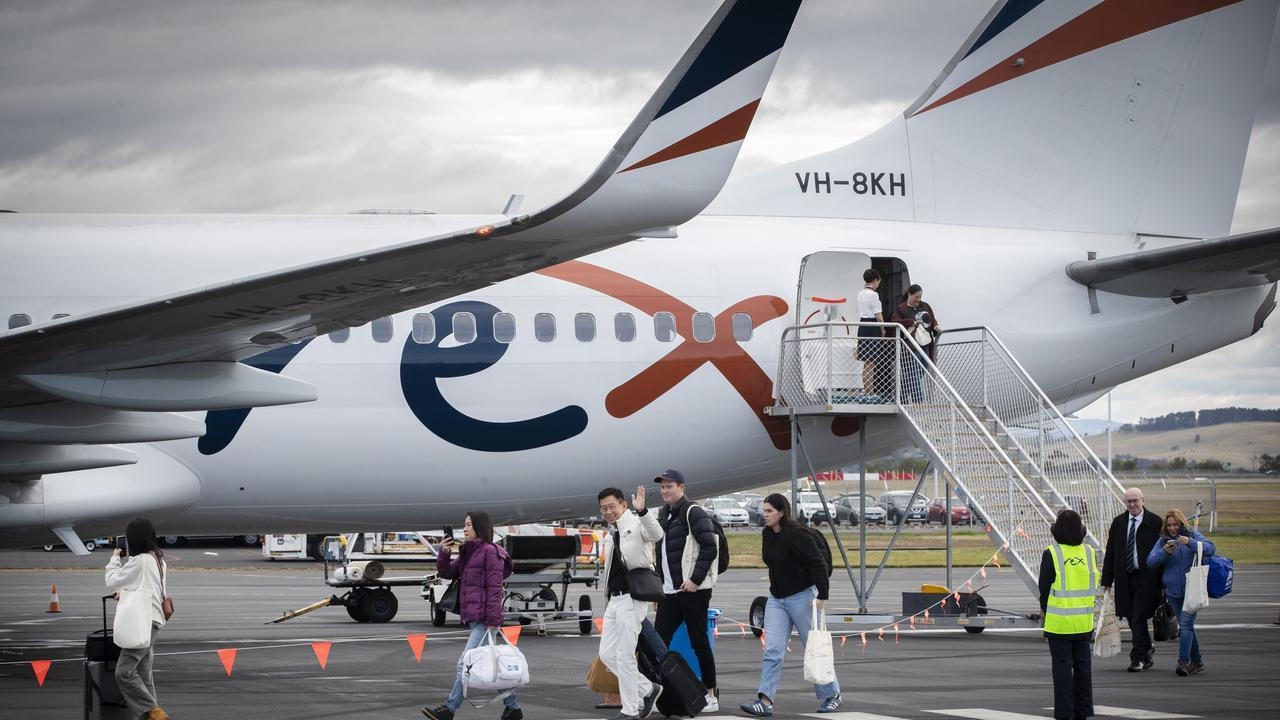
The deadline for submitting acquisition bids for the insolvent Australian airline Rex (Regional Express) has passed, with Anchorage Capital Advisors emerging as a prominent contender, according to the Australian Financial Review. Rex entered voluntary administration in July 2024 following a failed expansion into mainline domestic routes, a market dominated by Qantas and Virgin Australia. This strategic shift away from its traditionally profitable regional niche left the airline financially exposed. Although the administration process was initially expected to conclude within three months, it remains unresolved nearly a year later.

Administration Deadline and Competitive Landscape

Administrators face a Federal Court-imposed deadline of June 30 to secure a buyer for Rex. Any extension beyond this date will require convincing the court that substantial progress is being made in the sale process. Anchorage Capital, a distressed debt investor that previously pursued Frontier Airlines before losing to Indigo Partners, now confronts multiple challenges in its bid for Rex. These include regulatory scrutiny, competition from other interested parties, and concerns regarding its own financial stability. Market analysts suggest that Rex’s stock price and investor sentiment may fluctuate in response to the ongoing bidding process, while competitors could adopt strategic measures to protect their market share or counter Anchorage’s offer.

Among other potential bidders is Western Australia-based HMC Group, operator of Nexus Airlines. Nexus Managing Director Michael McConachy has expressed interest in expanding within Western Australia, though the company’s national ambitions appear limited. Another proposal under consideration involves a debt-for-equity swap, which would see Rex’s secured and unsecured creditors take ownership stakes, potentially facilitating the airline’s return to the Australian Stock Exchange. Under this plan, the Australian government would acquire an approximate 10% stake in Rex after repaying AUD 150 million (USD 98 million) owed to a major lender.

Government Support and Political Implications

Despite the ongoing uncertainty, government support has enabled Rex to maintain its scheduled regional propeller services to remote and regional airports. However, its mainline Boeing 737-800 operations ceased following the administration announcement. The political stakes are significant, as allowing Rex’s regional services to collapse is widely regarded as untenable. The government has indicated a willingness to nationalize the airline should no buyer materialize.

The competitive environment remains dynamic. Recent developments in the airline sector include GlobalData extending the bid deadline for ICG while terminating discussions with KKR, highlighting the complexity and volatility inherent in current airline acquisitions.

As the June 30 deadline approaches, attention remains focused on the administrators and prospective buyers to determine the future of one of Australia’s key regional carriers.

More news
Kenya Airways Aims to Resume Operations of Grounded Fleet by Early 2027

Kenya Airways Aims to Resume Operations of Grounded Fleet by Early 2027

Kenya Airways Aims to Resume Operations of Grounded Fleet by Early 2027 Plans for Fleet Reactivation and Expansion Kenya Airways (KQ, Nairobi Jomo Kenyatta) has announced its intention to have its entire grounded fleet operational by early 2027. Speaking at a press conference in Nairobi on August 19, CEO George Kamal stated, “By January 2027, we expect to have the full Kenya Airways fleet back. Once we have our fleet back, we will be able to compete.” Currently, approximately one-third of the airline’s 35 aircraft remain inactive, with 10 planes grounded according to ch-aviation data. Alongside reactivating its existing fleet, Kenya Airways plans to expand by acquiring a second Boeing 777-300ER and two additional Boeing 737-800 aircraft. Challenges Amid Intensifying Competition and Regulatory Scrutiny The airline’s path to full operational capacity faces significant challenges. Kenya Airways is contending with heightened competition from regional carriers such as CemAir and Airlink, which have broadened their networks and strengthened their market presence following the exit of other airlines in the region. These competitors are expected to respond to Kenya Airways’ return with aggressive pricing and expanded routes to protect their market share. Moreover, the resumption of operations after a prolonged grounding period is likely to attract increased scrutiny from both regulators and passengers. Concerns regarding safety and service quality will be paramount as the airline seeks to restore confidence and meet international aviation standards. Kenya Airways must also address technical issues related to its grounded aircraft, ensuring all planes comply with stringent regulatory requirements before returning to service. The airline’s management has underscored its commitment to safety and compliance as it pursues the 2027 reactivation target. As Kenya Airways advances its recovery plan, its ability to manage competitive pressures, regulatory demands, and operational hurdles will be crucial in reestablishing its position within the regional aviation market.
StandardAero Expands Bombardier Global MRO Services at Van Nuys Facility

StandardAero Expands Bombardier Global MRO Services at Van Nuys Facility

StandardAero Expands Bombardier Global MRO Services at Van Nuys Facility StandardAero has significantly enhanced its business aviation maintenance offerings at its Van Nuys, California facility by incorporating comprehensive support for select Bombardier Global aircraft. The site has received authorization to conduct airframe inspections, repairs, structural work, and avionics services for the Global Express, Global Express XRS, Global 5000, Global 6000, and Global 7500 models. Expansion of Capabilities and Workforce Investment Leveraging over 25 years of experience servicing Gulfstream operators, StandardAero is investing in both its workforce and tooling to accommodate the addition of Bombardier’s Global family to its maintenance portfolio. Giovanni Spitale, president of StandardAero Business Aviation, emphasized the significance of this development, noting the company’s longstanding expertise with large-cabin aircraft and its commitment to broadening service offerings through the inclusion of the Global series. The Van Nuys facility has already commenced servicing Bombardier Global operators, performing inspection and repair tasks, installing SpaceX Starlink systems on Global 5000 aircraft, and conducting BR710 engine line maintenance. The site also supports a multi-aircraft Global fleet operator. As a Rolls-Royce-authorized service center for the BR710 engine—which powers most Global models—StandardAero provides both on-site engine line maintenance and in-field support via its Mobile Service Team. Market Context and Operational Challenges The expansion aligns with sustained demand for Bombardier’s Global series, which has seen over 1,200 aircraft delivered worldwide, with more than 600 in North America alone. Market trends also indicate growing interest in Bombardier’s GlobalEye program, a development that may further influence the competitive landscape and stimulate demand for Global jets and associated maintenance services. Nonetheless, integrating Bombardier maintenance operations into the existing Van Nuys facility presents several challenges. StandardAero must navigate the complexities of merging new service lines, mitigate potential supply chain disruptions, and contend with competitive pressures as other maintenance, repair, and overhaul (MRO) providers may respond by enhancing their own capabilities or forming strategic partnerships to protect market share. The Van Nuys facility operates under approvals from the Federal Aviation Administration (FAA), European Union Aviation Safety Agency (EASA), Agencia Federal de Aviación Civil (AFAC), and Transport Canada Civil Aviation (TCCA), ensuring compliance with international regulatory standards. Beyond Van Nuys, StandardAero also offers Global aircraft maintenance and modification services at its Springfield, Illinois location, which provides FAA Organization Designation Authorization (ODA) and engineering support. As the business aviation sector continues to evolve, StandardAero’s expanded capabilities position the company to capitalize on emerging opportunities while managing the operational and competitive complexities inherent in servicing Bombardier’s Global fleet.
Operating Costs of a Boeing 787-9 Dreamliner Per Hour in 2026

Operating Costs of a Boeing 787-9 Dreamliner Per Hour in 2026

Operating Costs of a Boeing 787-9 Dreamliner Per Hour in 2026 The Boeing 787-9 Dreamliner is widely recognized as a premier long-haul aircraft, valued for its fuel efficiency and extended range. However, establishing a definitive hourly operating cost for the 787-9 is challenging due to the variability of numerous factors. These include fluctuating fuel prices, maintenance agreements, crew wages, airport fees, aircraft utilization rates, and differing ownership models, all of which significantly influence overall expenses. Estimated Hourly Costs and Variability Industry estimates for 2026 indicate that the variable operating cost of a Boeing 787-9 will range between $13,000 and $14,000 per flight hour. This estimate generally encompasses fuel, maintenance, crew salaries, ground handling, and navigation fees. When fixed costs and ownership-related expenses—such as depreciation, financing, or leasing—are factored in, the total hourly cost can escalate to between $15,500 and $22,000. These figures are highly sensitive to the specific operational practices and business models employed by individual airlines. It is important to emphasize that no universal hourly cost exists for the 787-9. Airlines operating longer routes with high utilization rates may achieve lower per-hour costs compared to those flying shorter sectors with more frequent ground time. Variations in maintenance contracts, labor agreements, airport networks, and financing arrangements further differentiate the cost structures among operators. For instance, JetHunter estimates variable operating expenses at approximately $13,160 per flight hour, though this figure is contingent on particular fuel price assumptions and should be regarded as a reference rather than a definitive benchmark. Fuel Costs and Market Challenges Fuel remains the largest and most volatile component of the 787-9’s operating costs. Boeing highlights that the aircraft’s advanced aerodynamics, modern engines, and composite materials contribute to up to 25% better fuel efficiency compared to older models. This efficiency is especially critical for ultra-long-haul routes such as London to Perth or San Francisco to Singapore. Despite these advantages, fuel expenses can still account for roughly $7,000 per flight hour, and any increase in global fuel prices could substantially raise this cost. Looking ahead to 2026, rising fuel prices pose a significant challenge that could markedly increase operational expenses for airlines. In response, carriers may adjust ticket pricing, optimize route networks, or pursue alternative, more fuel-efficient aircraft to manage costs effectively. Additionally, airlines might negotiate more favorable supplier contracts or reallocate capacity to more profitable routes to mitigate financial pressures. Regulatory developments are also expected to impact the cost environment. For example, proposed regulatory measures in Russia aimed at tightening criteria for airlines seeking international routes could affect operational flexibility and cost structures, particularly for carriers operating in or transiting through affected regions. Conclusion While the Boeing 787-9 Dreamliner offers substantial economic and operational benefits, its hourly operating cost in 2026 will be shaped by a complex interplay of fuel prices, operational strategies, and evolving regulatory frameworks. Airlines will need to maintain agility and adapt to both market dynamics and regulatory changes to sustain profitability on long-haul routes.
Cabinet Urged to Form Interagency Group on Aircraft Leasing Taxation

Cabinet Urged to Form Interagency Group on Aircraft Leasing Taxation

Cabinet Urged to Form Interagency Group on Aircraft Leasing Taxation The Cabinet of Ministers of Ukraine faces urgent calls to establish an interagency working group to address the contentious issue of aircraft lease payment taxation. This matter has drawn significant attention within the aviation sector following the Economic Security Bureau’s recent interpretation of leasing operations as royalty payments. This reinterpretation has triggered investigations into at least five airlines accused of failing to pay royalties on leased aircraft and helicopters. Government Response and Industry Concerns Volodymyr Kreidenko, Deputy Chairman of the Verkhovna Rada Committee on Transport and Infrastructure, underscored the government’s authority to coordinate relevant state bodies in resolving this issue. He emphasized that convening such a platform is a direct responsibility of the Cabinet, given its executive mandate. Industry representatives, speaking at a recent roundtable, highlighted increasing pressure from the Economic Security Bureau and urged the Cabinet, alongside the Ministry of Finance, State Tax Service, and other agencies, to develop a unified and clear position on the taxation of aircraft lease payments. They warned that without definitive guidance grounded in both Ukrainian and international law, Ukraine risks jeopardizing a high-tech sector that continues to operate, fulfill international contracts, and contribute to the state budget despite ongoing conflict. Kreidenko proposed that the working group include representatives from key government bodies such as the Ministry of Finance, State Tax Service, Economic Security Bureau, Ministry for Communities and Territories Development, and the State Aviation Service. Crucially, he also advocated for the inclusion of Ukrainian aviation industry representatives and members of parliament from relevant committees to ensure effective oversight and practical outcomes. Broader Context and Legislative Considerations The debate over aircraft leasing taxation in Ukraine mirrors broader global challenges faced by the aviation industry. Navigating complex regulatory frameworks and ensuring compliance with international tax laws remain critical as the global aircraft leasing market evolves. Major manufacturers like Airbus and Boeing are closely monitoring regulatory developments, while the emergence of Chinese leasing firms is reshaping market dynamics across Asia. This intensifying competition is prompting countries worldwide to adapt their leasing policies to maintain competitiveness. Additionally, international law firms specializing in aircraft finance and leasing, such as Smith Gambrell, are expanding their expertise, potentially influencing market practices and responses to new taxation frameworks. Kreidenko noted that the Parliamentary Committee on Transport and Infrastructure lacks the jurisdiction to resolve the tax classification issue independently, as it falls under the remit of the tax committee. He recommended that, alongside the interagency group’s efforts, the Ministry of Finance should issue a generalized tax consultation on the taxation of aircraft operating lease transactions. Such a measure, he argued, would provide the fastest and most effective unified clarification, taking into account international treaties on double taxation. Should administrative measures prove inadequate, Kreidenko indicated that the Verkhovna Rada might need to consider targeted amendments to the Tax Code. He also suggested that the Business Ombudsman Council could serve as an additional mechanism to safeguard business interests as Ukraine navigates these complex regulatory and market challenges.
IndiGo CEO Plans 60 Airbus A350s to Boost International Capacity by 40% by 2030

IndiGo CEO Plans 60 Airbus A350s to Boost International Capacity by 40% by 2030

IndiGo CEO Announces Acquisition of 60 Airbus A350s to Expand International Capacity by 40% by 2030 At its 23rd Annual General Meeting, IndiGo’s newly appointed CEO, Willie Walsh, unveiled an ambitious plan to significantly expand the airline’s international operations. Central to this strategy is the acquisition of 60 Airbus A350-900 widebody aircraft, which will enable IndiGo to increase its international capacity share from approximately 30% today to 40% by the fiscal year 2030. This move is designed to position the carrier as a formidable competitor against foreign airlines and to capture a larger portion of global transit traffic. Strategic Expansion Amid Operational and Financial Challenges The decision to invest in the Airbus A350 fleet marks a critical step in IndiGo’s efforts to restore and grow its long-haul services. However, the airline currently faces notable operational challenges. IndiGo recently suspended its London Heathrow route, citing the need to await the delivery of the new A350 aircraft before resuming widebody flights. The airline is also recovering from a significant scheduling disruption in December, which led to the cancellation of roughly 4,200 flights. This disruption contributed to a sharp financial reversal, with the company moving from a net profit of ₹2,176.3 crore in the first quarter of fiscal year 2026 to a consolidated net loss of ₹237.6 crore in the same quarter of fiscal year 2027. The financial strain was further intensified by soaring fuel costs, which escalated to ₹10,832.9 crore. Leadership Transition and Operational Stability Willie Walsh assumed the role of CEO on August 3, succeeding Pieter Elbers, and has prioritized the integration of widebody aircraft alongside efforts to stabilize operations. His leadership arrives at a critical juncture as IndiGo grapples with intermittent outages in its core reservation system, which disrupted booking and check-in processes in August. These technical difficulties pose potential short-term risks to the airline’s brand reputation if not promptly resolved. Financial Performance and Market Position Despite the near-term financial pressures, IndiGo reported a 19.9% year-on-year increase in operational revenue, reaching ₹24,584.1 crore in the June 2026 quarter. This growth was supported by strong unit yields. The airline continues to dominate the domestic market with a share exceeding 65% and maintains a substantial cash reserve of ₹52,884.6 crore, providing a financial cushion as it embarks on this multi-year transformation. Nevertheless, the transition to widebody operations introduces higher fixed costs, which challenge IndiGo’s traditional low-cost carrier model. Competitive Dynamics and Industry Outlook IndiGo’s expansion into the widebody segment is expected to intensify competition with Air India and Middle Eastern carriers on long-haul routes. Domestically, the airline’s duopoly position supports robust passenger yields, which increased by 21.3% to ₹6.04 in the first quarter of fiscal year 2027. Meanwhile, the competitive landscape is evolving, with the Adani Group seeking regulatory approval to launch its own airline, potentially challenging IndiGo’s dominance in the Indian aviation sector. Market analysts remain divided on the implications of IndiGo’s substantial A350 order. While some view it as a strategic initiative to reestablish widebody operations and capitalize on international growth opportunities, others caution against the financial and operational risks underscored by recent disruptions. As IndiGo navigates leadership changes, operational challenges, and heightened competition, its capacity to execute this expansion while sustaining profitability will be closely monitored.
Airbus Shares Stable Amid Rising H1 2026 Deliveries and Revenue

Airbus Shares Stable Amid Rising H1 2026 Deliveries and Revenue

Airbus Shares Stable Amid Rising H1 2026 Deliveries and Revenue Strong First-Half Performance Reflects Market Recovery Airbus shares have remained steady as the aerospace giant reported solid financial results for the first half of 2026, driven by increased commercial aircraft deliveries and robust revenue growth. By August 21, 2026, Airbus had delivered 351 commercial aircraft, underscoring a sustained recovery and strong demand for fleet renewal across the global aviation sector. This delivery volume positions the company well to exceed its 2025 figures, provided supply chains remain stable and airlines continue their expansion and replacement programs. Revenue for the period reached EUR 33.2 billion, marking a 12% increase compared to the same period in 2025. This growth reflects Airbus’s enhanced ability to convert its substantial order backlog into sales at an accelerated pace. The commercial aircraft segment accounted for EUR 23.9 billion of revenue, while the Defence and Space division contributed EUR 6.3 billion. This balance highlights civil aerospace as the primary earnings driver, complemented by diversification through government and security contracts. The revenue increase is attributed not only to higher delivery volumes but also to improved pricing power and a favorable product mix, with strong demand for both narrowbody and widebody aircraft. Airbus’s performance in the first half of 2026 compares favorably with global competitors, many of whom are also scaling up production but continue to face supply-chain and labor challenges. Facility Expansion and Strategic Outlook In a clear signal of confidence in future growth, Airbus has announced an expansion of its A220 wing facility in Belfast. The company aims to increase A220 production to 13 aircraft per month by 2028. This initiative involves new infrastructure development and job creation, aligning manufacturing capacity with anticipated medium-term demand for fuel-efficient regional and small narrowbody jets. The expansion underscores Airbus’s commitment to the A220 program, reflecting confidence in its order book and economic viability. It also positions the company to capitalize on the next phase of fleet modernization as airlines prioritize more efficient aircraft. Challenges and Market Dynamics Despite these positive developments, Airbus faces certain challenges. Its exposure to the Japanese market introduces some risk, particularly in light of Sumitomo Osaka Cement’s capital allocation strategy. A board meeting scheduled for July 30, 2026, to consider the sale of investment securities could indirectly affect market sentiment and investor confidence. Additionally, the company’s progress in executing planned asset sales remains an important factor to monitor. Competitive pressures are also intensifying. Rolls-Royce reported a strong first half in 2026 with an improved outlook, potentially heightening rivalry within the aerospace sector. Nevertheless, Airbus’s results demonstrate resilience and an ability to manage risks effectively amid evolving market and competitive dynamics. Overall, Airbus’s stable share performance reflects investor confidence in its capacity to sustain growth, navigate challenges, and leverage strong post-pandemic demand in the aerospace industry.
Eight Aboard Twin-Engine Cessna Crash in Remote Alaska

Eight Aboard Twin-Engine Cessna Crash in Remote Alaska

Eight Killed in Twin-Engine Cessna Crash Near Remote Alaska Radar Site A twin-engine Cessna charter plane crashed near a remote radar station in western Alaska on Thursday, resulting in the deaths of all eight people on board, according to the Alaskan Command. The aircraft, operated by Security Aviation, was traveling from Anchorage to Cape Newenham when it went down near the Cape Newenham Long Range Radar Site, approximately 40 miles south of Goodnews Bay. Details of the Crash and Response Efforts The National Transportation Safety Board (NTSB) and the Federal Aviation Administration (FAA) have launched a joint investigation into the incident. Clint Johnson, chief of the NTSB’s Alaska office, confirmed that the plane was carrying two pilots and six passengers. The crash occurred on land close to Cape Newenham Airport, an Air Force airstrip that serves as the primary access point to the radar station. Following a report of an “aircraft incident” near the radar site, the Alaska Rescue Coordination Center initiated a search-and-rescue operation. Alaska State Troopers and the Rescue Coordination Center responded promptly to the scene. Authorities have not yet disclosed the identities of those involved. Aviation Safety Concerns in Alaska This tragic event highlights ongoing concerns about aviation safety in Alaska, a state known for its challenging flying conditions and a history marked by fatal crashes. Previous accidents in the region have prompted scrutiny of operational practices, including issues related to aircraft weight limits and the sufficiency of FAA oversight. Officials have stated that further information will be released as the investigation progresses. The cause of the crash remains under active review.
American Airlines Plans to Receive New Aircraft Deliveries in 2026

American Airlines Plans to Receive New Aircraft Deliveries in 2026

American Airlines to Expand Fleet and Upgrade Cabins in 2026 American Airlines, one of the world’s largest carriers by fleet size, is set to undertake a significant expansion and modernization of its aircraft fleet in 2026. With a history dating back to the 1920s and a network spanning nearly 350 destinations across more than 60 countries, the airline currently operates over 1,000 aircraft. Over the coming years, American Airlines plans to take delivery of 280 new planes, including 102 Airbus A321neos, 44 A321XLRs, 115 Boeing 737 MAX 10s, and 19 Boeing 787-9 Dreamliners. Delivery Schedule and Fleet Expansion For the year 2026, the airline anticipates receiving 48 new aircraft, according to its latest Fleet Fact Sheet. This follows the acceptance of 22 aircraft so far this year, comprising a mix of 737 MAX 8s, A321neos, and A321XLRs. The remainder of the year will see the arrival of 15 additional A320 family aircraft and 11 Embraer E175s. This revised figure is slightly lower than earlier projections, which initially estimated 55 deliveries for 2026 before being adjusted to 49 and now 48. The downward revision is primarily attributed to supplier delivery delays. A significant alteration in the delivery timeline concerns the Boeing 787-9 Dreamliner. Although American Airlines is awaiting 19 Dreamliners and holds options for 28 more, recent schedule adjustments have postponed one 787 delivery from 2026 to 2027, while advancing two originally slated for 2028. Consequently, the airline does not expect to receive any 787-9s in 2026. These changes reflect ongoing supply chain challenges at Boeing, which has experienced production rates below targets in early 2026. Cabin Upgrades and Competitive Positioning Beyond fleet expansion, American Airlines is embarking on a major cabin upgrade program aimed at enhancing its competitive stance, particularly against rivals Delta and United. Beginning in 2028, the airline will retrofit existing aircraft and equip new deliveries with advanced seatback entertainment systems featuring 4K displays and USB-C charging ports. This initiative responds to rising passenger expectations and competitive pressures, as Delta and United currently offer seatback screens on more than 900 and 800 aircraft, respectively. In addition, American Airlines plans to increase the number of premium seats across its narrowbody fleet to attract higher-yield customers. The airline will also refurbish its Boeing 787-8 Dreamliners with new business-class suites, further elevating its premium product offering. These strategic investments are designed to reinforce American Airlines’ position as a leading premium carrier and to narrow the profitability gap with its main competitors. Despite the adjustments to its delivery schedule, American Airlines remains committed to modernizing its fleet and enhancing the passenger experience as part of its long-term strategy for growth and competitiveness.
Delta Flight Returns to Atlanta Airport Due to Engine Trouble

Delta Flight Returns to Atlanta Airport Due to Engine Trouble

Delta Flight Returns to Atlanta Airport Following Engine Malfunction Emergency Landing After Mechanical Issue A Delta Air Lines flight was compelled to return to Hartsfield-Jackson Atlanta International Airport on Thursday evening after encountering engine trouble shortly after departure. Flight 1518, a Boeing 737-900 carrying 173 passengers and bound for Raleigh, North Carolina, safely landed back at the airport after the flight crew identified a mechanical problem with the aircraft’s right engine. The affected plane was immediately taken out of service for a thorough inspection and necessary maintenance. Delta is currently rebooking all passengers on alternative flights to their intended destination. Airline Response and Operational Impact A Delta spokesperson underscored the airline’s prioritization of safety, stating, “Nothing is more important than the safety of our people and customers.” The company also issued an apology to travelers for the disruption caused by the incident. This event presents several operational challenges for Delta, including potential delays in maintenance schedules as the aircraft undergoes repairs. Passenger dissatisfaction is another concern, given the interruption to travel plans. Furthermore, the incident is likely to attract increased scrutiny from aviation regulators investigating the mechanical fault. Broader Implications for Delta Beyond immediate operational effects, such incidents can influence market perceptions of the airline. Investor confidence may waver temporarily, potentially impacting Delta’s stock performance. Competitors might also leverage the situation to highlight their own service reliability records. Delta has reiterated its commitment to safety and customer service as it addresses the consequences of the engine malfunction. Efforts are underway to minimize inconvenience for affected passengers while ensuring compliance with all safety protocols. This story is ongoing, and further updates will be provided as more information becomes available.
Samoa Airways Recovers Damaged DHC-6-300 Aircraft

Samoa Airways Recovers Damaged DHC-6-300 Aircraft

Samoa Airways Undertakes Recovery of Damaged DHC-6-300 Aircraft Samoa Airways (OL, Apia Faleolo) is actively engaged in the recovery of its damaged DHC-6-300 aircraft, registration 5W-FAY (msn 690), following a runway excursion at Fitiuta on July 28, 2026. Rather than opting for temporary repairs and a ferry flight to its maintenance base in Apia Faleolo, the airline has chosen to dismantle the aircraft on site. Engineers from Unity Aviation will conduct a thorough technical assessment to determine whether repairs can be completed in Samoa or if the aircraft will require more extensive work in Canada. The recovery operation, which began with the aircraft’s removal from the airport on August 14, is expected to take up to three months. Operational Challenges Amid Industry Changes The grounding of 5W-FAY has rendered approximately one-third of Samoa Airways’ fleet inoperable, underscoring the operational vulnerabilities faced by smaller regional carriers. This incident occurs amid significant shifts in the regional aviation market, including the relaunch of the DHC Sherpa airlifter, which is altering competitive dynamics and potentially impacting the market position of aircraft such as the DHC-6-300. Regional competitors like CemAir have demonstrated resilience and strategic agility, successfully navigating growth despite prevailing industry challenges. Broader trends within the aviation sector are also shaping Samoa Airways’ recovery strategy. Major carriers, including Copa Airlines, are projecting increased capacity, while others like SunExpress are embracing flexible and sustainable growth models. The ongoing recovery from the COVID-19 pandemic has highlighted the critical importance of adaptability, as evidenced by operational disruptions experienced by airlines such as Aerodiana. These evolving conditions are likely to influence both the technical repair decisions and the commercial considerations surrounding the restoration of Samoa Airways’ fleet. As the airline awaits the outcome of the technical evaluation, it faces the complex task of balancing immediate operational demands with the broader, evolving dynamics of the regional and global aviation markets. The decision on whether 5W-FAY can be repaired locally or must undergo more extensive work abroad will carry significant implications for Samoa Airways’ competitiveness and resilience in an increasingly fluid industry environment.
line









