
Orquesta conocimientos de IA para convertirlos en acción

Tendencias
Categories
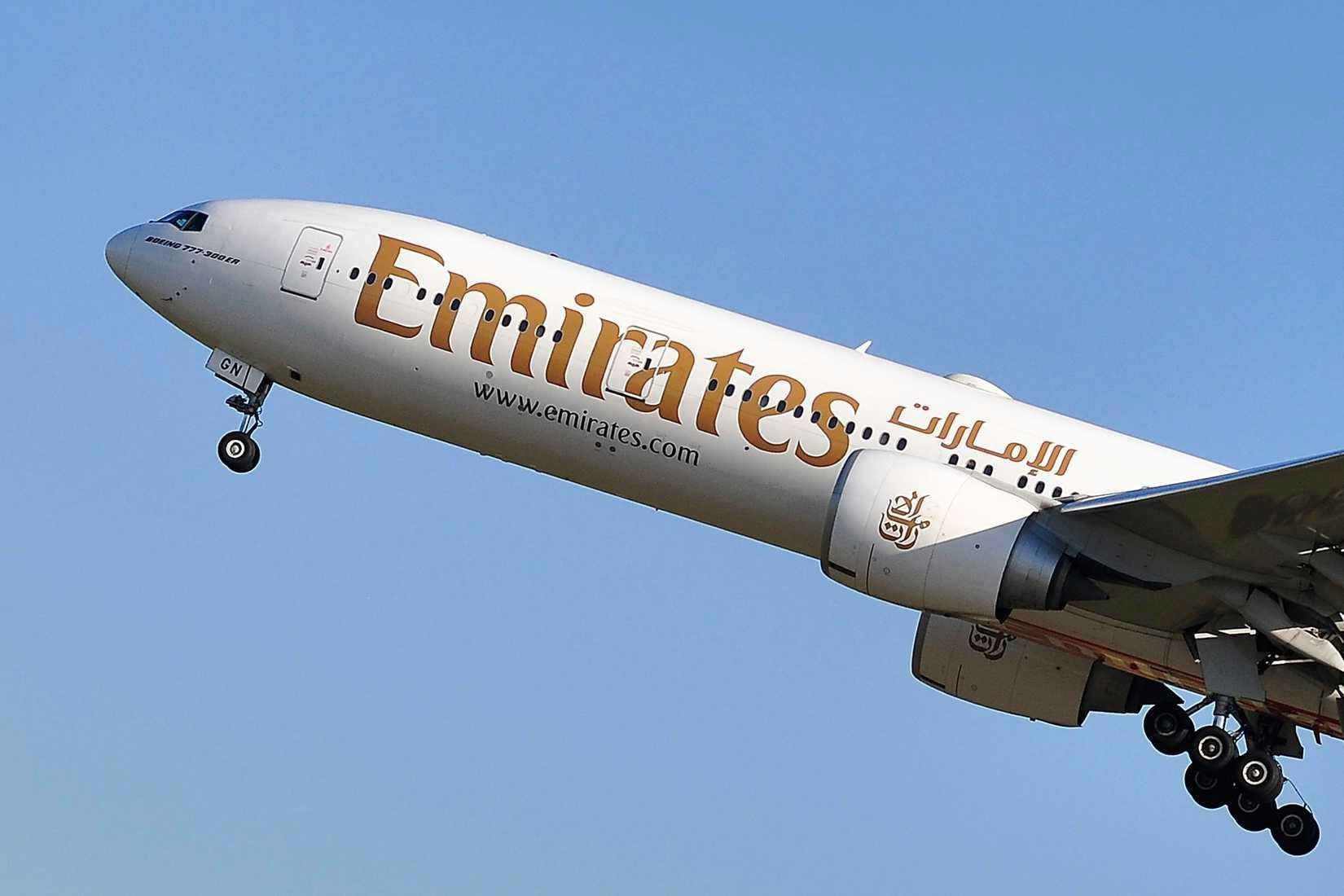
Assessing the Challenges of the Boeing 777-300
Assessing the Challenges of the Boeing 777-300
The Boeing 777 represents a landmark achievement in commercial aviation as the largest and most powerful twin-engine jet ever developed by the company. Since its debut, the 777 has become the world’s most-produced widebody aircraft, effectively bridging the capacity gap between Boeing’s 767 and 747 families while replacing older trijet models such as the Douglas DC-10 and Lockheed L-1011. Launched in 1990 by United Airlines and entering service in 1995, the 777 family has delivered 1,781 aircraft from 2,457 orders, securing its position as the best-selling widebody jet to date.
Variants and Market Performance
Boeing engineered the 777 in multiple variants to meet diverse airline requirements for range and passenger capacity. The original 777-200 was designed for high-volume domestic and regional long-haul routes, offering a range of up to 5,240 nautical miles. This was followed by the 777-200ER, which extended the range to 7,065 nautical miles, and the 777-200LR, known as the “Worldliner,” which pushed the limits further to 8,555 nautical miles. These models, alongside the highly successful 777-300ER, have become integral to airline fleets worldwide.
Despite the overall success of the 777 family, the 777-300 variant encountered significant commercial challenges. Introduced to serve a specific market niche, the 777-300 struggled to gain widespread adoption, with only 60 units sold. This limited demand prevented the model from recouping its development costs, especially when contrasted with the 777-300ER, which sold in the hundreds and emerged as one of the most popular widebody aircraft ever produced. The 777-300’s underperformance underscores the risks associated with developing aircraft tailored to narrow market segments.
Technological Innovations and Broader Challenges
The 777’s hallmark features—including large turbofan engines, raked wingtips, a six-wheel main landing gear, a circular fuselage, and advanced fly-by-wire controls—set new benchmarks in efficiency and operational performance. Nevertheless, Boeing faces challenges that extend beyond the performance of individual models.
Currently, Boeing’s commercial airplane division is contending with profitability difficulties, with expectations for a return to profit now postponed until 2027. This delay is largely attributed to increased costs following the acquisition of parts supplier Spirit AeroSystems. Market reactions have been mixed; some investors express concern over Boeing’s financial stability, while others remain optimistic about potential catalysts such as accelerated production of the 737 MAX and the prospect of achieving positive free cash flow by 2026.
Meanwhile, the competitive landscape remains fluid. Although direct responses from competitors are still uncertain, the undervaluation of Brazil’s aviation sector points to untapped growth potential in the region. This emerging opportunity could indirectly influence Boeing’s future market positioning.
The Boeing 777 family’s overall success is thus tempered by the commercial shortcomings of the 777-300 and ongoing financial pressures within Boeing’s commercial division. As the company navigates these challenges, its capacity to adapt and leverage emerging market opportunities will be critical to sustaining its leadership in the global aviation industry.

Etihad Airways Suspends Airbus A380 Flights on Key Route

Aditya Birla Group Seeks Approval for Aircraft Leasing in GIFT City

Qatar Airways Highlights Innovation and Connectivity at Arabian Travel Market 2026

Hong Kong's Five-Year Plan Includes Andrew Fan's Aircraft Parts Processing Hub Proposal

ACIA Aero Leasing Delivers ATR72-600 to Air Nostrum

RTX Appoints Jill Albertelli as Head of Pratt & Whitney

TAT Technologies Joins Beyond Aero Hydrogen Aircraft Program

AURAK Study Highlights Barriers to Air Taxi Adoption in Emerging Economies

Xiamen Air Selects Altitude for 787 Maintenance at Heathrow

Etihad and Swissport Extend Global Partnership
