
Orquesta conocimientos de IA para convertirlos en acción

Tendencias
Categories
China Approves Air Taxis as U.S. Faces Regulatory Delays
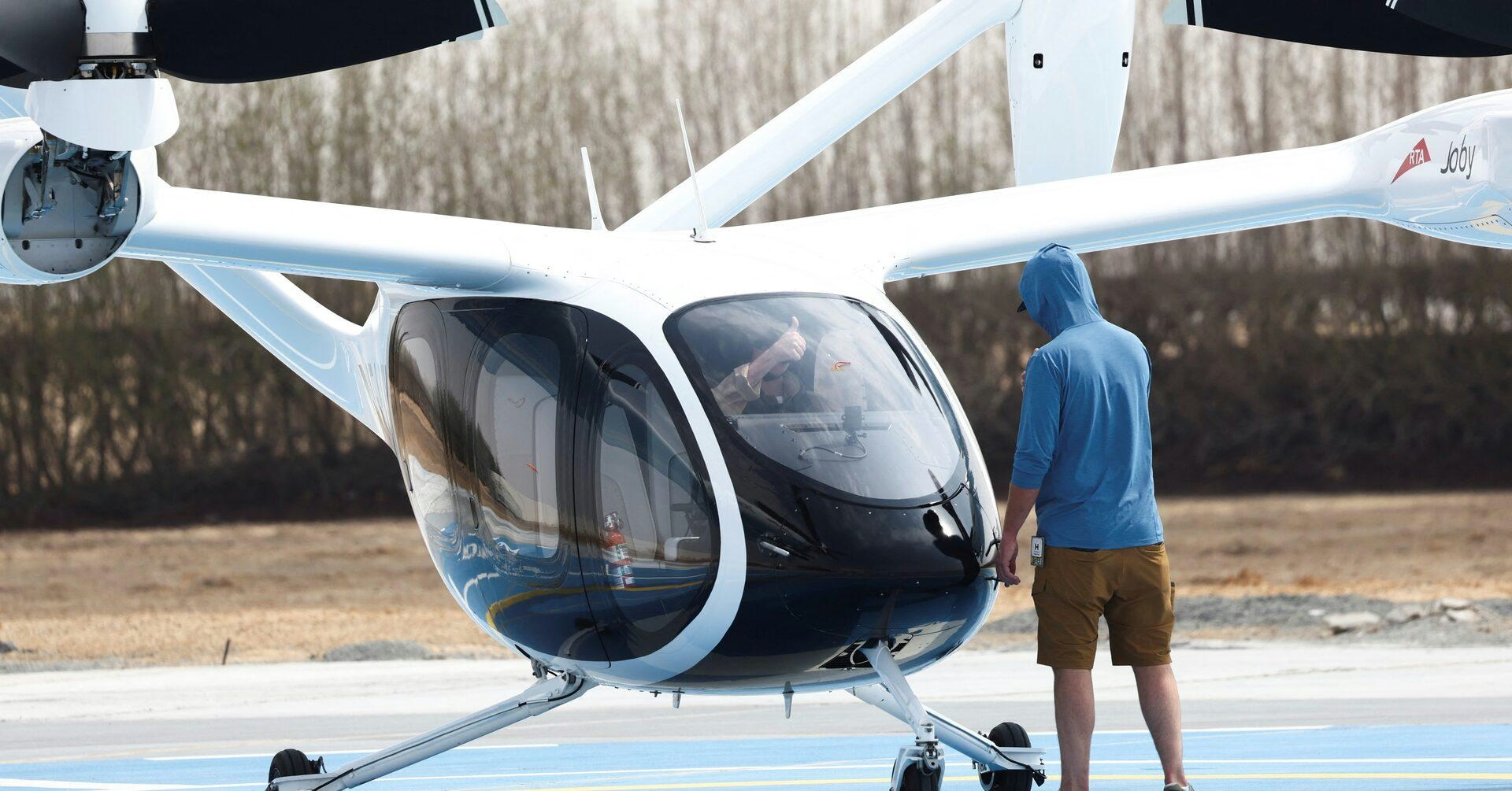
China Advances Air Taxi Commercialization Amid U.S. Regulatory Challenges
China has taken a decisive lead in the commercialization of air taxis by granting full certification to two Advanced Air Mobility (AAM) designs: EHang’s multirotor vehicle and AutoFlight’s winged multirotor. This development starkly contrasts with the United States, where the Federal Aviation Administration (FAA) has yet to approve any AAM aircraft beyond experimental use. The divergence highlights a growing regulatory gap between the two nations in the emerging field of urban and regional air transportation.
Regulatory Hurdles and Industry Challenges in the United States
The FAA faces significant challenges in certifying powered-lift aircraft, including electric vertical takeoff and landing (eVTOL) vehicles, which do not fit neatly into existing categories for airplanes or helicopters. The agency is therefore compelled to adapt its regulatory framework in real time. This process is further complicated by the Biden administration’s ambitious goal to demonstrate commercial AAM operations at the 2028 Los Angeles Olympics, a timeline that conflicts with the FAA’s typical five- to nine-year certification process for new aircraft types. To date, no AAM vehicle has received full FAA certification.
Compounding these regulatory delays are ongoing legal disputes among leading U.S. AAM companies such as Joby Aviation, Archer Aviation, and Vertical Aerospace. These conflicts threaten to slow certification efforts and undermine investor confidence. Meanwhile, the FAA has approved Honda’s all-electric air taxi, despite its limited 15-minute endurance, underscoring persistent industry-wide challenges related to battery technology and energy storage.
A recent Congressional Research Service (CRS) report underscores the complexity of certifying AAM aircraft in the United States, arriving as Chinese regulatory agencies move swiftly to bring air taxis to market. The report also highlights a critical gap in the FAA’s delegation structure: none of the leading U.S. AAM developers currently hold Organization Designation Authorization, a key program designed to streamline certification processes.
Legislative and Strategic Frameworks for Advanced Air Mobility
In 2022, Congress formally defined Advanced Air Mobility through the Advanced Air Mobility Coordination and Leadership Act, envisioning a transportation system that leverages advanced technologies—including electric and hybrid aircraft—to move people and goods across urban and regional routes. The FAA’s Innovate28 plan, released in July 2023, targets initial AAM operations by 2028. That same month, the agency updated air carrier regulations to permit passenger and cargo operations using powered-lift aircraft, followed by further regulatory changes scheduled for November 2024 and the establishment of a temporary Special Federal Aviation Regulation set to remain in force until 2035.
The FAA Reauthorization Act of 2024 introduced additional mandates, requiring the agency to publish a special final rule for AAM operations and to establish a powered-lift advisory committee. Recommendations from this committee are expected to influence future certification rules for electric, hybrid, and hydrogen propulsion systems. In December 2025, the Department of Transportation released a national AAM strategy outlining infrastructure and airspace management needs through 2036.
Despite these initiatives, a recent Government Accountability Office (GAO) report highlights ongoing uncertainty regarding the timeline for electric aircraft to enter commercial service in the United States. The four leading American companies—Archer, Beta Technologies, Joby, and Wisk Aero—are pursuing various certification pathways, with Wisk aiming to develop a fully autonomous, four-passenger aircraft.
Global Implications and the Pace of Innovation
While the U.S. regulatory environment remains in flux, China’s rapid approvals have established a new global benchmark in the AAM sector. This contrast is further reflected in the electric vehicle industry, where Tesla recently launched its "Full Self-Driving" capabilities in China after years of delays, whereas local Chinese EV manufacturers have already introduced proprietary self-driving technologies. These developments underscore China’s accelerating momentum in advanced mobility technologies, positioning the country at the forefront of the evolving transportation landscape.

Hong Kong's Five-Year Plan Includes Andrew Fan's Aircraft Parts Processing Hub Proposal

ACIA Aero Leasing Delivers ATR72-600 to Air Nostrum

RTX Appoints Jill Albertelli as Head of Pratt & Whitney

TAT Technologies Joins Beyond Aero Hydrogen Aircraft Program

AURAK Study Highlights Barriers to Air Taxi Adoption in Emerging Economies

Xiamen Air Selects Altitude for 787 Maintenance at Heathrow

Etihad and Swissport Extend Global Partnership

Sepehran Airlines B737 Returns to Mashhad After Tyre and Engine Issues

Etihad Deploys Widebody Fleet to Meet Strong Demand

Korean Air Finalizes $36.2 Billion Deal with Boeing
