
Orquesta conocimientos de IA para convertirlos en acción

Tendencias
Categories
China Joins Exclusive Group of Countries Producing Single-Crystal Blades for Advanced Aircraft Engines
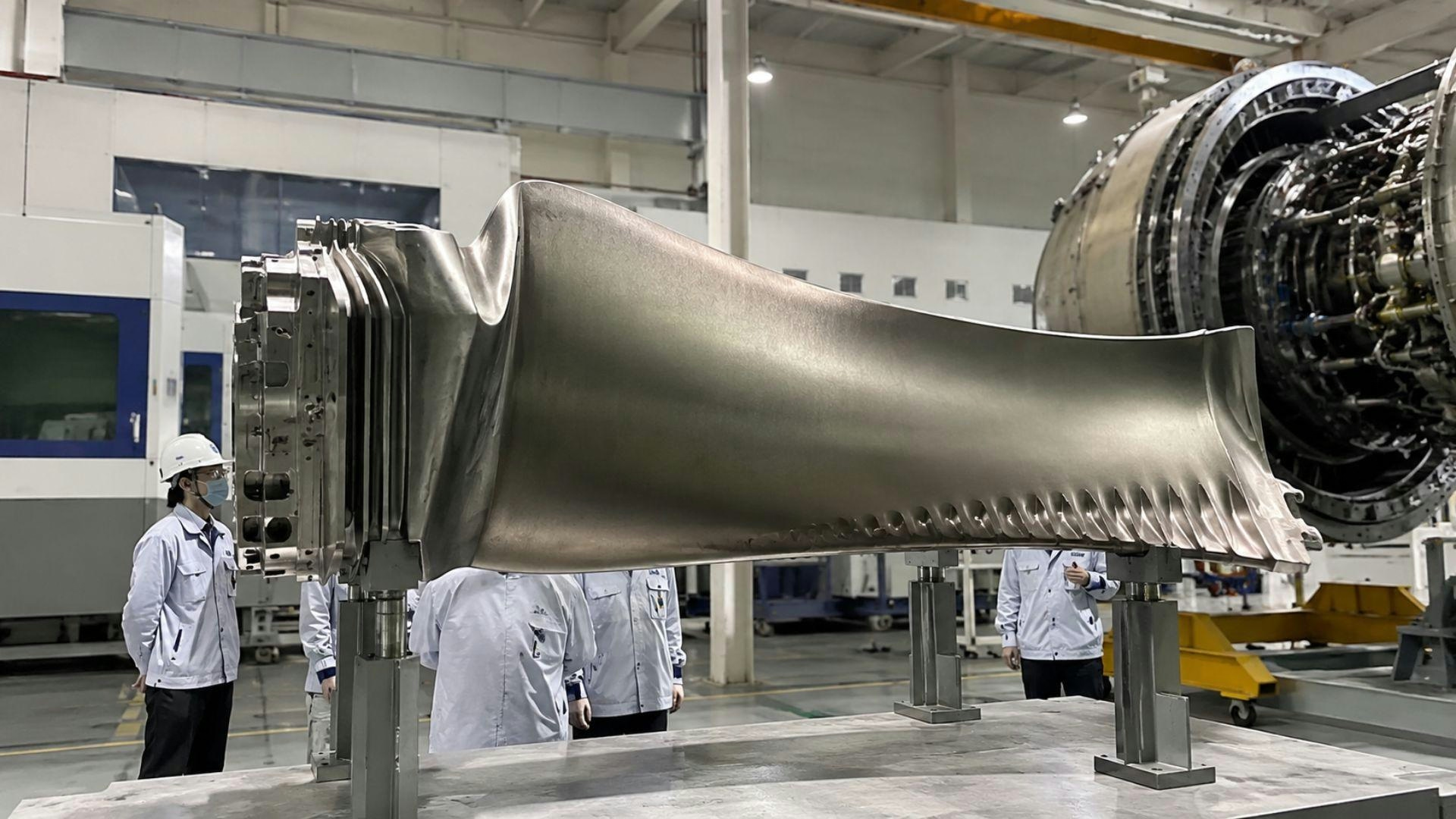
China Joins Elite Group in Producing Single-Crystal Blades for Advanced Aircraft Engines
China has announced a major technological milestone, declaring full mastery over the production of single-crystal turbine blades—critical components for high-performance aircraft engines. This development, reported by Chinese state media, places China among a select group of nations, including the United States, United Kingdom, Russia, and France, capable of independently developing, manufacturing, and deploying this advanced technology without reliance on foreign suppliers.
Significance of Single-Crystal Blades in Aerospace Engineering
Single-crystal blades are indispensable to the “hot section” of turbine engines, where temperatures reach extreme levels immediately following fuel combustion. Components in this area must withstand intense heat, high rotational speeds, severe pressure, and corrosive environments. The durability of these blades directly influences engine efficiency, power output, fuel consumption, reliability, and the operational lifespan of both military and civilian aircraft.
Unlike conventional metal parts composed of multiple crystalline grains, which contain boundaries that can weaken under stress, single-crystal blades are produced as a continuous crystal. This unique structure eliminates internal grain boundaries, significantly enhancing resistance to deformation and wear at elevated temperatures. Consequently, single-crystal blades are widely regarded as a technological benchmark in advanced aeronautical engines and represent a critical barrier to achieving industrial autonomy in aerospace manufacturing.
China’s Technological Breakthrough and Challenges Ahead
China’s recent advancement centers on the DD6 alloy, a nickel-based, second-generation monocrystalline superalloy developed by the AECC Beijing Institute of Aeronautical Materials. Engineered to improve mechanical strength, thermal stability, and corrosion resistance under extreme conditions, the DD6 alloy is claimed by the institute’s chief engineer, Li Jiarong, to match or exceed the performance of comparable Western alloys. However, these assertions are based on internal evaluations, with no independent public verification currently available to fully validate the DD6’s performance relative to its Western counterparts.
Despite this progress, China continues to face significant challenges in maintaining technological parity with established aerospace leaders in the United States and Europe. Ensuring consistent quality control to meet stringent international standards remains a formidable task, as does managing potential supply chain vulnerabilities that could disrupt production. These issues are critical as China endeavors to strengthen its position within the global aerospace market.
Implications for the Global Aerospace Industry
The international aerospace community is closely monitoring China’s advancements in single-crystal blade technology. Increased competition may affect major manufacturers such as Boeing and GE Aerospace, potentially prompting intensified research and development efforts or strategic partnerships among rival nations and companies seeking to protect their market share. Furthermore, China’s progress in this sensitive technological domain could exacerbate trade tensions, particularly if perceived as a challenge to the dominance of established players.
As China advances its capabilities in single-crystal blade production, the global landscape for advanced aircraft engines is likely to experience heightened competition and potential shifts in market dynamics.

Etihad Airways Suspends Airbus A380 Flights on Key Route

Aditya Birla Group Seeks Approval for Aircraft Leasing in GIFT City

Qatar Airways Highlights Innovation and Connectivity at Arabian Travel Market 2026

Hong Kong's Five-Year Plan Includes Andrew Fan's Aircraft Parts Processing Hub Proposal

ACIA Aero Leasing Delivers ATR72-600 to Air Nostrum

RTX Appoints Jill Albertelli as Head of Pratt & Whitney

TAT Technologies Joins Beyond Aero Hydrogen Aircraft Program

AURAK Study Highlights Barriers to Air Taxi Adoption in Emerging Economies

Xiamen Air Selects Altitude for 787 Maintenance at Heathrow

Etihad and Swissport Extend Global Partnership
