
Orquesta conocimientos de IA para convertirlos en acción

Tendencias
Categories
Seven-Year Delay Renders 30 Completed Boeing 777-9s Financially Obsolete
Seven-Year Delay Renders 30 Completed Boeing 777-9s Financially Obsolete
Certification Delays and Regulatory Challenges
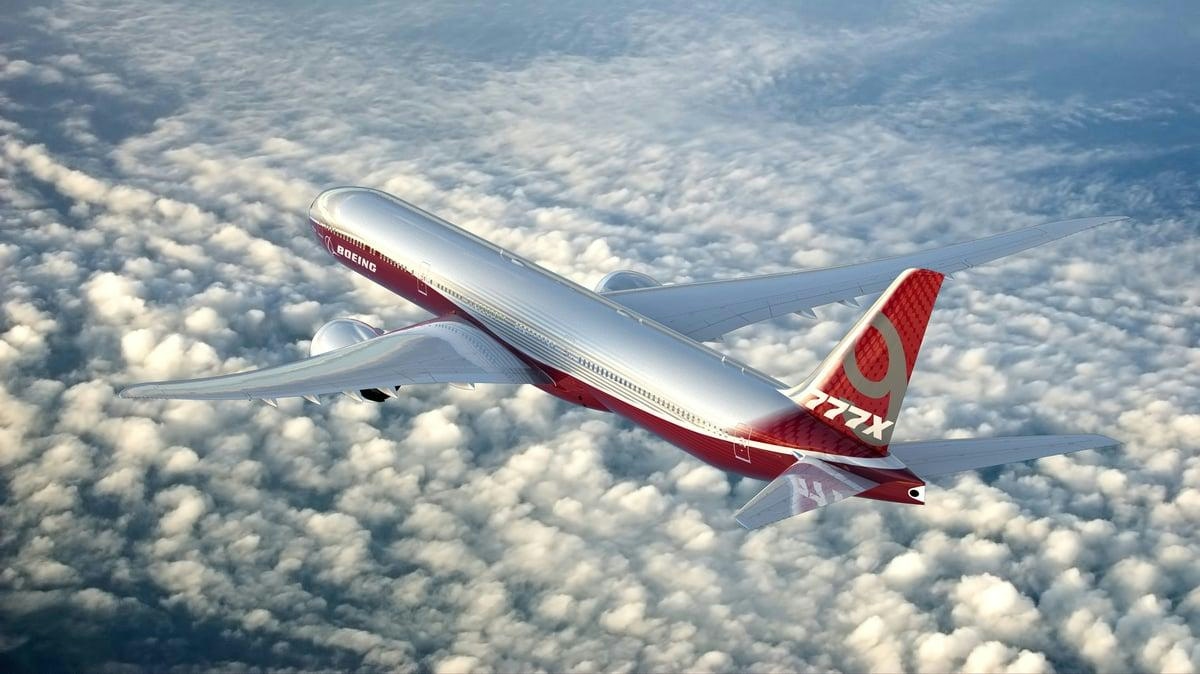
The 2026 Farnborough Airshow, while highlighting advancements in aviation technology and securing significant aircraft orders, also brought renewed attention to Boeing’s beleaguered 777X program. Emirates President Sir Tim Clark, a prominent customer, publicly rejected the first ten early-production Boeing 777-9s stored at Everett, likening them to “baked bean cans.” His pointed remark underscored a troubling reality: over 30 completed 777-9 aircraft, some already painted in customer liveries, have become financially obsolete without having flown a single commercial mile.
This predicament stems from a seven-year delay in certification that has fundamentally disrupted Boeing’s manufacturing and delivery plans. When the 777X program was launched in 2013, Boeing anticipated a relatively smooth regulatory process, expecting early production models to roll off the line by 2019 with only minor retrofits required before delivery. However, following the 737 MAX crisis, the Federal Aviation Administration (FAA) significantly overhauled its compliance standards. The agency abandoned its previous practice of delegated certification, subjecting every aspect of the 777-9 to rigorous scrutiny. This led to repeated shifts in the certified baseline design, forcing Boeing to continuously revise manufacturing drawings and leaving early 2019 and 2020 airframes increasingly misaligned with evolving regulatory requirements.
Manufacturing and Financial Implications
Boeing’s initial “build-and-store” strategy, designed to protect global supply chains, quickly became a logistical and financial burden. More than 30 early-build 777-9s have accumulated in storage at Paine Field, exposed to the damp climate of the Pacific Northwest. As these aircraft remained idle, their systems became technologically outdated, and the cost of upgrading them to meet the latest standards escalated dramatically. Far from generating revenue, these stored widebodies have instead consumed capital, contributing to an estimated $15 billion in accounting charges and program write-downs.
The process of “change incorporation”—retrofitting stored aircraft to comply with new certification standards—has proven far more complex and costly than initially anticipated. Unlike standard assembly, retrofitting requires engineers to dismantle completed cabins, cut into sealed structures, and remove intricate wiring to access components needing replacement. This labor-intensive procedure disrupts production economics and renders restoring early-build aircraft to airworthiness a formidable challenge.
Industry Impact and Future Outlook
Frustration among airlines over the 777X delays continues to mount, compounded by concerns regarding engine costs, maintenance delays, and overhaul bottlenecks. Emirates, the largest customer for the 777X, now anticipates receiving its first 777-9 deliveries in the second quarter of 2027—several years behind the original schedule. There is a growing risk that by the time these aircraft enter service, they may already be surpassed by newer technologies.
The FAA currently expects to certify the 777-9 late this year or early next year, but the damage to Boeing’s program is already extensive. More than 30 completed aircraft remain in limbo, requiring extensive and costly modifications before they can be deployed commercially. The 777X saga serves as a cautionary example of how regulatory upheaval, production miscalculations, and rapid technological change can combine to render even the most advanced airliners obsolete before their inaugural flight.

Etihad Airways Suspends Airbus A380 Flights on Key Route

Aditya Birla Group Seeks Approval for Aircraft Leasing in GIFT City

Qatar Airways Highlights Innovation and Connectivity at Arabian Travel Market 2026

Hong Kong's Five-Year Plan Includes Andrew Fan's Aircraft Parts Processing Hub Proposal

ACIA Aero Leasing Delivers ATR72-600 to Air Nostrum

RTX Appoints Jill Albertelli as Head of Pratt & Whitney

TAT Technologies Joins Beyond Aero Hydrogen Aircraft Program

AURAK Study Highlights Barriers to Air Taxi Adoption in Emerging Economies

Xiamen Air Selects Altitude for 787 Maintenance at Heathrow

Etihad and Swissport Extend Global Partnership
