Imagen

Orquesta conocimientos de IA para convertirlos en acción

¡Únete hoy a la lista de espera de AeroGenie!

Tendencias

Categories

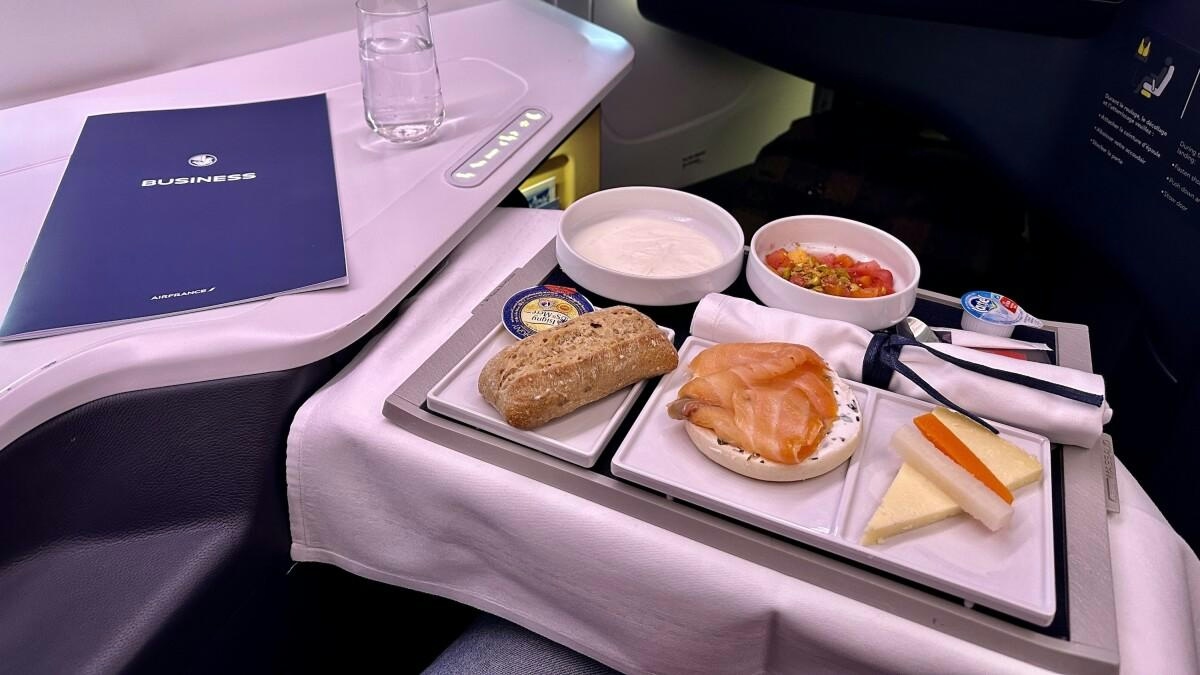
Sunclass Airlines Innovates Onboard Catering Amid Airport Competition
February 19, 2026By ePlane AI
Sunclass Airlines Innovates Onboard Catering Amid Airport Competition
0
0
Sunclass Airlines
Onboard Catering
Airport Competition

Sunclass Airlines Innovates Onboard Catering Amid Intensifying Airport Competition

Sunclass Airlines, a prominent operator in Scandinavian leisure travel, is overhauling its onboard catering strategy in response to mounting competition from airport food outlets and evolving passenger preferences. The airline, which primarily operates charter flights connecting Nordic travelers to warmer destinations across Europe and beyond, faces shifting market dynamics and operational challenges that demand a fresh approach to inflight meal services.

Responding to Changing Passenger Behavior and Market Pressures

Tobias Ögren, head of inflight product and catering at Sunclass Airlines, points to a significant decline in pre-order meal uptake, attributing this trend to the expanding and increasingly assertive food offerings available within airport terminals. Passengers, often utilizing mobile applications, are more inclined to purchase food at the airport and bring it onboard, thereby challenging traditional airline catering models. “The offerings from the airports are getting bigger, and they are also getting more aggressive with their communication,” Ögren explains.

In response, Sunclass is focusing on enhancing the value and variety of its onboard menu. Internal testing indicates that pre-booked meals are frequently more affordable and convenient than airport alternatives, a message now central to the airline’s pre-departure communications. This strategy aims to reclaim market share from airport vendors, particularly in major hubs such as Chicago O’Hare, where competition among carriers like United and American Airlines is especially fierce.

Innovation and Collaboration as Strategic Pillars

Innovation lies at the core of Sunclass’s renewed catering approach. The airline is experimenting with lighter, more flexible meal options—including burgers, kebab rolls, and pizza slices—that reflect popular terminal choices. Industry events such as the World Travel Catering and Onboard Services Expo (WTCE) have become vital platforms for Sunclass to explore new products, engage with suppliers, and address operational challenges. Ögren emphasizes the value of these gatherings: “We’re trying to challenge [airport catering] by looking into new meal alternatives that passengers might find in the terminal. That’s where I think the show [WTCE] is very good, because you get new ideas and can meet up with new potential suppliers who can assist you.”

WTCE has also fostered direct collaboration with partners, exemplified by a meeting with Marfo that resulted in the creation of a bespoke onboard burger, now a staple of Sunclass’s light meal offerings. “It can sometimes be that straightforward,” Ögren reflects, highlighting the importance of face-to-face industry engagement.

Beyond menu innovation, Sunclass is exploring new revenue streams, including a revamped buy-on-board program inspired by serendipitous encounters with emerging brands at WTCE. These initiatives come at a critical time as the broader foodservice industry contends with rising labor costs, supply chain disruptions, and increasing pressure to reduce waste—factors that directly affect airline catering operations.

As Sunclass navigates these complexities, its efforts to align onboard offerings with changing customer expectations and operational realities underscore the airline’s commitment to maintaining competitiveness in a rapidly evolving travel environment.

More news
Ontic COO Discusses Building Resilient Aviation Supply Chains

Ontic COO Discusses Building Resilient Aviation Supply Chains

Ontic COO Discusses Building Resilient Aviation Supply Chains Navigating Increasing Pressures on Aviation Supply Chains In the contemporary aviation sector, the resilience of supply chains has become as vital as operational efficiency. Brian Sartain, Chief Operating Officer at Ontic, underscores the growing challenges confronting aviation supply chains and details how Ontic is striving to secure long-term reliability for its clientele. The aviation supply chain is currently experiencing sustained pressure from multiple sources. Demand has surged sharply, with production volumes in many areas now meeting or surpassing pre-pandemic levels. This heightened demand is placing unprecedented strain on suppliers, many of whom are tasked with delivering quantities beyond their previous experience. Specialized suppliers, in particular, face the difficult task of supporting both established and emerging platforms while contending with limited resources and minimal capacity for rapid expansion. These challenges are further exacerbated by inflationary trends. Rising costs for materials, energy, labor, and logistics have complicated procurement processes. Aerospace components often require mature material specifications, rare alloys, or restricted minerals, making sourcing increasingly complex and costly. Currency fluctuations affect purchasing power, while volatility in raw material prices leads to unpredictable component costs. Additionally, fuel procurement remains a significant financial burden for airlines, adding another layer of economic pressure. Regulatory, Geopolitical, and Talent Challenges Beyond economic factors, geopolitical shifts and evolving regulatory frameworks contribute to the complexity of maintaining resilient supply chains. Aviation regulations are particularly stringent, often necessitating months or even years to navigate. The substantial time and investment required to rebuild or adapt supply network capacity leave little room for rapid adjustments. Unlike other industries, aerospace cannot easily switch suppliers or redesign components without incurring significant costs, delays, and regulatory obstacles. The imperatives of performance, certification, and safety are non-negotiable, rendering resilience a strategic imperative. Talent shortages compound these difficulties. The industry depends on highly specialized skills, including machinists capable of working to exacting tolerances, technicians proficient in programming legacy equipment, and engineers knowledgeable in both traditional and modern technologies. Experts in supply chain risk management are also scarce. As these critical skills become increasingly rare, supplier capacity tightens, lead times lengthen, and overall supply chain resilience diminishes. A Strategic Approach to Long-Term Resilience Economic pressures demand continuous adaptation from aviation businesses. For operators and original equipment manufacturers (OEMs), the challenge extends beyond securing parts to ensuring sustained confidence in supply. Resilience now requires a proactive and flexible strategy that aligns suppliers with the unique demand profiles, technical complexities, and life-cycle expectations of each platform. Sartain emphasizes that these challenges represent a structural transformation rather than temporary disruptions. Building resilient aviation supply chains involves long-term engineering—anticipating risks, investing in talent, and developing sourcing strategies capable of withstanding economic, regulatory, and geopolitical shocks. For Ontic and the broader industry, resilience is not merely an objective but an essential condition for delivering a lifetime of flight.
AI Firms Acquire Defunct Airlines’ Emails and Digitize Historical Books

AI Firms Acquire Defunct Airlines’ Emails and Digitize Historical Books

AI Firms Acquire Defunct Airlines’ Emails and Digitize Historical Books Acquisition of Spirit Airlines’ Digital Archives Google has confirmed the purchase of internal data from Spirit Airlines for $10 million to enhance its artificial intelligence models. Spirit Airlines, a budget carrier that ceased operations in May due to escalating jet fuel prices and mounting debt, is selling an extensive collection of digital records. This dataset includes hundreds of millions of employee emails, Microsoft Teams messages, spreadsheets, calendars, and operational data. Google has assured that all information will be anonymized prior to its use. The value of such enterprise data has surged as AI developers exhaust publicly available internet sources for training material. The Spirit Airlines dataset attracted intense competition, with Google outbidding data labeling startup Mercor, which had offered $7.5 million. Industry experts observe that defunct companies often leave behind vast digital archives—ranging from codebases and email threads to Slack messages and IT tickets—that provide an authentic snapshot of workplace communication and operations. Startups like SimpleClosure and Sunset, which specialize in business wind-downs, now routinely acquire these digital assets for AI training purposes. This emerging trend is prompting a reassessment of corporate asset management, particularly in bankruptcy proceedings. As distressed companies monetize their digital records, competitors are reevaluating the worth of their own data archives and facing increased scrutiny over similar acquisition strategies. Legal and ethical questions are also surfacing, especially concerning privacy, fair use, and copyright. The destruction of rare books and historical materials for AI training has ignited debate among archivists and ethicists, who express concern over balancing cultural heritage preservation with commercial data demands. Financial Growth and Industry Developments Anthropic, the AI firm behind the coding agent Claude Code, has experienced a remarkable surge in revenue, reaching a run rate of $65 billion by the end of July, up from $47 million in May, according to Bloomberg. This rapid growth, driven by the popularity of its coding technology, has positioned Anthropic as a leading contender in the AI sector, with plans to go public later this year. For context, OpenAI’s annualized revenue recently surpassed $40 billion. Reuters reports that Anthropic projects revenues of approximately $200 billion by 2028. Meanwhile, AI video generation startup Higgsfield has secured $400 million in Series B funding at a $5.4 billion valuation. The round was led by DST Global, with participation from Valor Capital, Goldman Sachs Capital, Menlo Ventures, and Accel. Launched in early 2025, Higgsfield has achieved $700 million in annualized revenue within just 16 months. In a separate transaction, payments giant Stripe has finalized the acquisition of OpenRouter—a startup that enables companies to switch between AI models—for over $7 billion, mere months after OpenRouter’s last funding round valued the company at $1.3 billion. Personalities Behind the AI Boom Camilla Clark, wife of Anthropic CEO Dario Amodei, remains largely out of the public spotlight. Recent profiles have shed light on her entrepreneurial background, which includes ventures such as a luxury adult entertainment company and a social dieting app. Clark also played a pivotal role in connecting former Google CEO Eric Schmidt with Amodei, facilitating Schmidt’s investment in Anthropic’s Series A funding. She is reported to be a key adviser to Amodei, providing counsel as the company experiences rapid growth. As AI firms continue to compete for new sources of training data, the monetization of digital records from defunct companies and historical archives is reshaping the technology industry and intensifying discussions around data ethics and corporate responsibility.
Google and UK Collaborate to Address Aviation’s Climate Impact

Google and UK Collaborate to Address Aviation’s Climate Impact

Google and UK Collaborate to Address Aviation’s Climate Impact Contrails, the white streaks trailing behind aircraft, form when water vapor condenses around microscopic pollutant particles emitted by airplane engines. Once considered a benign aspect of air travel, these condensation trails are now recognized as a significant contributor to global warming. According to Google and its partners, contrails account for approximately one third of aviation’s total climate impact by trapping heat in the atmosphere and accelerating climate change. Operation Blue Skies: A Collaborative Research Initiative In response to this environmental challenge, Google has partnered with the UK government and leading aviation organizations to launch Operation Blue Skies, a 30-month research program aimed at reducing aviation’s climate footprint. The initiative will concentrate on the northeastern Atlantic Ocean, where hundreds of commercial flights will participate in trials over the next two winters. The program’s primary approach involves making subtle adjustments to flight altitudes to reduce contrail formation. Air traffic controllers will guide aircraft to avoid atmospheric conditions conducive to contrail development. Central to this effort is Google’s artificial intelligence technology, which will provide real-time forecasts predicting when and where contrails are likely to form, enabling more informed routing decisions. Potential Impact and Future Implications Operation Blue Skies aims to demonstrate that even minor modifications in flight paths can yield measurable environmental benefits. Scientific estimates attribute between 1% and 2% of global warming to contrails, underscoring the importance of targeting their reduction within the aviation sector. By combining advanced AI capabilities with close cooperation among technology companies, government agencies, and the aviation industry, the initiative seeks to establish a model for sustainable air travel. If successful, the findings from Operation Blue Skies could influence broader policy and operational changes worldwide, contributing to efforts to mitigate aviation’s role in climate change on a global scale.
U.S. Army Orders 12 Airbus UH-72B Lakota Helicopters in $140.7 Million Contract

U.S. Army Orders 12 Airbus UH-72B Lakota Helicopters in $140.7 Million Contract

U.S. Army Awards $140.7 Million Contract for 12 Airbus UH-72B Lakota Helicopters The U.S. Army has awarded Airbus a contract valued at up to $140.7 million for the procurement of 12 new UH-72B Lakota helicopters, reinforcing its light utility helicopter fleet. The initial contract amount stands at $115.4 million, with additional options that could bring the total value to the upper limit. This agreement encompasses the delivery of aircraft, associated equipment, and program management services. Production and support operations will be conducted at Airbus’s facility located at Redstone Arsenal in Alabama, with activities scheduled to continue through December 2030. Advancements and Operational Role of the UH-72B Lakota The UH-72B Lakota represents the latest iteration in the Lakota helicopter family, tailored for a variety of non-combat missions. These include training, personnel transport, liaison duties, surveillance, search and rescue, and aeromedical evacuation. The aircraft also plays a critical role in domestic operations, particularly in support of civil authorities through the Army National Guard. This procurement marks a transition from the older UH-72A models to the more advanced UH-72B variant. The upgrade introduces several significant enhancements, such as a five-blade main rotor derived from the Airbus H145 family, a Fenestron tail rotor designed to improve safety and performance, and twin Safran Arriel 2E engines equipped with Full Authority Digital Engine Control (FADEC) systems for superior propulsion management. While these improvements promise enhanced operational capabilities, the transition may pose logistical and integration challenges as the Army phases out legacy platforms and incorporates new technologies. Strategic Implications and Market Context The multi-year contract structure ensures a consistent supply of Lakota helicopters to support Army missions through the end of the decade, funded by fiscal year 2024 and 2025 aircraft acquisition programs. This approach aligns with the Army’s broader modernization strategy rather than constituting a one-time procurement. Industry analysts observe that the Army’s sustained investment in the UH-72B could stimulate demand for its advanced features, including ejectable cabin doors, air conditioning systems, and barrier filters for engine air intakes. Meanwhile, competitors such as AgustaWestland are expected to promote alternative training and utility helicopter platforms in an effort to capture a portion of the U.S. military market. As production continues in Alabama, the UH-72B Lakota is poised to maintain a vital role in Army aviation, supporting a diverse range of missions while enhancing operational flexibility and readiness well into the coming decade.
FlightPath3D Expands Partnership with Gogo

FlightPath3D Expands Partnership with Gogo

FlightPath3D Expands Partnership with Gogo Amid Competitive and Regulatory Challenges FlightPath3D, a global leader in moving map technology, has announced an expansion of its partnership with Gogo, a leading provider of business aviation connectivity infrastructure. Since their initial collaboration in 2020, the companies have reached a significant milestone: FlightPath3D’s mobile-first moving map is now installed on over 1,000 aircraft equipped with Gogo Vision worldwide. Enhancing the Inflight Experience The interactive mapping solution is fully integrated with the Gogo Vision inflight entertainment system, allowing passengers to access real-time flight tracking and destination information on personal devices such as laptops, tablets, and smartphones. Designed for the modern connected cabin, the service enables passengers to explore their journey without using personal or operator data plans. Multilingual support further enriches the experience for international travelers. FlightPath3D’s technology is engineered for seamless operation across various devices, platforms, and browsers. Its intuitive, mobile-first interface leverages Gogo’s over-the-air content and software delivery system, enabling flight departments to update the onboard passenger experience without requiring aircraft downtime. The mapping solution forms a core component of the Gogo Vision inflight entertainment portfolio, supporting both standard and enhanced map experiences available through Gogo Vision+ and Vision 360. Navigating Market and Regulatory Dynamics As business aviation operators increasingly seek digital cabin experiences that rival the convenience and functionality of ground-based services, the expanded partnership aims to meet these evolving passenger expectations. However, FlightPath3D faces several challenges in deepening its collaboration with Gogo. The company must contend with competition from other inflight entertainment and connectivity providers, ensure smooth integration with diverse business aviation systems, and adapt to ongoing regulatory changes affecting aviation technology. Market responses to the partnership’s expansion may include increased scrutiny from investors regarding its financial implications, while competitors may enhance their own offerings to maintain market share. Despite these challenges, FlightPath3D’s strengthened alliance with Gogo positions both companies to address the growing demand for sophisticated and user-friendly inflight digital experiences. With its scalable, device-agnostic technology and commitment to continuous innovation, FlightPath3D remains a trusted provider of passenger mapping solutions as the business aviation sector continues to evolve.
IFPL Group Celebrates 30 Years of Aircraft Cabin Engineering on Isle of Wight

IFPL Group Celebrates 30 Years of Aircraft Cabin Engineering on Isle of Wight

IFPL Group Celebrates 30 Years of Aircraft Cabin Engineering on the Isle of Wight IFPL Group is commemorating three decades of pioneering aircraft cabin engineering from its headquarters on the Isle of Wight. Established in 1996 by Geoff Underwood OBE, the company began as a modest operation in a garage, driven by a mission to address practical challenges faced by airlines through innovative engineering solutions. Over the years, IFPL has evolved into a globally recognized supplier of aircraft cabin technology, with its products installed on aircraft around the world. Innovations Shaping the Aircraft Cabin Experience A defining moment in IFPL’s early history was the creation of its patented Long Life Audio Jack, which resolved longstanding reliability issues in aircraft cabins. This breakthrough significantly enhanced durability and reduced maintenance requirements, setting a new industry benchmark and cementing IFPL’s reputation for delivering practical, high-performance engineering solutions. Since then, IFPL has broadened its product range to include advanced cabin interior technologies such as the Reversible USB-A connector, the Transform in-seat power system, and Cobalt Spectrum LED mood lighting. These innovations are designed to elevate passenger comfort, improve operational efficiency, reduce aircraft weight, and simplify installation and maintenance processes for airlines and operators. Commitment to Real-World Engineering and Industry Recognition Founder and CEO Geoff Underwood has consistently emphasized the company’s philosophy of designing products that perform reliably in real operating environments. “If you understand the real operating environment and engineer for it properly, you can make a meaningful difference for both passengers and operators,” he stated. This pragmatic approach has been central to IFPL’s sustained growth and success. Operating from two purpose-built facilities, IFPL employs a highly skilled workforce with comprehensive in-house capabilities encompassing design, prototyping, manufacturing, and testing. The company’s dedication to craftsmanship and long-term innovation has been recognized with five Queen’s Awards for Enterprise. This milestone year also follows Underwood’s recent appointment as an OBE for services to the technology industry, underscoring IFPL’s significant impact on aviation technology. Navigating Market Dynamics and Future Prospects IFPL’s 30th anniversary coincides with a period of rapid evolution in the aircraft cabin interiors market, which is projected to reach USD 38 billion by 2031. This growth is driven by airlines’ ongoing investments in fleet modernization and cabin upgrades. As the company looks ahead, it faces the challenge of maintaining its competitive edge amid evolving regulatory standards and potential supply chain disruptions, while continuing to innovate. Market demand for IFPL’s solutions is expected to increase as airlines prioritize enhanced passenger experience and operational efficiency. At the same time, competitors are intensifying research and development efforts and pursuing strategic partnerships to remain competitive in this dynamic sector. Throughout 2026, IFPL will mark its 30-year journey with a series of editorials and articles highlighting the people, products, and milestones that have defined the company. As it celebrates this significant anniversary, IFPL remains committed to advancing aircraft cabin technology, focusing on intelligent power systems, connected cabins, and sustainable, energy-efficient solutions—continuing its legacy of innovation and excellence in aviation engineering.
"Without an Engine, There Is No Aircraft Industry," Says Gusarov on the PD-8

"Without an Engine, There Is No Aircraft Industry," Says Gusarov on the PD-8

"Without an Engine, There Is No Aircraft Industry," Says Gusarov on the PD-8 A Milestone for Russian Aviation The Russian aviation sector has marked a pivotal achievement with the delivery of the first two production PD-8 engines intended for the SJ-100 aircraft. Developed as a domestic replacement for the Franco-Russian SaM146 engine, the PD-8 represents a critical component in Russia’s broader strategy to establish a fully import-substituted passenger airliner. This development underscores the country’s ambition to reduce reliance on foreign technology and strengthen its aerospace industry. Roman Gusarov, a noted aviation expert, emphasized the significance of the PD-8’s introduction, describing it as a foundational moment for the industry. He stated, “It is the appearance of a production power unit that allows us to talk about the real prospect of a new Superjet. You can build as many aircraft as you want, but without an engine, it’s worth nothing.” The installation of the first PD-8 engine on an initial production aircraft marks a tangible advancement for the Superjet New project, signaling progress toward operational independence. Technological Development and Production Challenges The creation of the PD-8 engine involved mastering advanced materials and manufacturing technologies, achieved through close collaboration with scientific institutions and metallurgical enterprises. The current focus extends beyond the production of individual engines to establishing a sustainable manufacturing cycle that can support the ongoing needs of the SJ-100 program. In addition to powering new aircraft, the PD-8 is under consideration for retrofitting existing Superjet 100s currently equipped with the SaM146 engine. Gusarov estimates that modernization efforts could be applicable to between 50 and 100 aircraft, contingent on the age and economic feasibility of each airframe. He remarked, “There are younger aircraft that still have half their life ahead of them; it’s a shame to write them off. If re-engining pays off, then it makes sense to invest in it.” Economic and Operational Considerations Despite the technical progress, the economic justification for retrofitting remains a subject of debate. Andrey Patrakov, a former Airbus auditor and head of the RunAvia flight safety service, expressed skepticism regarding the financial benefits of replacing the SaM146 with the PD-8, describing the cost-effectiveness of such upgrades as “highly questionable.” Industry analysts also highlight challenges related to the PD-8’s operational track record. The engine currently lacks extensive long-term service data, which is crucial for identifying potential structural vulnerabilities and determining its lifespan. While the PD-8 is viewed by some as a landmark achievement for Russia’s aerospace ambitions, others stress the necessity of demonstrating its durability and reliability under real-world operating conditions. Strategic Implications The successful certification and delivery of the PD-8 places Russia among a select group of countries capable of independently designing and manufacturing aeronautical engines. As the PD-8 enters commercial service, its performance will be closely monitored not only as a symbol of technological sovereignty but also as a critical test of its viability and competitiveness in the global aviation market.
GMF AeroAsia Delivers Upgraded C-130H to Indonesian Air Force

GMF AeroAsia Delivers Upgraded C-130H to Indonesian Air Force

GMF AeroAsia Delivers Upgraded C-130H to Indonesian Air Force GMF AeroAsia has completed the delivery of an upgraded C-130H Hercules transport aircraft to the Indonesian Air Force, marking a pivotal advancement in the country’s efforts to modernize its military fleet. This milestone reflects Indonesia’s strategic intent to enhance its airlift capabilities amid shifting regional security challenges. Navigating Procurement Challenges and Geopolitical Constraints The delivery arrives in the context of longstanding obstacles faced by Indonesia’s military procurement processes. Historically, arms embargoes have limited access to essential defense technologies, causing delays in modernization initiatives. GMF AeroAsia’s successful upgrade and delivery of the C-130H underscore the company’s technical expertise and its ability to operate effectively within a complex geopolitical landscape. Indonesia’s continued dependence on foreign military equipment remains a subject of scrutiny. While the upgraded C-130H improves operational readiness, it also raises important questions about national sovereignty and the sustainability of relying on external suppliers for critical defense assets. This dependence has fueled ongoing debates within Indonesia regarding the balance between addressing immediate operational requirements and advancing greater self-reliance in defense manufacturing. Implications for the Defense Industry and Operational Capabilities The delivery of the upgraded aircraft intensifies competition among aerospace firms vying for a presence in Indonesia’s defense sector. GMF AeroAsia’s achievement sets a new standard, likely prompting competitors to offer more competitive pricing and advanced technologies in future procurement bids. This competitive environment is expected to stimulate innovation and influence Indonesia’s strategic decisions as it seeks to expand and modernize its air force. Despite the challenges, the upgraded C-130H is anticipated to significantly enhance the Indonesian Air Force’s capacity to undertake diverse missions, ranging from humanitarian assistance to strategic transport operations. The project highlights the vital role of domestic aerospace capabilities in supporting national defense goals, even as Indonesia continues to manage the complexities of international defense partnerships and market competition.
National Aerospace Corporation to Develop MRO Digitalization and Low-Altitude Economy Roadmaps

National Aerospace Corporation to Develop MRO Digitalization and Low-Altitude Economy Roadmaps

National Aerospace Corporation to Develop MRO Digitalization and Low-Altitude Economy Roadmaps KUALA LUMPUR (Aug 19) — The National Aerospace Corporation Malaysia (Naico), operating under the Ministry of Investment, Trade and Industry (Miti), has announced plans to develop two comprehensive national roadmaps aimed at strengthening and futureproofing the country’s aerospace sector. These initiatives include the Maintenance, Repair and Overhaul (MRO) Digitalization Roadmap, which seeks to modernize the MRO industry, and the Low-Altitude Economy (LAE) Roadmap, designed to cultivate the ecosystem for urban air mobility, encompassing drones and unmanned aerial vehicles (UAVs). Modernizing the MRO Sector The MRO Digitalization Roadmap is slated for completion within six months and targets a sector that generated approximately RM13 billion in revenue in 2025, representing 40% of Malaysia’s total aerospace revenue. Despite its economic significance, the MRO industry currently trails behind global digitalization standards, with many local operators still dependent on manual and conventional workflows. This reliance on outdated processes has resulted in longer turnaround times, increased operational costs, and diminished competitiveness in an increasingly data-driven and automated market. Shamsul Kamar Abu Samah, CEO of Naico Malaysia, underscored the urgency for the industry to embrace advanced technologies such as predictive maintenance, digital twins, automation, artificial intelligence, robotics, and advanced manufacturing. To facilitate this transition, Naico is conducting a national technology and digital readiness assessment for local MRO companies. This study will also evaluate financing mechanisms, including public-private partnerships and joint financing frameworks, to enable small and medium enterprises to adopt digital operations affordably. The roadmap will be benchmarked against leading global MRO hubs, including Singapore, Japan, China, and Germany. However, the sector faces significant challenges, notably ongoing global supply chain disruptions highlighted in recent reports by Honeywell Aerospace. These disruptions threaten to delay the adoption of new technologies and could undermine the overall competitiveness of Malaysia’s MRO industry. Building the Low-Altitude Economy Parallel to the MRO initiative, the LAE Roadmap aims to develop Malaysia’s urban air mobility ecosystem through a phased implementation plan extending to 2040. Drawing on international best practices from countries such as China, Japan, and the United Kingdom, the roadmap seeks to position drones and UAVs as high-value investment opportunities while reinforcing the nation’s aerospace value chain. Deputy Minister of Investment, Trade and Industry Sim Tze Tzin emphasized the sector’s growth potential, noting that under Malaysia’s Drone Technology Action Plan, the drone and UAV ecosystem alone is projected to contribute RM50.71 billion to the national GDP and generate 100,000 high-skilled jobs by 2030. This strategic push towards digitalization and urban air mobility coincides with intensifying competition from emerging players like Skyla, which recently unveiled an eVTOL mockup, signaling heightened interest in advanced air mobility technologies. Industry analysts suggest that established aerospace companies may respond by leveraging expertise from the defense and space sectors to maintain their competitive advantage. As Malaysia advances its aerospace ambitions, the successful implementation of these roadmaps will hinge on overcoming supply chain constraints, securing adequate investment, and adapting swiftly to rapid technological developments within a fiercely competitive global market.
Second Airliner Damages Runway Lights at Munich Days After Boeing 787 Incident

Second Airliner Damages Runway Lights at Munich Days After Boeing 787 Incident

Second Airliner Damages Runway Lights at Munich Days After Boeing 787 Incident Incident Overview Munich Airport has become the focus of aviation safety concerns following two separate runway incidents within a span of 48 hours. On Monday, August 17, a Lufthansa Airbus A380 damaged runway approach lights during landing on Runway 26L, just two days after a Vietnam Airlines Boeing 787 experienced a similar event on the same runway. German aviation authorities have initiated investigations into both occurrences, raising questions about runway safety and operational protocols at the busy international hub. Flight LH459, arriving from San Francisco with 351 passengers and crew, was on final approach to Runway 26L at approximately 5:10 p.m. local time after a transatlantic flight lasting around ten hours. Preliminary findings indicate that the A380 (registration D-AIML) touched down short of the designated threshold, causing its landing gear to strike and damage several approach lights located in the paved chevron area preceding the main landing zone. Despite the low touchdown, the flight crew maintained full control of the aircraft, which taxied safely to its gate. No injuries were reported, and no emergency evacuation was necessary. The aircraft remains grounded at Munich for technical inspections and repairs to the landing gear. Previous Incident and Comparative Analysis The Lufthansa incident follows closely on the heels of a related event on Saturday, August 15, involving a Vietnam Airlines Boeing 787-9 Dreamliner (registration VN-A869). During its takeoff roll on Runway 26L, the Dreamliner encountered acceleration difficulties and lifted off with only about 300 feet of runway remaining. In doing so, it struck approach lights at the far end of the runway, sustained a tail strike, and triggered tire pressure warnings. The aircraft returned safely to Munich, landing on Runway 26R before becoming disabled on the taxiway. Vietnam Airlines is currently conducting technical assessments while managing operational disruptions caused by the grounding. While both incidents involved damage to runway approach lights on Runway 26L, they occurred during different phases of flight—landing for the Lufthansa A380 and takeoff for the Vietnam Airlines 787. The Lufthansa aircraft’s premature touchdown contrasts with the Boeing 787’s late liftoff and runway overrun. Both aircraft remain grounded pending further technical evaluation. Investigations and Industry Response Germany’s Federal Bureau of Aircraft Accident Investigation (BFU) has formally opened inquiries into both events. Investigators have retrieved flight data and cockpit voice recorders from the Lufthansa A380 to examine parameters such as glideslope adherence, airspeeds, and pilot inputs in the critical moments before touchdown. Although severe thunderstorms had affected Munich earlier in the day, visibility at the time of the Lufthansa flight’s arrival was reported at 10 kilometers with only light showers, suggesting weather was not a primary factor. The consecutive incidents have intensified scrutiny of runway safety inspections and repair protocols at Munich Airport. Regulatory authorities are expected to review operational procedures, while both airlines may face increased oversight and potential insurance claims. The events have also sparked broader discussions within the aviation industry, with competitors and regulators closely monitoring similar occurrences worldwide and assessing the adequacy of current runway safety measures. The Vietnam Airlines incident, in particular, has drawn attention to Boeing 787 operations, prompting market observers to anticipate heightened regulatory and insurer focus on the aircraft type. BFU officials have cautioned against drawing premature conclusions, emphasizing that despite the similarities in runway damage, the circumstances of each incident differ significantly. To date, investigators have found no evidence of a shared systemic or technical failure contributing to the events.
line









