
Orquesta conocimientos de IA para convertirlos en acción

Tendencias
Categories
The Rutan Boomerang: An Aircraft Designed Asymmetrically
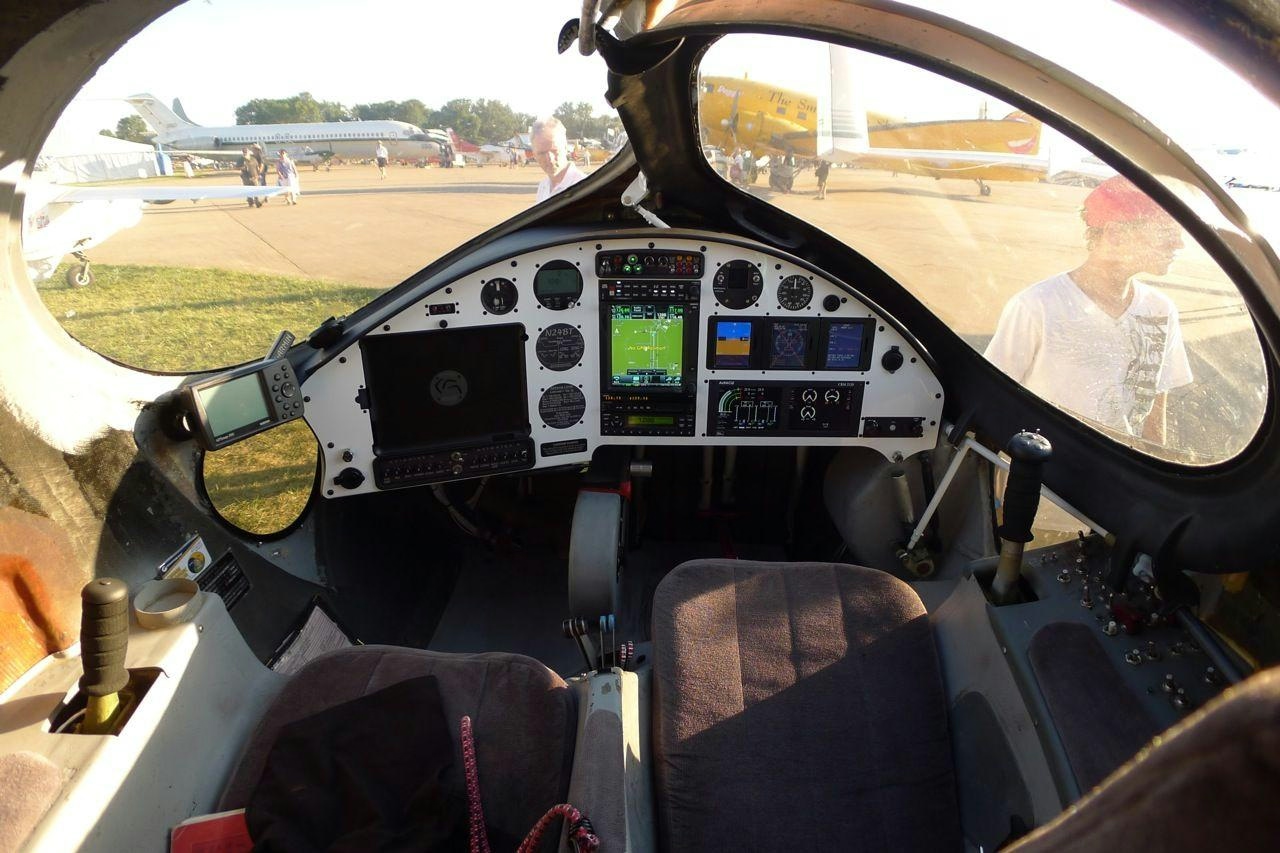
The Rutan Boomerang: An Aircraft Designed Asymmetrically
When Burt Rutan introduced the Boomerang at the Oshkosh AirVenture in 1996, it immediately captured the attention of the aviation community with its strikingly unconventional design. At first glance, the aircraft appeared almost disjointed: a small engine boom protruded conspicuously to the left of the fuselage, the right wing was noticeably shorter by five feet compared to the left, the wings swept forward rather than backward, and the tail assembly was distinctly asymmetrical. To many observers, the Boomerang resembled two mismatched airplanes awkwardly joined together. However, beneath this unusual exterior lay a highly innovative light aircraft engineered with a clear purpose.
When questioned about the aircraft’s peculiar form, Rutan’s explanation was straightforward: “Self preservation.” This succinct statement encapsulates the Boomerang’s core design philosophy, which prioritizes safety and control in critical flight conditions.
Addressing the Risks of Conventional Twin-Engine Aircraft
Understanding the Boomerang’s design requires an appreciation of the inherent dangers associated with traditional twin-engine airplanes. In most conventional twins, such as the Beechcraft Baron, the engines are mounted widely apart on each wing. Should one engine fail, the remaining engine’s thrust, being off-center, causes the aircraft to yaw sharply toward the inoperative side. At speeds below the so-called “minimum control speed,” the rudder’s authority is insufficient to counteract this yaw, potentially leading to loss of control or even a dangerous spin. Pilots must exert considerable effort to maintain directional stability, making engine failure one of the most perilous scenarios in light twin operations.
Rutan’s Innovative Asymmetric Design
Contrary to the prevailing emphasis on symmetry in aircraft design, Rutan embraced asymmetry as a deliberate solution to the twin-engine problem. The Boomerang’s two turbocharged Lycoming engines, rated at 210 and 200 horsepower respectively, are positioned remarkably close to the aircraft’s centerline—less than a foot apart—compared to nearly six feet on a Beechcraft Baron. This proximity significantly reduces the yawing moment generated by an engine failure.
To complement this engine placement, the airframe itself is asymmetrical. The offset engine boom, unequal wing lengths, and forward-swept wings are all precisely engineered to counterbalance the asymmetric thrust and maintain controllability. Drawing on design principles from his earlier aircraft, the Defiant and Catbird, Rutan ensured that the Boomerang’s minimum control speed falls below its stall speed. This means the aircraft remains controllable even at very low speeds, enhancing safety during critical phases of flight. Additionally, the wing is designed to stall at the root first, providing pilots with early warning signs while the outer wing continues to generate lift.
The Boomerang accommodates five seats and boasts a range of approximately 1,900 miles at a cruising speed near 300 miles per hour, demonstrating that its unconventional design does not compromise performance.
Market Reception and Industry Implications
Despite its technical ingenuity, the Boomerang’s radical asymmetry has met with skepticism within the broader aviation industry. While some enthusiasts and innovators applaud its safety advancements, many traditionalists remain cautious, favoring more conventional aircraft configurations. Established manufacturers may respond by reinforcing their existing models or exploring their own asymmetric concepts, though such departures from tradition are rare.
In the context of the global commercial aircraft market—dominated by industry giants like Boeing and Airbus, alongside emerging competitors such as COMAC—the Boomerang occupies a niche segment. The market is projected to grow steadily at a compound annual growth rate of 3.8% from 2026 to 2034, yet the influence of asymmetric designs like the Boomerang on this growth remains uncertain.
Ultimately, the Boomerang exemplifies Burt Rutan’s willingness to challenge conventional design norms in pursuit of enhanced safety and controllability, regardless of how unconventional the resulting aircraft may appear.

Etihad Airways Suspends Airbus A380 Flights on Key Route

Aditya Birla Group Seeks Approval for Aircraft Leasing in GIFT City

Qatar Airways Highlights Innovation and Connectivity at Arabian Travel Market 2026

Hong Kong's Five-Year Plan Includes Andrew Fan's Aircraft Parts Processing Hub Proposal

ACIA Aero Leasing Delivers ATR72-600 to Air Nostrum

RTX Appoints Jill Albertelli as Head of Pratt & Whitney

TAT Technologies Joins Beyond Aero Hydrogen Aircraft Program

AURAK Study Highlights Barriers to Air Taxi Adoption in Emerging Economies

Xiamen Air Selects Altitude for 787 Maintenance at Heathrow

Etihad and Swissport Extend Global Partnership
