
Orquesta conocimientos de IA para convertirlos en acción

Tendencias
Categories
Thrust Vectoring and Its Role in Modern Combat
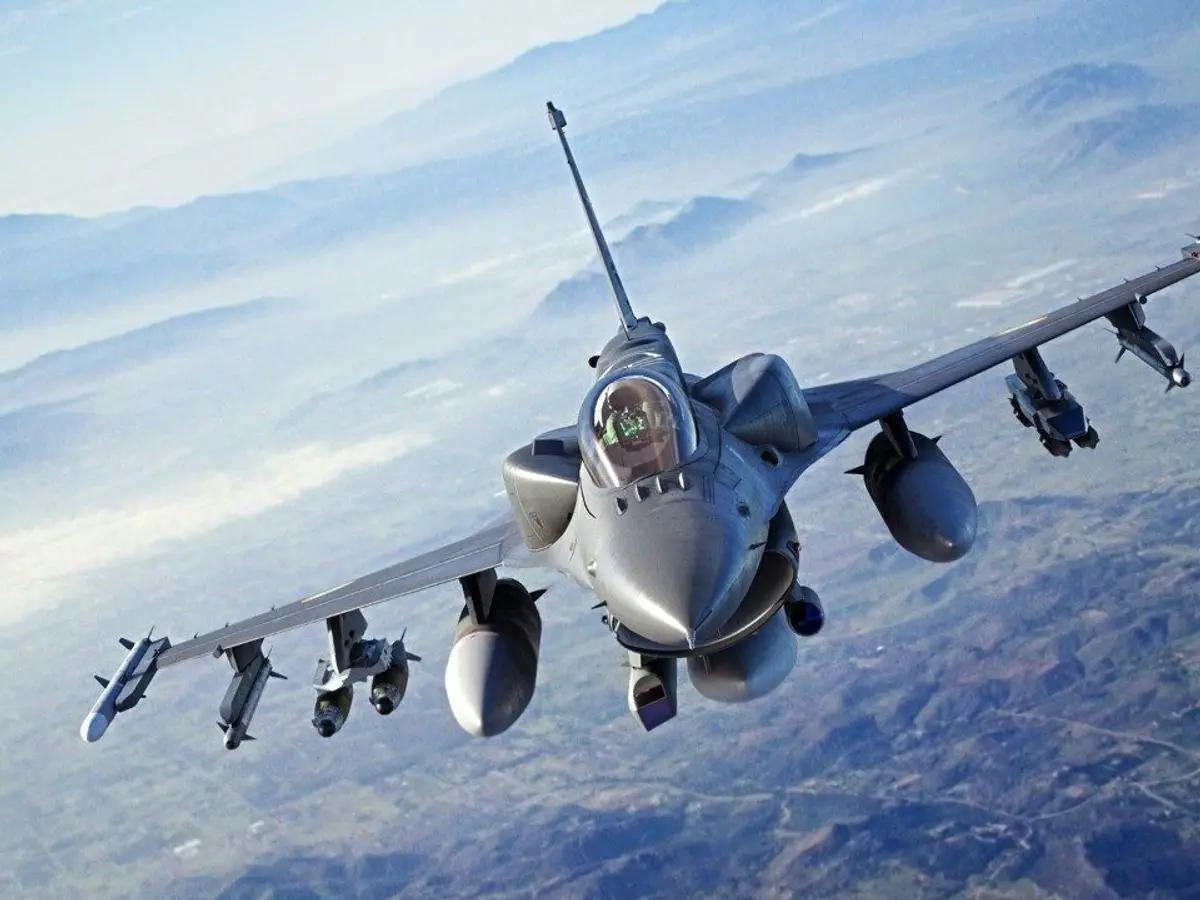
Thrust Vectoring and Its Role in Modern Combat
Modern fighter aircraft traditionally rely on manipulating airflow over control surfaces such as elevators, rudders, and ailerons to execute maneuvers. This conventional method proves effective under normal flight conditions but becomes increasingly unreliable as the aircraft slows significantly or reaches extreme angles of attack. In these situations, airflow separation occurs, rendering control surfaces ineffective and increasing the risk of loss of control or stall. Thrust vectoring technology addresses this limitation by enabling pilots to steer the aircraft through direct manipulation of engine exhaust, maintaining control even when the wings fail to generate sufficient lift.
Understanding Thrust Vectoring
Thrust vectoring involves deflecting the engine’s exhaust flow to control the aircraft’s orientation independently of aerodynamic surfaces. There are two primary types of thrust vectoring nozzles employed in modern fighters. The first, exemplified by the F-22 Raptor, uses two-dimensional (2D) nozzles that move only in pitch and feature rectangular shapes designed to reduce radar and infrared signatures. The second type, found on aircraft such as the Su-35 and Su-57, consists of three-dimensional (3D) or multi-axis nozzles capable of swiveling in both pitch and yaw, prioritizing enhanced agility over stealth considerations.
This technology enables advanced post-stall maneuvers, including the Cobra and Herbst turn, which were initially demonstrated by experimental aircraft like the X-31 and F-18 HARV during the 1990s. These maneuvers allow pilots to maintain control and execute rapid directional changes beyond the limits of conventional aerodynamic control.
Operational Mechanism and Integration
The operational principle of thrust vectoring is relatively straightforward: movable flaps within the engine’s exhaust nozzle redirect thrust to pitch or yaw the aircraft as required. In sophisticated fighter jets, the flight-control computer seamlessly integrates thrust vectoring with traditional control inputs, relieving pilots from manually adjusting the nozzles. As Chris Flynn, F119 engine program director at Pratt & Whitney, explains, “The pilot doesn’t control the nozzle independently.”
Tactical Advantages in Combat
Thrust vectoring offers significant advantages in air combat, particularly in close-range dogfights. The ability to rapidly orient the aircraft’s nose toward an adversary at low speeds or high angles of attack can prove decisive. This capability allows pilots to perform maneuvers that would otherwise result in loss of control, providing a critical edge in engagements. Capt. John “Rocks” Wagemann, an F-22A pilot with the U.S. Air Force, notes, “It gives us the nose authority to turn the jet while the wings are stalled, similar to a controlled flat spin.”
Challenges and Industry Implications
Despite its operational benefits, thrust vectoring remains relatively rare in frontline fighters due to several significant challenges. The integration of advanced vectoring systems entails high development and retrofit costs. Additionally, the technology introduces increased mechanical complexity, weight, and thermal loads, which elevate maintenance requirements and may impact overall reliability. Furthermore, vectoring nozzles can increase an aircraft’s infrared and radar signatures, potentially compromising stealth capabilities.
These factors necessitate rigorous testing and validation to ensure that thrust vectoring systems meet performance and safety standards. Consequently, many aircraft manufacturers and air forces opt against incorporating thrust vectoring unless the tactical advantages justify the associated costs and complexities.
Market Dynamics and Technological Competition
The pursuit of thrust vectoring has stimulated substantial investment in defense technology firms specializing in propulsion and avionics. This competitive landscape has prompted rapid advancements and strategic partnerships aimed at sharing development costs and mitigating risks. The ongoing race for technological superiority is shaping the future of aerial combat, as military forces and manufacturers carefully balance the trade-offs between agility, survivability, and operational expense.

Etihad Airways Suspends Airbus A380 Flights on Key Route

Aditya Birla Group Seeks Approval for Aircraft Leasing in GIFT City

Qatar Airways Highlights Innovation and Connectivity at Arabian Travel Market 2026

Hong Kong's Five-Year Plan Includes Andrew Fan's Aircraft Parts Processing Hub Proposal

ACIA Aero Leasing Delivers ATR72-600 to Air Nostrum

RTX Appoints Jill Albertelli as Head of Pratt & Whitney

TAT Technologies Joins Beyond Aero Hydrogen Aircraft Program

AURAK Study Highlights Barriers to Air Taxi Adoption in Emerging Economies

Xiamen Air Selects Altitude for 787 Maintenance at Heathrow

Etihad and Swissport Extend Global Partnership
