
Orquesta conocimientos de IA para convertirlos en acción

Tendencias
Categories
Understanding DO-178C: Aviation Software Safety Standards
Understanding DO-178C: Aviation Software Safety Standards
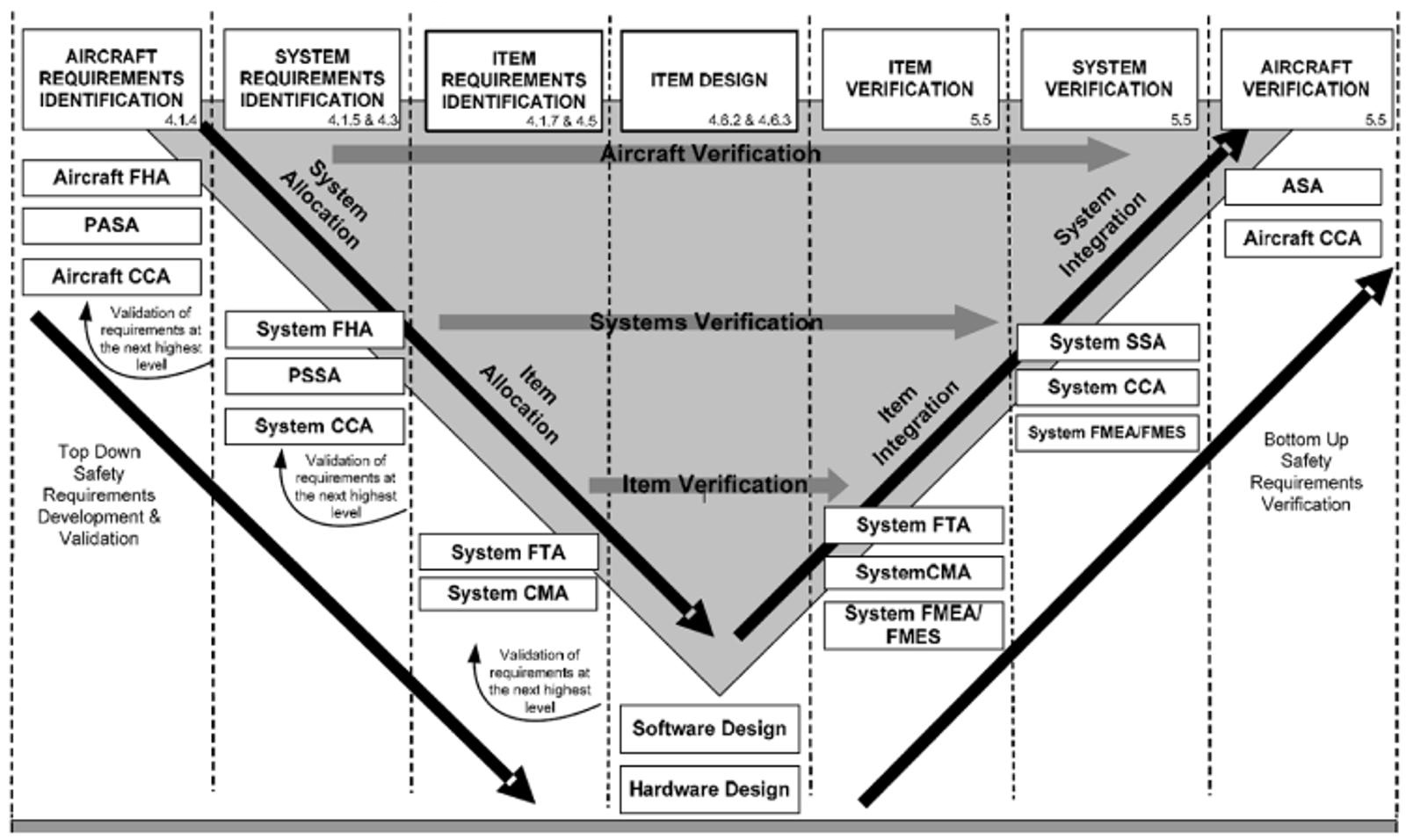
DO-178C, formally titled Software Considerations in Airborne Systems and Equipment Certification, serves as the foundational standard for ensuring software safety within the aerospace sector. Regulatory bodies such as the Federal Aviation Administration (FAA) in the United States and the European Union Aviation Safety Agency (EASA) in Europe depend on DO-178C to govern and approve software deployed in civil aviation. The standard’s principal objective is to mitigate the risk of software failures that could compromise aircraft safety by enforcing stringent processes throughout the software development lifecycle.
Traceability and Assurance Levels
A central tenet of DO-178C is its rigorous emphasis on traceability. Each line of code must be explicitly linked to a defined requirement, and every requirement must undergo thorough testing. This methodology guarantees that the software performs solely its intended functions, eliminating unintended behaviors. The standard is founded on the principle that safety and quality must be integrated from the earliest stages of development rather than appended later.
Software components are categorized according to Design Assurance Levels (DAL), which range from Level A, indicating potential catastrophic failure, to Level E, representing no impact on safety. For instance, Level A encompasses critical systems such as flight controls and autopilot, Level B includes braking systems, Level C covers flight management systems, Level D pertains to maintenance data recorders, and Level E applies to non-safety-critical systems like in-flight entertainment. The rigor of development and verification processes intensifies in accordance with the criticality of the software’s function.
Evolving with Technology
DO-178C, introduced in 2011 as a successor to DO-178B, reflects advancements in software engineering by incorporating four key supplements. DO-330 addresses software tool qualification, ensuring that tools such as compilers and code generators meet reliability standards comparable to the software they help produce. DO-331 facilitates model-based development and verification, enabling engineers to specify requirements visually and mathematically, often through platforms like Simulink, which can automatically generate code. DO-332 focuses on object-oriented technology, imposing strict guidelines to manage risks associated with features like inheritance, polymorphism, and dynamic memory allocation, thereby preventing unpredictable behavior in safety-critical contexts. Lastly, DO-333 introduces formal methods to enhance verification rigor.
Compliance Challenges and Industry Impact
Achieving compliance with DO-178C presents considerable challenges for manufacturers. Designing systems that maintain simplicity and traceability sufficient to satisfy regulatory scrutiny is inherently complex. Additional difficulties arise from managing processor migrations, which can affect structural coverage and timing, qualifying software tools, compiling exhaustive certification evidence, and controlling program costs. These challenges have influenced market dynamics by increasing demand for software solutions inherently aligned with DO-178C’s stringent requirements. Consequently, industry competitors are investing in more efficient compliance methodologies and leveraging advanced technologies to improve software reliability and safety, aiming to secure both regulatory approval and competitive advantage.

Etihad Airways Suspends Airbus A380 Flights on Key Route

Aditya Birla Group Seeks Approval for Aircraft Leasing in GIFT City

Qatar Airways Highlights Innovation and Connectivity at Arabian Travel Market 2026

Hong Kong's Five-Year Plan Includes Andrew Fan's Aircraft Parts Processing Hub Proposal

ACIA Aero Leasing Delivers ATR72-600 to Air Nostrum

RTX Appoints Jill Albertelli as Head of Pratt & Whitney

TAT Technologies Joins Beyond Aero Hydrogen Aircraft Program

AURAK Study Highlights Barriers to Air Taxi Adoption in Emerging Economies

Xiamen Air Selects Altitude for 787 Maintenance at Heathrow

Etihad and Swissport Extend Global Partnership
