
Orquesta conocimientos de IA para convertirlos en acción

Tendencias
Categories
U.S. Food Delivery Drones Now Transport Over 8 Pounds
U.S. Food Delivery Drones Now Transport Over 8 Pounds
Expanding Payload Capacities in Drone Delivery
The food delivery drone industry in the United States has historically been constrained by payload limitations, with most drones capable of carrying only around five pounds. This capacity sufficed for small orders such as chicken wings, ice cream, or groceries but restricted the scope of drone delivery services. Recently, however, several operators have begun to push these boundaries by introducing drones capable of transporting heavier loads, signaling a significant shift in the sector.
Flytrex, a company operating in both the U.S. and Israel, has launched its new Sky2 drone, which it claims is the first on-demand delivery drone able to carry up to 8.8 pounds. This payload capacity is sufficient to transport two large pizzas, bread bites, and sodas in a single trip. This development aligns with the capabilities of Irish company Manna’s flagship drone, which can carry up to four kilograms (approximately 8.8 pounds) and reportedly deliver four 15-inch pizzas simultaneously. Manna’s CEO, Bobby Healy, has emphasized that managing volume presents a greater challenge than weight in drone delivery, underscoring the complexities involved in optimizing both capacity and efficiency.
Other U.S. operators are also enhancing their payload limits. Zipline’s P2 drone can carry up to eight pounds, while Amazon Prime Air’s MK30, Dexa’s DE-2020, and Wing’s flagship model each have a maximum payload of five pounds. Matternet’s M2 drone is limited to approximately 4.4 pounds. Flytrex’s previous model supported payloads up to 6.6 pounds, making the Sky2 a notable advancement in the company’s delivery capabilities.
Technological Innovations and Operational Deployment
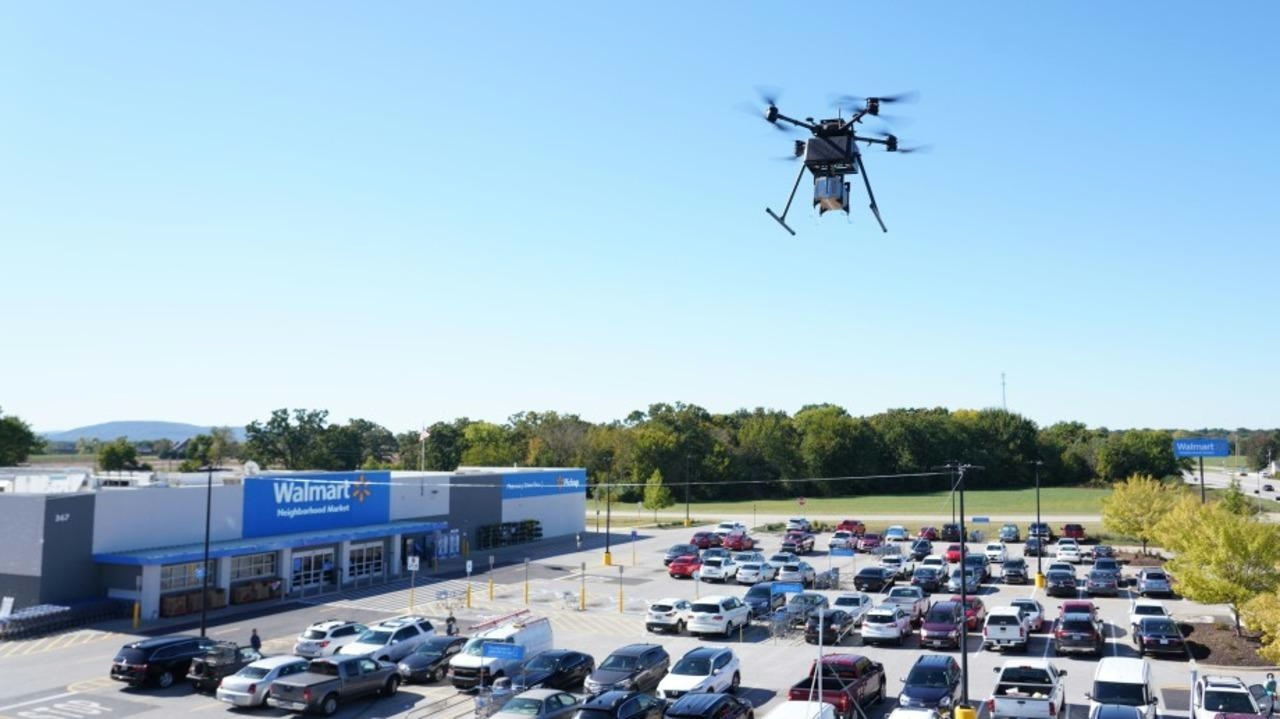
The Sky2 is an autonomous octocopter being introduced through a partnership with Little Caesars, initially launching at a single store in Wylie, Texas. Customers place orders via the Flytrex app, after which drones collect the food from outside the restaurant and deliver it within an average of 4.5 minutes. The drone employs AI-based flight logic for navigation and uses a tether system to gently lower cargo to the ground. This method is designed to enhance delivery accuracy and safety, offering an improvement over parachute drops or simple hovering releases.
Flytrex CEO Amit Regev highlighted the company’s commitment to making drone delivery practical for everyday consumers, stating, “A big part of advancing this market is making sure people can get the food they actually want, when they want it.” The Sky2 also extends Flytrex’s delivery radius from 2.5 to 4 miles, thereby expanding its potential customer base. Collaborations with platforms such as Uber Eats further broaden the reach of these services.
Challenges and Industry Outlook
Despite these technological advancements, the expansion of drone delivery faces significant challenges. Regulatory approval remains a major hurdle, particularly concerning beyond visual line of sight (BVLOS) operations, which are stringently regulated by the Federal Aviation Administration (FAA). Public acceptance and competition from traditional delivery services also present obstacles to widespread adoption. Recent reports from Amazon customers about damaged drone deliveries highlight the ongoing need to improve reliability and customer satisfaction.
Market responses have been mixed, with increasing interest from businesses seeking efficiency gains through drone delivery. In turn, competitors are investing in technological enhancements aimed at improving delivery accuracy and safety. Meanwhile, some manufacturers are developing larger cargo drones, such as Elroy Air’s Chaparral, which is designed to carry up to 300 pounds over long distances. This represents a different use case from the rapid, local deliveries targeted by food delivery drones.
As drone technology continues to evolve, operators must carefully balance payload capacity, regulatory compliance, and operational reliability to establish drone delivery as a viable and trusted option for consumers.

Etihad Airways Suspends Airbus A380 Flights on Key Route

Aditya Birla Group Seeks Approval for Aircraft Leasing in GIFT City

Qatar Airways Highlights Innovation and Connectivity at Arabian Travel Market 2026

Hong Kong's Five-Year Plan Includes Andrew Fan's Aircraft Parts Processing Hub Proposal

ACIA Aero Leasing Delivers ATR72-600 to Air Nostrum

RTX Appoints Jill Albertelli as Head of Pratt & Whitney

TAT Technologies Joins Beyond Aero Hydrogen Aircraft Program

AURAK Study Highlights Barriers to Air Taxi Adoption in Emerging Economies

Xiamen Air Selects Altitude for 787 Maintenance at Heathrow

Etihad and Swissport Extend Global Partnership
