
Orchestrer les insights d’IA pour les transformer en actions

Tendances
Categories
Automation and AI Drive Changes in Airport Baggage Handling Systems Through 2034
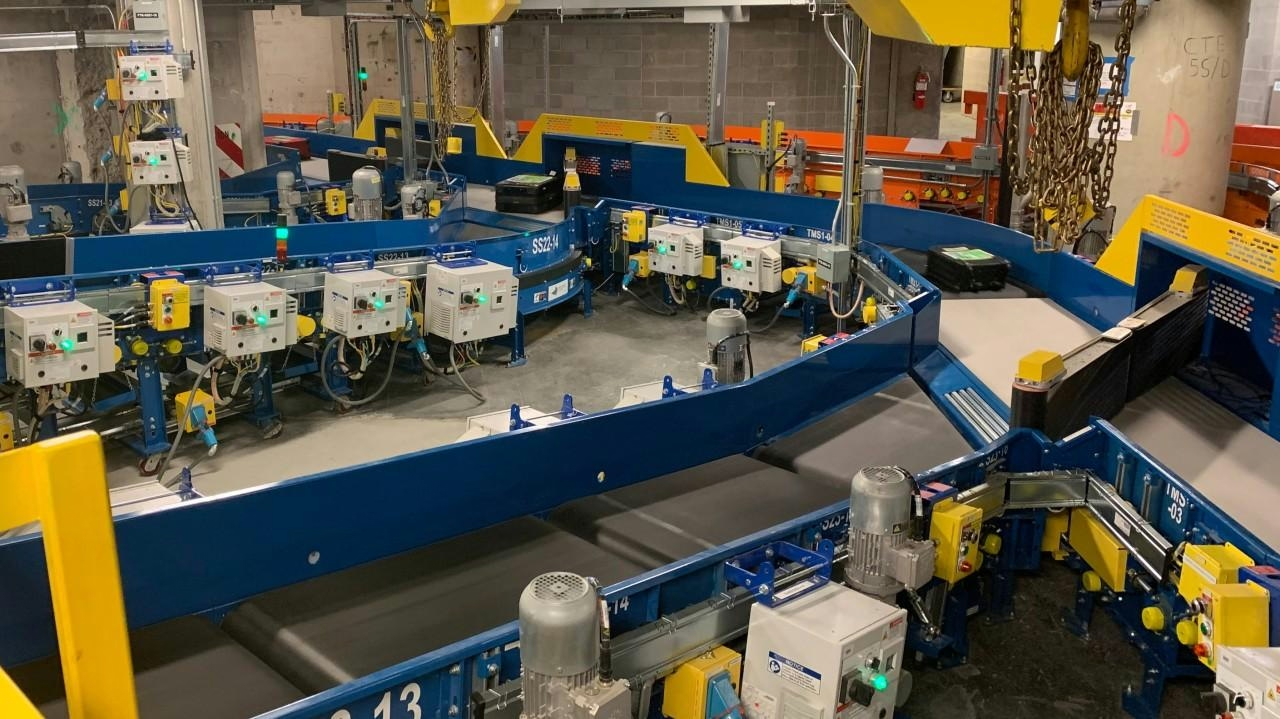
Automation and AI Drive Changes in Airport Baggage Handling Systems Through 2034
The global airport baggage handling system market is experiencing significant transformation, propelled by advancements in automation, RFID technology, and artificial intelligence (AI). As airports worldwide upgrade their infrastructure to accommodate increasing passenger volumes, the emphasis is shifting towards enhancing operational efficiency, minimizing baggage mishandling, and creating smarter, end-to-end baggage journeys.
Recent market analysis indicates that the airport baggage handling system market was valued at USD 9.1 billion in 2024 and is projected to nearly double to USD 18.6 billion by 2034, representing a compound annual growth rate (CAGR) of 7.4%. This expansion is driven by airport modernization efforts, rising traveler numbers, and the widespread adoption of intelligent automation solutions.
Market Overview and Technological Innovations
Modern baggage handling systems (BHS) integrate a variety of technologies, including automated conveyors, sorters, scanners, RFID readers, baggage carts, and centralized control systems. Increasingly, these systems incorporate Internet of Things (IoT) sensors, AI-powered analytics, and digital twin technologies to reduce errors, increase throughput, and improve the overall passenger experience.
Leading aviation hubs are deploying next-generation baggage solutions to manage growing traffic volumes, reduce operational delays, and comply with stringent International Air Transport Association (IATA) baggage tracking standards, such as Resolution 753. RFID-based tracking is expanding rapidly due to its superior accuracy and traceability, while AI-driven predictive analytics are being employed to anticipate and prevent system overloads.
Industry Leaders and Recent Developments
Prominent companies in the airport baggage handling market include Siemens Logistics, Vanderlande Industries, Daifuku Co. Ltd., BEUMER Group, Rapiscan Systems, Smiths Detection, SITA, Alstef Group, and Honeywell International. These firms specialize in automated sorting, baggage screening, airport IoT solutions, and smart tracking technologies.
Recent years have witnessed several notable advancements. The widespread adoption of RFID tracking has accelerated following IATA mandates. Autonomous trolleys and robot-assisted baggage transport systems are becoming more prevalent, alongside increased deployment of in-line baggage screening systems utilizing CT-based scanning technology. Self-service bag drop systems have expanded, facilitating contactless processing, while digital twin implementations enable real-time operational simulation. Major airport expansion projects across the Middle East, Asia-Pacific, and North America further underscore the sector’s growth.
A significant example is Melbourne Airport’s recent trial of a high-tech baggage system developed by BEUMER Group. This initiative has doubled the airport’s baggage handling capacity and introduced real-time tracking capabilities, exemplifying the broader industry trend toward advanced, integrated baggage handling solutions.
Market Segmentation and Growth Dynamics
Conveyor and sortation systems currently dominate the market by type, with RFID and barcode tracking systems experiencing rapid growth. Within solutions, baggage tracking and monitoring represent the fastest-growing segment, driven by ongoing digital transformation efforts. Technological innovation is led by RFID, IoT, AI, and robotics, which are reshaping baggage handling processes. Large and mega airports are at the forefront of adoption due to their higher baggage throughput and greater automation requirements. Among applications, departure baggage handling remains the most complex and dominant area.
Challenges and Industry Outlook
Despite the promising benefits of automation and AI, integrating new baggage handling systems with existing airport infrastructure poses considerable challenges. Ensuring real-time tracking accuracy and managing the transition for airline and airport personnel are critical concerns. Initial skepticism among stakeholders often arises due to cost implications and potential operational disruptions. Smaller airports may face financial constraints in implementing advanced systems, potentially widening the technological divide with larger hubs.
Nonetheless, the long-term advantages—improved efficiency, reduced delays, and enhanced passenger satisfaction—are expected to drive sustained adoption. As competition intensifies within the aviation sector, an increasing number of airports and service providers are likely to embrace these technologies to maintain their competitive edge in an evolving landscape.

Etihad Airways Suspends Airbus A380 Flights on Key Route

Aditya Birla Group Seeks Approval for Aircraft Leasing in GIFT City

Qatar Airways Highlights Innovation and Connectivity at Arabian Travel Market 2026

Hong Kong's Five-Year Plan Includes Andrew Fan's Aircraft Parts Processing Hub Proposal

ACIA Aero Leasing Delivers ATR72-600 to Air Nostrum

RTX Appoints Jill Albertelli as Head of Pratt & Whitney

TAT Technologies Joins Beyond Aero Hydrogen Aircraft Program

AURAK Study Highlights Barriers to Air Taxi Adoption in Emerging Economies

Xiamen Air Selects Altitude for 787 Maintenance at Heathrow

Etihad and Swissport Extend Global Partnership
