
Orchestrer les insights d’IA pour les transformer en actions

Tendances
Categories
Engine Issues Ground 22% of Airbus A220 Fleet
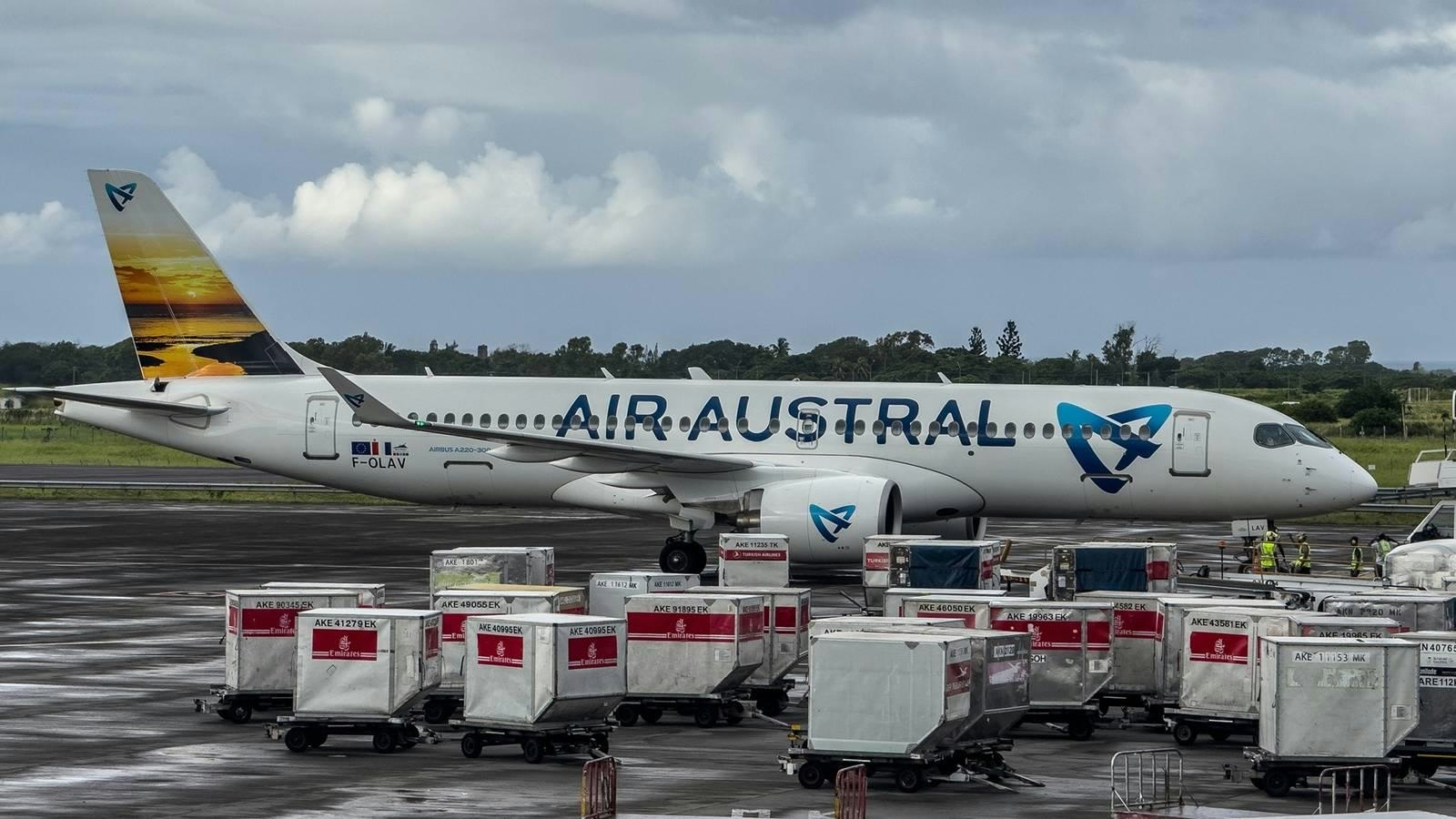
Engine Issues Ground 22% of Airbus A220 Fleet
Persistent engine problems have led to nearly a quarter of the global Airbus A220 fleet being grounded, with recent data and airline reports indicating that the situation may worsen in the coming months.
A Promising Aircraft Undermined by Engine Reliability Concerns
The Airbus A220, initially developed by Bombardier, was celebrated as a next-generation aircraft designed to enhance short-haul efficiency. Its spacious cabin, smooth handling, and fuel economy have earned praise from both airlines and pilots. However, the aircraft’s Pratt & Whitney PW1500G geared turbofan (GTF) engines have become a significant source of operational challenges. Durability issues, primarily related to corrosion and powder-metal defects, have necessitated earlier-than-anticipated maintenance interventions, resulting in premature wear and cracking of engine components.
These reliability challenges are not confined to the A220 alone. The broader PW1000G engine family, which also powers numerous Airbus A320neo and Embraer E2 aircraft, has experienced widespread groundings and reductions in engine life limits due to similar defects.
Groundings Escalate to 22% of the Fleet and May Increase Further
Industry data reported by FlightGlobal reveals that as of mid-October, 79 out of 367 A220 aircraft in service worldwide were grounded, representing approximately 22% of the fleet. This figure adds to the more than 500 aircraft globally grounded due to GTF engine issues, including a substantial portion of A320neo and Embraer E2 jets.
Estimates from IBA, cited by The Wall Street Journal, indicate that while 15% of A220s were grounded as of August 2024, up to 42% of the fleet could soon require inspections or maintenance. Although not all aircraft will be out of service simultaneously, these projections highlight the potential for extended operational disruptions as more planes undergo mandatory checks.
Airlines Confront Prolonged Operational Challenges
Airlines operating the A220 are experiencing significant operational strain. Swiss International Air Lines, a major A220 operator, anticipates that engine reliability issues will persist throughout the decade. The airline has already recorded a 25% reduction in A220 flight hours between September 2019 and September 2025, with a notable number of aircraft grounded. Breeze Airways, which depends heavily on the A220, along with Delta and JetBlue, also face ongoing uncertainty due to these engine problems.
Spirit Airlines has reported substantial operational disruptions and has received $72 million in credits from Pratt & Whitney to compensate for losses related to grounded aircraft. The widespread nature of the engine issues is compelling airlines to reconsider fleet strategies and prepare for further market adjustments.
Smaller Operators Opt to Withdraw from the A220 Program
The impact is particularly severe for smaller carriers. EgyptAir has exited the A220 program following prolonged groundings, while Air Austral recently announced plans to retire its entire A220-300 fleet, citing persistent GTF engine reliability problems. This decision reflects a strategic move by Air Austral to stabilize operations amid ongoing parts shortages and maintenance delays.
Passenger Experience and Broader Implications
For passengers, the immediate consequence is disruption to flight schedules. With up to one in five A220s grounded, airlines are forced to shuffle flights, substitute aircraft, and in some cases, cancel routes altogether. As inspections and repairs continue, travelers should anticipate ongoing schedule changes and reduced reliability on affected services.
The engine difficulties faced by the A220 underscore the challenges inherent in introducing new aviation technologies and the extensive impact when critical components fail to meet expectations. With no immediate resolution in sight, both airlines and passengers are preparing for a challenging period ahead.

Etihad Airways Suspends Airbus A380 Flights on Key Route

Aditya Birla Group Seeks Approval for Aircraft Leasing in GIFT City

Qatar Airways Highlights Innovation and Connectivity at Arabian Travel Market 2026

Hong Kong's Five-Year Plan Includes Andrew Fan's Aircraft Parts Processing Hub Proposal

ACIA Aero Leasing Delivers ATR72-600 to Air Nostrum

RTX Appoints Jill Albertelli as Head of Pratt & Whitney

TAT Technologies Joins Beyond Aero Hydrogen Aircraft Program

AURAK Study Highlights Barriers to Air Taxi Adoption in Emerging Economies

Xiamen Air Selects Altitude for 787 Maintenance at Heathrow

Etihad and Swissport Extend Global Partnership
