
Orchestrer les insights d’IA pour les transformer en actions

Tendances
Categories
IATA and CFM International Renew Engine Maintenance Agreement
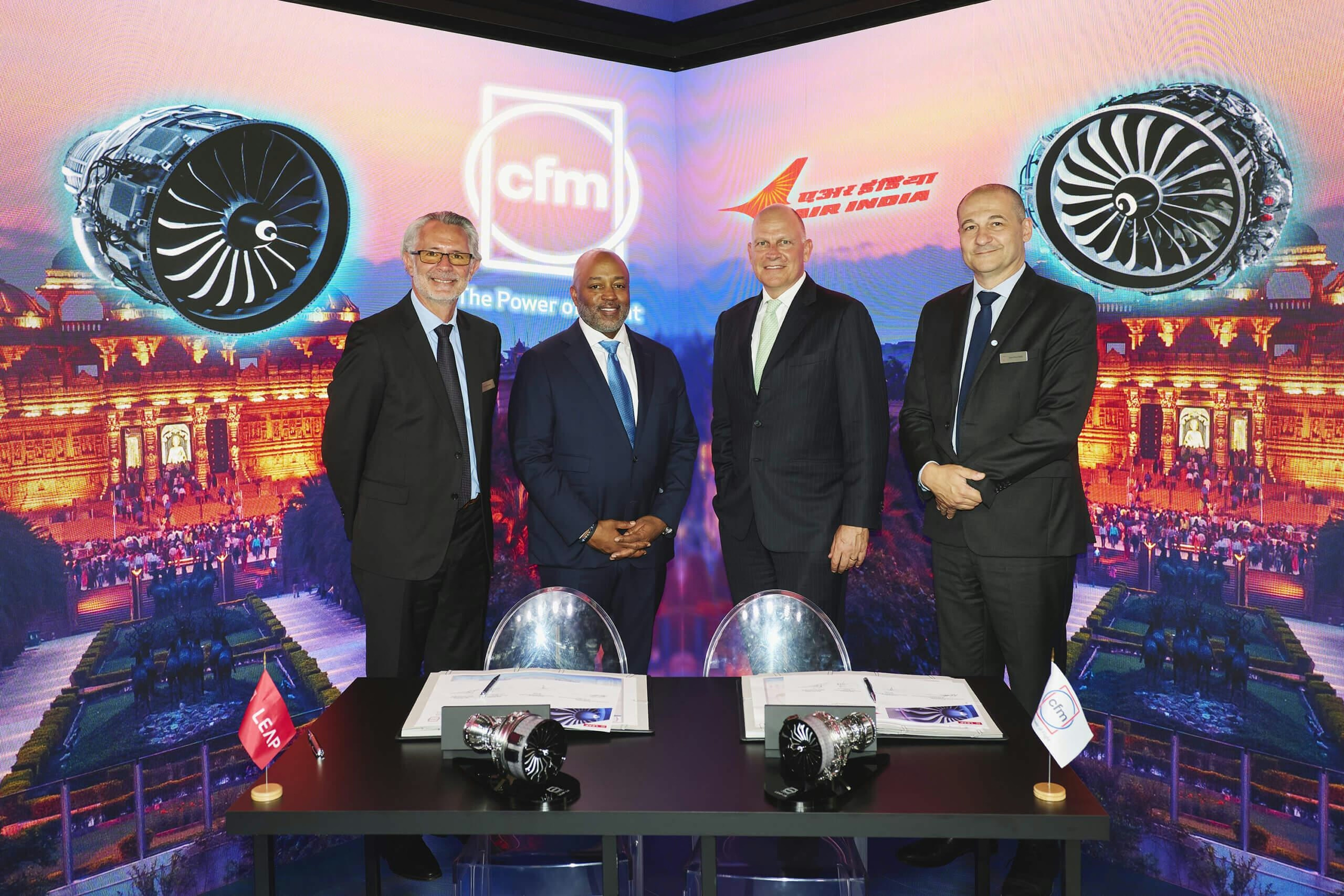
IATA and CFM International Renew Engine Maintenance Agreement
Strengthening Competition in Engine Maintenance
The International Air Transport Association (IATA) has announced the renewal of its agreement with CFM International (CFM), extending their partnership through February 2033. This renewed accord seeks to enhance competition within the maintenance, repair, and overhaul (MRO) market for CFM engines, a joint venture between GE Aerospace and Safran Aircraft Engines. The move comes at a critical juncture as airlines grapple with persistent supply chain disruptions and rising maintenance costs, which have increasingly strained operational capacities.
For years, airlines have faced restrictive aftermarket practices imposed by engine manufacturers, limiting competition and inflating expenses. These challenges have been exacerbated by constrained maintenance capacity and ongoing aerospace supply chain issues, resulting in grounded aircraft and escalating costs. A recent IATA study projects that these factors will add approximately $5.7 billion to engine leasing and maintenance expenditures for airlines in 2025.
Willie Walsh, IATA’s Director General, emphasized the significance of the renewed agreement, describing it as a timely measure that, while not a comprehensive solution, introduces essential pro-competitive aftermarket practices crucial for the industry’s sustainability. He noted that if fully leveraged, the agreement could provide immediate relief in terms of cost and capacity, aiding airlines in meeting demand despite ongoing supply chain challenges. Walsh also commended CFM for spearheading this reform and called on other manufacturers to adopt similar approaches.
CFM’s Commitment to an Open Aftermarket
Gaël Méheust, President and CEO of CFM International, reaffirmed the company’s dedication to fostering an open and competitive MRO ecosystem. He highlighted that CFM’s network includes numerous third-party providers engaged in overhauling, repairing, and maintaining engines, which contributes to reduced ownership costs and greater choice for airlines. Despite recent supply chain difficulties, Méheust stressed that CFM remains focused on customer satisfaction. He pointed out that CFM pioneered this open MRO model with its CFM56 engines, where nearly 40 independent shops compete for work, with CFM itself performing only about one-third of overhauls. This approach is now being extended to the newer LEAP engines.
Key Provisions and Industry Context
Originally signed in 2019, the agreement incorporates conduct policies aimed at expanding opportunities for third-party providers of engine parts and MRO services. These commitments apply to all CFM commercial engines, including the widely used CFM56 and the newer LEAP models. The agreement ensures that maintenance options remain accessible by allowing airlines and MRO providers to utilize CFM technical manuals and repair instructions, even when engines contain non-CFM parts or repairs. It also safeguards warranties based on the root cause of issues rather than penalizing the use of alternative parts or repairs. Furthermore, the agreement seeks to increase effective maintenance capacity by enabling independent MRO providers to compete for engine work, thereby helping to alleviate maintenance backlogs.
The renewal arrives amid heightened scrutiny of engine durability, particularly concerning CFM LEAP engines operating in challenging, dusty environments. Airlines are compelled to extend the service life of older aircraft due to delays in new aircraft deliveries, which is expected to increase maintenance demands. Competitors such as GE Aerospace, Rolls-Royce, and Pratt & Whitney are advancing their own engine technologies and inspection protocols in response. Recent incidents, including operational disruptions experienced by Spirit Airlines following Pratt & Whitney engine recalls, underscore the financial and operational risks linked to engine maintenance issues. These developments further highlight the critical importance of robust and competitive MRO practices across the aviation industry.

Etihad Airways Suspends Airbus A380 Flights on Key Route

Aditya Birla Group Seeks Approval for Aircraft Leasing in GIFT City

Qatar Airways Highlights Innovation and Connectivity at Arabian Travel Market 2026

Hong Kong's Five-Year Plan Includes Andrew Fan's Aircraft Parts Processing Hub Proposal

ACIA Aero Leasing Delivers ATR72-600 to Air Nostrum

RTX Appoints Jill Albertelli as Head of Pratt & Whitney

TAT Technologies Joins Beyond Aero Hydrogen Aircraft Program

AURAK Study Highlights Barriers to Air Taxi Adoption in Emerging Economies

Xiamen Air Selects Altitude for 787 Maintenance at Heathrow

Etihad and Swissport Extend Global Partnership
