
Orchestrer les insights d’IA pour les transformer en actions

Tendances
Categories
M1 Support Services Secures $601 Million MRO Contract with U.S. Army
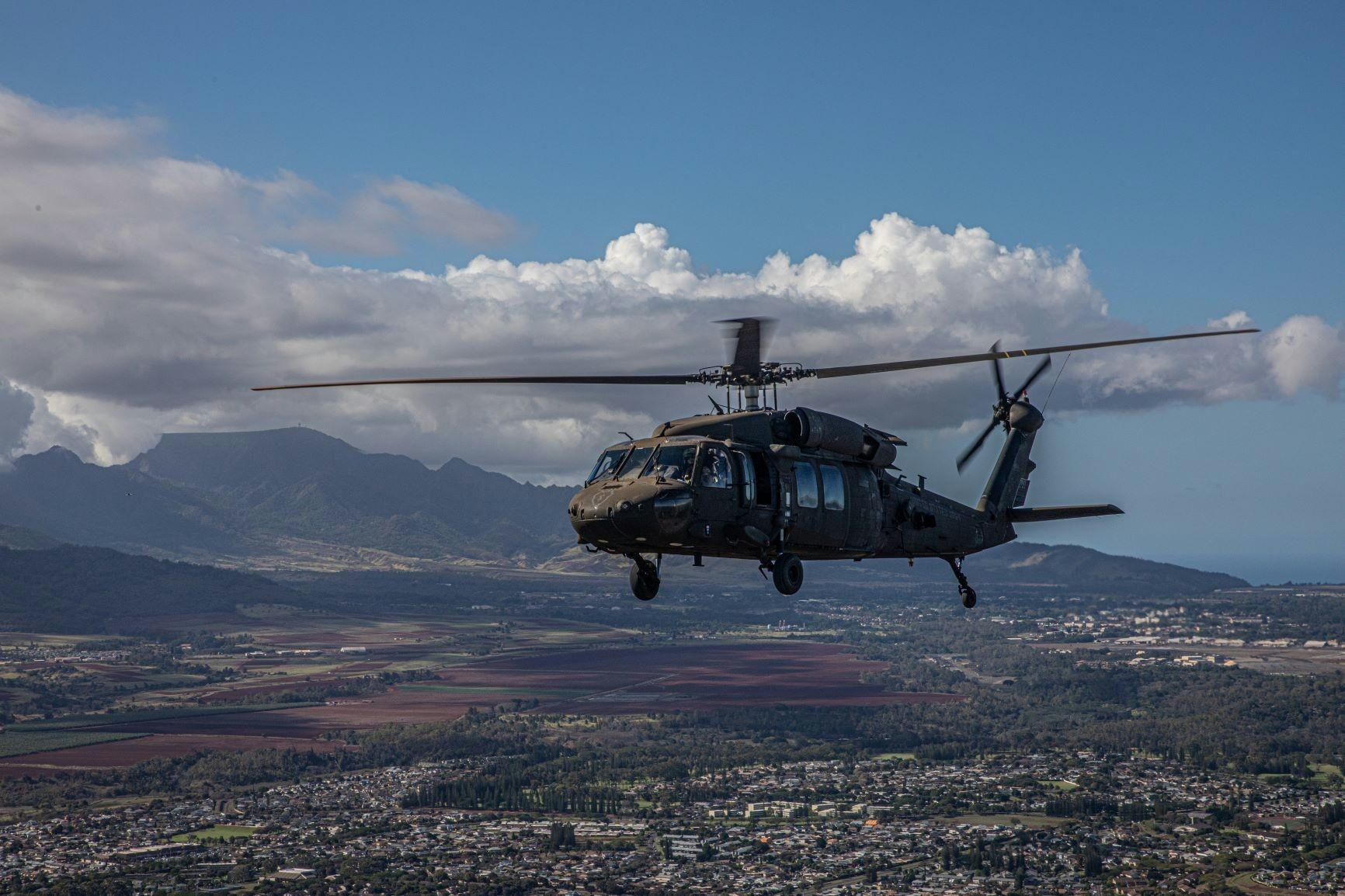
M1 Support Services Secures $601 Million MRO Contract with U.S. Army
M1 Support Services (M1) has been awarded a $601.1 million contract modification to continue providing maintenance, repair, and overhaul (MRO) services for the U.S. Army’s aviation training operations at Fort Rucker, Alabama. The contract extension, which runs through January 15, 2027, underscores M1’s critical role in supporting one of the largest military flight training programs globally.
Scope of Services and Operational Demands
Under the terms of the agreement, M1 will deliver a full range of maintenance services, including organizational, intermediate, and limited depot-level support for a fleet exceeding 500 rotary-wing aircraft. This fleet comprises key platforms such as the AH-64 Apache, UH-60 Black Hawk, CH-47 Chinook, UH-72 Lakota, and TH-1 helicopters, operated by both the U.S. Army and U.S. Air Force. These aircraft are stationed across five primary airfields at Fort Rucker, reflecting the extensive scale and complexity of the training environment.
M1’s operations support a demanding training tempo, with aircraft conducting up to 400 sorties daily and accumulating over 200,000 flight hours annually. To sustain this high operational tempo, the company employs more than 3,000 personnel, including maintenance technicians, aircrew, and support staff. These teams work continuously in three shifts to ensure aircraft availability, safety, and mission readiness throughout the year.
George Krivo, Chairman and CEO of M1 Support Services, highlighted the company’s dedication to the Army Aviation Center of Excellence, stating, “M1 stands for ‘Mission First,’ and we dedicate ourselves every day to ensure aircraft are well-maintained and available to train the next generation of Army Aviators.”
Industry Challenges and Strategic Context
The contract award arrives amid broader challenges within the defense sector and shifting priorities in military aviation. Maintaining legacy aircraft remains a complex undertaking, as recent Government Accountability Office (GAO) recommendations have urged the Army to improve tracking of partner feedback on aging platforms. This evolving landscape may require M1 to adapt its maintenance approaches to meet changing operational and technical requirements.
The extension also intensifies competition among defense contractors, with rival firms poised to demonstrate their capabilities in managing sophisticated military equipment to secure future contracts. Market responses to M1’s contract win are likely to be influenced by ongoing defense budget considerations and the Army’s focus on emerging technologies, including efforts to identify a replacement for the Gray Eagle unmanned aircraft. Such modernization initiatives could potentially redirect resources and attention away from existing support contracts.
Furthermore, recent financial activities and contract developments involving major industry players like RTX Corporation are shaping market dynamics, as investors evaluate the broader implications for competitors and the defense sector at large.
As the U.S. Army seeks to balance modernization with the imperative to sustain current training operations, M1’s contract extension highlights both the enduring significance and the evolving challenges of maintaining military aviation readiness.

Etihad Airways Suspends Airbus A380 Flights on Key Route

Aditya Birla Group Seeks Approval for Aircraft Leasing in GIFT City

Qatar Airways Highlights Innovation and Connectivity at Arabian Travel Market 2026

Hong Kong's Five-Year Plan Includes Andrew Fan's Aircraft Parts Processing Hub Proposal

ACIA Aero Leasing Delivers ATR72-600 to Air Nostrum

RTX Appoints Jill Albertelli as Head of Pratt & Whitney

TAT Technologies Joins Beyond Aero Hydrogen Aircraft Program

AURAK Study Highlights Barriers to Air Taxi Adoption in Emerging Economies

Xiamen Air Selects Altitude for 787 Maintenance at Heathrow

Etihad and Swissport Extend Global Partnership
