
Orchestrer les insights d’IA pour les transformer en actions

Tendances
Categories
Six Airbus Jets That Challenged Boeing’s Dominance
Six Airbus Jets That Challenged Boeing’s Dominance
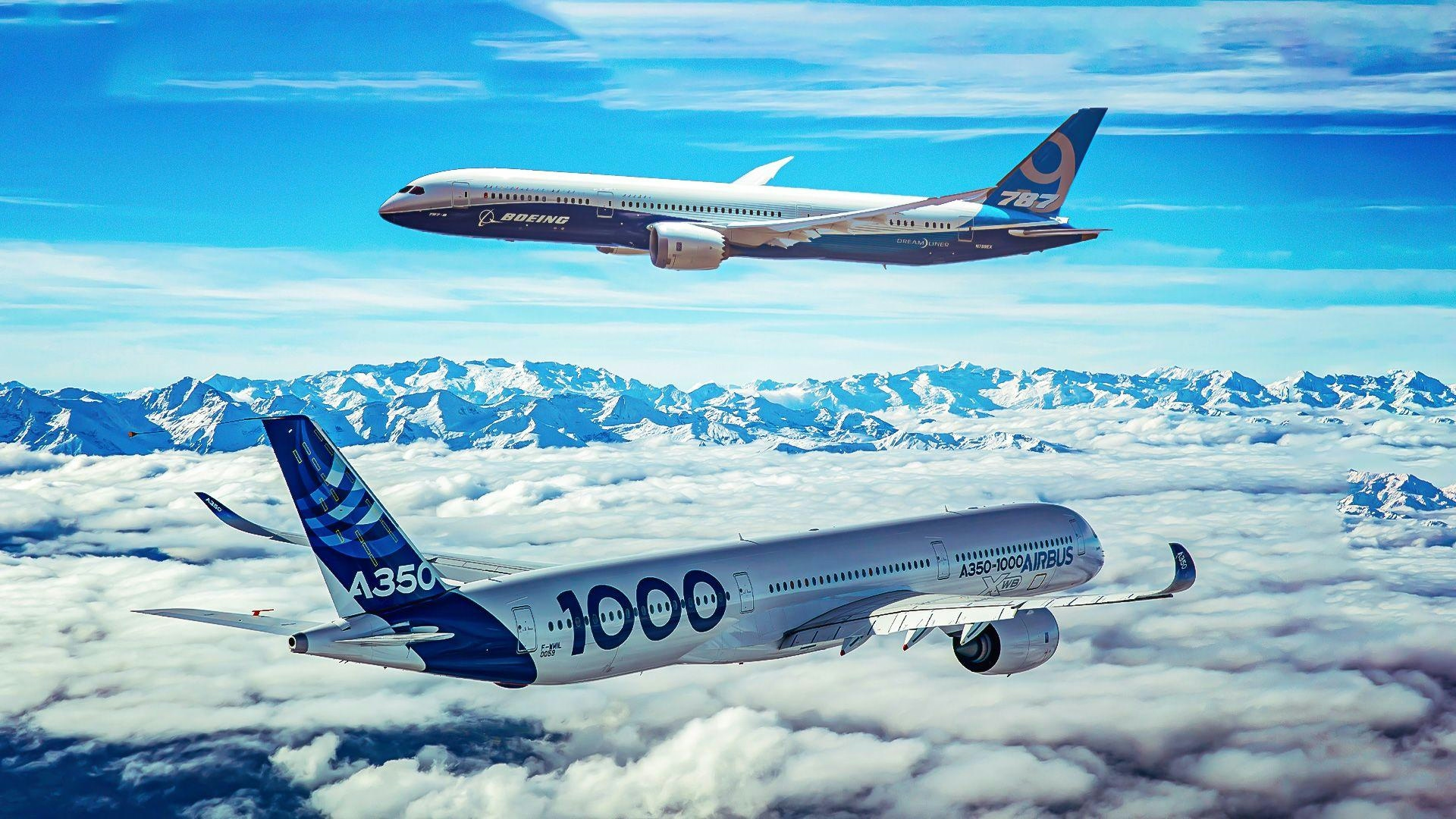
Airbus has fundamentally transformed the competitive dynamics of the global aviation industry, systematically challenging the American aerospace dominance that had prevailed since the 1960s. When the European consortium was established, Boeing and McDonnell Douglas controlled nearly every major international route. Over the past five decades, Airbus introduced six pioneering aircraft models that redefined operational efficiency, revolutionized cockpit technology, and compelled the industry to reconsider the economics of commercial air travel.
The European Challenge to Boeing
The 1970s marked a critical turning point as European manufacturers united under the Airbus banner to confront the entrenched American aerospace giants. At that time, Boeing held over 80% of the widebody aircraft market, a dominance that appeared unassailable. Airbus entered the market with a distinctive philosophy focused on pilot ergonomics, fuel efficiency, and a standardized cockpit design across all its models. This approach resonated strongly with airlines and pilots alike, who benefited from significant reductions in training costs when transitioning between different Airbus aircraft.
By 2026, Airbus had secured approximately half of all new global aircraft orders, fundamentally reshaping the economics of the aerospace sector. The A320neo family, in particular, has experienced surging demand, especially from major carriers such as China Eastern Airlines, highlighting Airbus’s expanding influence in key international markets. Despite this, Airbus’s first-quarter deliveries in 2026 declined year-over-year, even as Boeing achieved a nine-year high in deliveries during February. Geopolitical tensions between the United States and China continue to pose risks to Boeing’s delivery schedules and long-term order book in the Asia-Pacific region. Nevertheless, Boeing’s return to net profitability in 2025 reflects a strong market response to its industrial restructuring efforts.
Cockpit Innovation and Efficiency
Airbus’s A300 was the first widebody aircraft to feature a truly standardized digital cockpit, a design philosophy that was subsequently adopted across its entire fleet. This commonality enabled airlines to rotate pilots between different aircraft families with minimal retraining, in stark contrast to Boeing’s model-specific certification requirements that increased operational costs. The introduction of fly-by-wire technology with the A320 eliminated mechanical linkages, enhancing both safety and efficiency. Across its models, Airbus’s emphasis on cockpit ergonomics and human-factors research has made long-haul operations less demanding for flight crews, while fuel efficiency improvements have averaged between 20 and 25 percent compared to previous-generation competitors.
Six Airframes That Changed Aviation
The A300, launched in 1974, pioneered the widebody twin-engine era and directly challenged the Boeing 747 and McDonnell Douglas DC-10. Its reliability and fuel savings quickly earned the confidence of airlines worldwide. The A320, introduced in 1987, revolutionized narrowbody travel with its fly-by-wire controls and standardized cockpit, becoming the best-selling commercial aircraft in history; by 2026, over 10,000 A320 family jets are in operation globally. The A330, which entered service in 1993, competed directly with the Boeing 777, offering exceptional range and cargo capacity that proved especially valuable on high-utilization routes between Asia and Europe. The A350, introduced in 2015, represented a significant advancement in materials science with its composite airframe, reducing weight and fuel consumption while enabling longer routes with smaller crews. The A380, launched in 2007, became the world’s largest passenger aircraft, setting new benchmarks for capacity and passenger comfort. Finally, the A320neo family has secured substantial global orders, particularly in Asia, and remains central to Airbus’s competitive advantage.
Through these six aircraft, Airbus has not only challenged Boeing’s longstanding dominance but has also driven the entire commercial aviation industry to innovate, adapt, and redefine the possibilities of air travel.

Etihad Airways Suspends Airbus A380 Flights on Key Route

Aditya Birla Group Seeks Approval for Aircraft Leasing in GIFT City

Qatar Airways Highlights Innovation and Connectivity at Arabian Travel Market 2026

Hong Kong's Five-Year Plan Includes Andrew Fan's Aircraft Parts Processing Hub Proposal

ACIA Aero Leasing Delivers ATR72-600 to Air Nostrum

RTX Appoints Jill Albertelli as Head of Pratt & Whitney

TAT Technologies Joins Beyond Aero Hydrogen Aircraft Program

AURAK Study Highlights Barriers to Air Taxi Adoption in Emerging Economies

Xiamen Air Selects Altitude for 787 Maintenance at Heathrow

Etihad and Swissport Extend Global Partnership
