Image

Orchestrer les insights d’IA pour les transformer en actions

Inscrivez-vous dès aujourd’hui sur la liste d’attente d’AeroGenie !

Tendances

Categories

Vertical Aims to Raise $850 Million for Air Taxi Certification
March 30, 2026By ePlane AI
Vertical Aims to Raise $850 Million for Air Taxi Certification
0
0
Vertical Aerospace
Valo eVTOL
Air Taxi Certification

Vertical Aerospace Secures $850 Million Financing Package to Advance Air Taxi Certification

Comprehensive Funding to Support Valo eVTOL Certification Through 2026 and Beyond

Vertical Aerospace, the U.K.-based manufacturer of electric vertical takeoff and landing (eVTOL) air taxis, announced on Monday that it has secured a nonbinding agreement for a financing package valued at up to $850 million. The funds are intended to support the certification process of its flagship Valo aircraft through 2026 and potentially extend beyond that timeline. This announcement follows a recent warning from the company regarding cash flow concerns that raised questions about its financial sustainability.

The financing package was arranged in collaboration with Vertical’s longstanding investor Mudrick Capital Management and Yorkville Advisors Global. If finalized, the agreement would inject substantial capital into the company, including up to $800 million in investments directed toward Vertical’s facilities through 2027 and beyond. Yorkville has committed to purchasing up to $250 million in Series A convertible equity and establishing a $500 million equity line of credit over 36 months, enabling Vertical to draw funds as required. Mudrick Capital will contribute an additional $50 million through new convertible notes and has agreed to extend the repayment deadline for existing notes from December 2028 to December 2030, aligning with the anticipated entry into service of the Valo air taxi.

Vertical estimates the certification process for the Valo will require approximately $700 million. According to its latest earnings report, the company held $93 million in cash and cash equivalents at the end of 2025, supplemented by an expected $28 million from tax relief and government grants. The company’s cash burn for 2025 was $112 million, consistent with prior projections, and it reported an operating loss of $127 million, which was smaller than anticipated. Over the next 12 months, Vertical plans to allocate roughly $195 million to accelerate flight testing, certification, and manufacturing activities.

CEO Stuart Simpson described the financing package as a pivotal development for the company, stating, “We have assembled a comprehensive, flexible financing package designed to execute our strategic plan and materially strengthened our ability to build and certify Valo.”

Intensifying Competition and Legal Challenges in the eVTOL Sector

The announcement comes amid escalating competition within the eVTOL industry, where companies such as Archer Aviation and Joby Aviation have unveiled ambitious plans to launch air taxi services. This competitive environment has intensified the race for certification and market entry. Market reaction to Vertical’s financing news has been positive, interpreting it as a sign of renewed financial stability and robust investor confidence. The new capital also reduces Vertical’s reliance on a backstop financial provider, granting the company greater flexibility in selecting strategic partners.

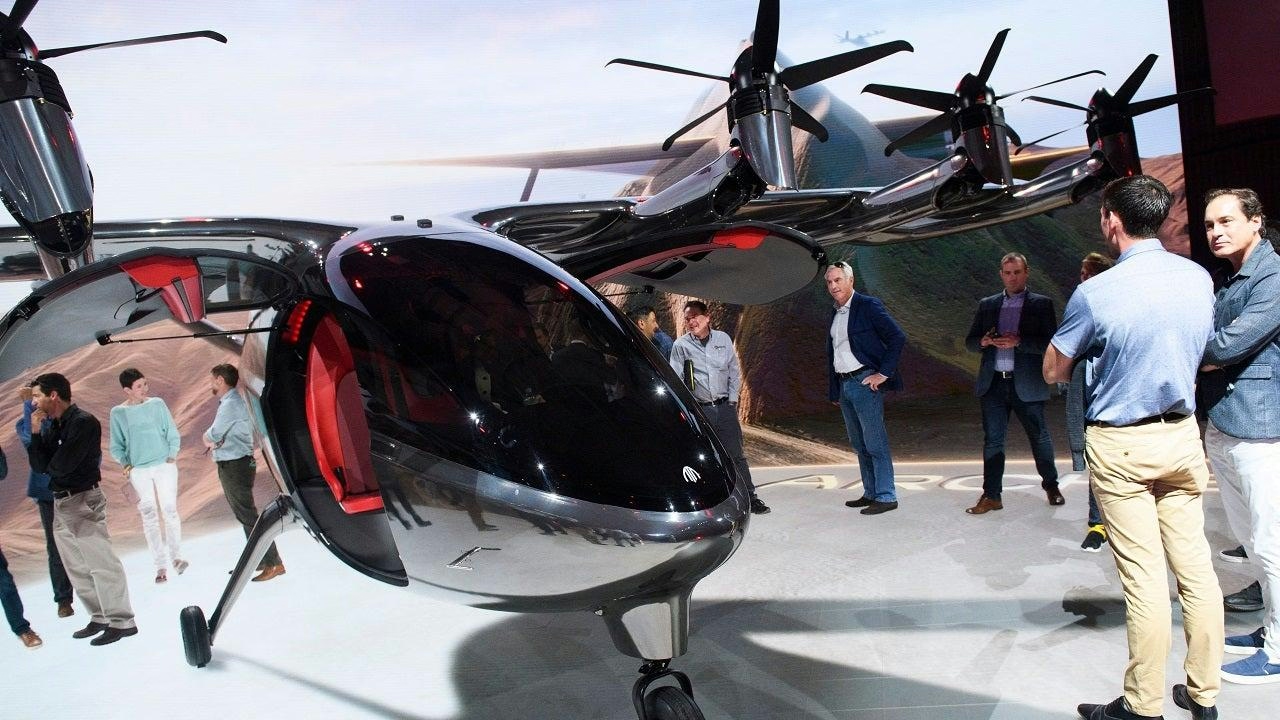
Despite these advances, the competitive landscape remains fraught with legal disputes. Archer Aviation has accused Joby Aviation of fraud related to alleged ties with China and has initiated a patent infringement lawsuit against Vertical, alleging that the Valo design infringes on elements of Archer’s Midnight aircraft. Nevertheless, Vertical’s leadership remains resolute in the face of these challenges.

On the same day as the financing announcement, Vertical disclosed it had raised an additional $50 million through the issuance of common equity shares. When combined with existing cash reserves, anticipated tax relief, and government grants, the company now has approximately $160 million available to support Valo’s certification efforts in 2026. Chairman Domhnall Slattery underscored the significance of the new funding, emphasizing that the package provides immediate working capital and flexible mechanisms to access further capital efficiently as the company advances through its certification milestones.

The partners involved in the financing expect to finalize the terms of the agreement by April 19, after which the funds will be deployed to accelerate Vertical’s certification and manufacturing objectives.

More news
Flying Cars Arrive, Poised to Transform Travel

Flying Cars Arrive, Poised to Transform Travel

Flying Cars Arrive, Poised to Transform Travel The long-envisioned era of flying cars, electric air taxis, and autonomous electric vertical takeoff and landing (eVTOL) aircraft is rapidly approaching reality. For decades, the concept of airborne personal vehicles—popularized by films such as *Back to the Future*—remained a distant dream. However, after years of technological challenges, setbacks, and intense speculation, a new generation of flying vehicles is transitioning from experimental prototypes to commercial production. Leading aviation firms, automakers, and investors are heavily investing in the development of eVTOL aircraft, autonomous air taxis, and road-legal vehicles capable of vertical flight. Unlike the sleek, futuristic designs often depicted in popular culture, most of these emerging vehicles rely on propeller-driven technology and are engineered to transport passengers or cargo above congested urban roads. This approach requires significantly less ground infrastructure compared to traditional aviation, potentially revolutionizing urban mobility. The market potential for these innovations is substantial. Morgan Stanley projects the personal autonomous aircraft sector could reach a valuation of $1.5 trillion. Meanwhile, Tomohiro Fukuzawa, CEO of SkyDrive, anticipates that flying taxi fares could decrease to roughly twice the cost of conventional taxi rides by 2030. Companies such as Joby Aviation, Ehang, and Alef are actively competing to make aerial commuting a practical and accessible option, though considerable obstacles remain. The Latest Vehicles Taking Flight Joby Aviation, in collaboration with Delta Airlines and Uber, is at the forefront of electric commuter aircraft development. In a recent demonstration, Joby’s eVTOL aircraft reduced the typical hour-long car journey from JFK Airport to central Manhattan to just seven minutes. The company’s ambition extends beyond serving affluent customers; it aims to democratize aerial mobility by offering pricing comparable to premium ground transportation services like Uber Black. Joby envisions transforming daily commuting by alleviating traffic congestion and reducing reliance on traditional rail systems. Ehang’s EH216-S distinguishes itself as a fully autonomous air taxi, having recently become the first self-flying air taxi to receive regulatory approval for commercial operations in China. Currently offering sightseeing flights, Ehang is conducting pilot projects across 19 countries, emphasizing the efficiency and scalability of autonomous flight. Nevertheless, public acceptance of pilotless air travel remains an open question, posing a potential barrier to widespread adoption. The Alef Model A represents the closest realization of the classic “flying car” concept. Although it does not resemble the iconic DeLorean, this road-legal electric vehicle fits within a standard garage, operates on conventional roads, and is capable of vertical takeoff. This dual functionality positions the Alef Model A as a versatile option bridging ground and air transportation. Challenges and the Road Ahead Despite growing enthusiasm and strong investor interest, the path to mainstream adoption of flying cars and eVTOL aircraft is fraught with challenges. Regulatory approval, particularly certification from agencies such as the Federal Aviation Administration, remains a significant hurdle. Additionally, the development of new charging infrastructure will be essential to support the anticipated fleets of electric aircraft. Concerns over noise pollution and public acceptance also present substantial uncertainties. While technological advancements continue at a rapid pace, it is unclear whether communities will welcome the presence of numerous low-flying vehicles in urban airspace. Although flying cars appear poised to enter the transportation landscape, their successful integration into everyday life will depend on overcoming regulatory, technical, and societal obstacles. The coming years will be critical in determining whether this long-anticipated vision of the future can truly take flight.
Qantas Faces Union Pressure on AI Strategy

Qantas Faces Union Pressure on AI Strategy

Qantas Faces Union Pressure on AI Strategy Union Seeks Clarity Amid Workforce Concerns The Australian Services Union (ASU) has formally requested an urgent meeting with Qantas chief executive Vanessa Hudson to gain greater insight into the airline’s artificial intelligence (AI) strategy. This move comes amid mounting apprehension regarding the potential impact of AI on the workforce and broader operational changes within the company. The union’s intervention follows comments made by Hudson in May 2026, where she emphasized the positive role AI tools have played in enhancing Qantas’s on-time performance by three to four percentage points. Hudson noted that AI technologies are currently employed to integrate maintenance records with weather data, thereby streamlining operations and boosting efficiency. Despite these advancements, the ASU contends that Qantas’s AI initiatives constitute an “active programme of major workforce change,” primarily aimed at cost reduction and accompanied by the risk of job losses. These concerns have been heightened by the airline’s recent decision to cut 400 head office positions earlier this year. Strategic Shifts Amid Market Pressures Qantas’s AI strategy is unfolding within a challenging industry environment marked by significant market pressures. The airline has recently decelerated its international capacity growth and extended reductions in domestic capacity in response to sharply rising fuel costs. These increases are linked to the ongoing fuel crisis stemming from the conflict in Iran. In response, Qantas has shifted capacity towards its European long-haul routes, reflecting a broader strategic realignment designed to navigate volatile market conditions. The airline’s experience highlights the complex intersection of AI adoption and operational restructuring, a challenge shared by companies worldwide. Technology firms such as Nvidia face risks related to AI investment and intensifying competition, while businesses in the United Kingdom have been cautioned about lagging behind in the AI economy due to skills shortages. For Qantas, the integration of AI represents not only a technological advancement but also a strategic response to external economic and geopolitical pressures, underscoring the intricate balance between workforce management, market dynamics, and rapid technological change. The Need for Transparency and Dialogue The ASU’s call for dialogue with Qantas leadership underscores the critical need for transparency as the airline seeks to balance innovation with employee interests. The forthcoming discussions may prove pivotal in setting a precedent for how airlines and other sectors manage the transition to AI-driven operations amid ongoing economic uncertainties and geopolitical challenges.
New Nonstop Flight Connects Seattle and Madrid

New Nonstop Flight Connects Seattle and Madrid

New Nonstop Flight Connects Seattle and Madrid On Wednesday, May 13, a significant milestone in transatlantic aviation was achieved as a Boeing 737-MAX 8 completed a nonstop flight from Seattle to Madrid. Covering nearly 7,200 kilometres without stopping, the aircraft defied its original plan to refuel in Glasgow, Scotland. Benefiting from favorable weather conditions and strong tailwinds, the flight reached Madrid in just eight and a half hours. Flight tracking data confirmed that the jet maintained continuous flight, underscoring the enhanced efficiency and extended range capabilities of modern aircraft when combined with optimal atmospheric conditions. Flight Details and Aviation Innovation The aircraft involved in this journey was a Boeing 737-MAX 8 on a delivery flight for Air Europa. Under typical operating conditions, this model has a range of approximately 6,480 kilometres with standard passenger and cargo loads. However, with no passengers or cargo aboard, the plane was significantly lighter, allowing for maximum fuel efficiency and an extended range. A ridge of high pressure over the northern Atlantic altered the jet stream, generating powerful tailwinds across Greenland, Iceland, and the United Kingdom. At its peak, the aircraft achieved ground speeds exceeding 950 km/h, demonstrating the combined advantages of advanced aeronautical engineering and favorable meteorological factors. Jet streams, which are fast-moving air currents in the upper atmosphere, play a critical role in transatlantic flights. Eastbound routes, such as the one from Seattle to Madrid, often utilize these winds to reduce both fuel consumption and flight duration. This particular flight exemplifies how airlines can optimize routes and operational efficiency when aircraft capabilities align with advantageous weather patterns. Thousands of transatlantic flights daily depend on such natural phenomena to ensure timely arrivals and cost-effective operations. Market Impact and Benefits for Travelers The launch of nonstop service between Seattle and Madrid reflects evolving dynamics within the transatlantic aviation market. Alaska Airlines, which introduced this route, now competes directly with Delta Air Lines, a dominant player in Seattle’s international market that is simultaneously expanding its transatlantic network. This increased competition is likely to offer travelers more options and potentially lower fares for both business and leisure travel. Nevertheless, Alaska Airlines faces logistical challenges, including navigating regulatory requirements and establishing comprehensive cargo and passenger service networks in Madrid as it enters a new European market. Delta’s response may involve adjustments to pricing or service offerings to maintain its market share. For travelers, the availability of optimized nonstop routes translates into faster connections and fewer layovers, particularly benefiting business passengers who value time efficiency. Leisure travelers gain more direct access to European destinations from major U.S. hubs like Seattle. Airlines are increasingly leveraging advanced flight planning software and real-time wind data to minimize delays and enhance fuel efficiency, appealing to passengers who are both cost-conscious and environmentally aware. As the aviation industry continues to innovate and intensify competition, passengers can anticipate more efficient, direct, and sustainable options for transatlantic travel.
Delta CEO Acknowledges AI Limits While Using It for Ticket Pricing

Delta CEO Acknowledges AI Limits While Using It for Ticket Pricing

Delta CEO Reflects on AI Limitations Amid Growing Use in Ticket Pricing Delta Air Lines CEO Ed Bastian recently addressed the inherent limitations of artificial intelligence, even as the airline increasingly integrates AI-driven systems into its ticket pricing strategies. Speaking at Emory University’s commencement ceremony, Bastian shared a personal experience with AI, revealing that he had initially used the technology to draft his speech but ultimately discarded the result. The Human Element in Communication Bastian explained to the graduates that the AI-generated speech lacked the warmth and authenticity he sought to convey. “It was not my personal voice, and it did not express my genuine appreciation for the opportunity to impart my insights to thousands of you,” he said. Emphasizing the importance of genuine human connection, he added, “You want to hear from me, not some algorithm of me.” The 68-year-old CEO chose instead to write his speech by hand, a decision that was met with applause from the audience. “So don’t worry,” he reassured, “I threw it away and took pencil to paper.” AI in Airline Pricing Under Scrutiny Bastian’s reflections come amid growing scrutiny of Delta’s use of AI for dynamic ticket pricing. The airline has faced criticism for maintaining high fares despite declining fuel costs, sparking debate over the transparency and fairness of AI-driven pricing models. Critics argue that such systems may prioritize cost recovery and profitability over customer satisfaction, raising concerns about the ethical implications of algorithmic decision-making in the industry. Market responses to Delta’s pricing approach have been mixed. Some passengers question the rationale behind premium fare adjustments, while others express unease about the opaque nature of how prices are determined. This controversy has also drawn attention to competitors, with JetBlue encountering similar accusations of “surveillance pricing.” The airline, however, denies using personal data to tailor individual fares. The Industry’s Ethical Challenge The broader airline sector continues to wrestle with the ethical challenges posed by AI-powered pricing. As carriers strive to balance profitability with consumer trust, the debate over the role of algorithms in setting ticket costs intensifies. Bastian’s candid acknowledgment of AI’s shortcomings—both in personal communication and business operations—underscores the ongoing challenge for airlines: harnessing technological innovation without sacrificing the human element essential to building lasting customer loyalty.
China Places First Boeing Order in Nearly a Decade for 200 Planes

China Places First Boeing Order in Nearly a Decade for 200 Planes

China Places First Boeing Order in Nearly a Decade for 200 Planes China is poised to place an order for 200 aircraft from Boeing, marking the first significant purchase of Boeing planes by the country in nearly ten years. This development was announced by U.S. President Donald Trump during a Thursday interview on Fox News. Referring to Chinese President Xi Jinping, Trump stated, “One thing he agreed to was he’s gonna order 200 jets. That’s a big thing, Boeings.” Although the specific models of the aircraft were not disclosed, Trump noted that Boeing CEO Kelly Ortberg initially sought an order for 150 jets but ultimately secured 200. Requests for comment from both the White House and Boeing have not yet been addressed. Significance of the Deal Amid U.S.-China Relations The agreement represents a potential thaw in the aviation sector of U.S.-China relations, which have been strained by years of trade tensions and stalled negotiations. For Boeing, this order is a crucial boost, especially as the company has faced mounting challenges in the Chinese market due to increasing competition from domestic manufacturers. The deal could signal renewed cooperation and a strategic opening for Boeing in one of the world’s fastest-growing aviation markets. Despite the positive headline, industry analysts remain cautious about the long-term impact of the order. Some experts had anticipated a larger purchase, while others highlight the persistent uncertainties surrounding the broader U.S.-China trade relationship. Boeing also contends with rising competition from Chinese aerospace firms such as AVIC, which recently secured a launch order for its HH-200 Cargo unmanned aerial system, underscoring China’s ambitions to expand its indigenous aviation capabilities. Market Reactions and Future Outlook Market responses to the announcement have been mixed. While the order is a welcome development for Boeing, global competitors including Airbus are expected to closely observe the evolving dynamics and may seek to leverage any shifts in the market. The deal highlights both the opportunities and challenges facing Boeing and the wider aviation industry as manufacturers compete for a share of China’s rapidly expanding aviation sector. As further details of the agreement emerge, the transaction will remain a focal point in assessing the trajectory of U.S.-China aviation relations and the competitive landscape within the global aerospace market.
Magnum Wings Completes Unmanned Air Taxi Flight Trial

Magnum Wings Completes Unmanned Air Taxi Flight Trial

Magnum Wings Completes Unmanned Air Taxi Flight Trial Magnum Wings, an Andhra Pradesh-based start-up, has successfully completed an unmanned flight trial of its V2 2.0 electric air taxi prototype, marking a significant milestone in India’s emerging urban air mobility sector. This achievement establishes Magnum Wings as the first Indian company to publicly demonstrate flying air taxi technology, placing it among a select group of global firms advancing air taxi platforms to the flight stage. Progress and Technical Specifications At a recent press conference, Managing Director Abhiram Chava detailed the company’s progress, noting that the V2 2.0 platform had already undergone structural testing prior to the flight trial. The prototype is designed for short-distance urban and regional transportation, with an endurance of approximately 45 minutes and an operational range close to 30 kilometres. Chava underscored the pride in joining the global ranks of innovators in this field, highlighting the significance of Magnum Wings’ accomplishment for both the company and the region. Looking forward, Magnum Wings intends to focus on certification processes and manned flight trials. Human flight testing will commence only after securing all necessary regulatory approvals and safety clearances. The company aims to launch initial commercial services by the end of the year, contingent upon obtaining mandatory certifications. Challenges and Industry Context Despite this progress, the path to commercial deployment remains complex. Regulatory certification, particularly from international authorities such as the Federal Aviation Administration (FAA), poses a considerable challenge. The development of supporting infrastructure, including new charging facilities, is also critical for the widespread adoption of electric air taxis. Furthermore, the sector faces intensifying competition and legal challenges, exemplified by patent infringement disputes involving major players like Archer Aviation, which have already affected partnerships such as Delta’s collaboration with Joby Aviation. Public acceptance and integration of air taxis into existing transportation networks present additional hurdles. While the vision of urban air mobility evokes futuristic imagery, skepticism persists regarding its practicality and safety. Ensuring seamless integration with current infrastructure will be essential to gaining public trust and achieving operational viability. Strategic Vision and Economic Potential Chava expressed optimism about the broader industrial potential of advanced air mobility in Andhra Pradesh. He highlighted the opportunity to generate thousands of high-skill jobs across various domains, including aircraft manufacturing, battery systems, electronics, composites, software development, testing, maintenance, training, and operations. Magnum Wings is actively exploring applications of electric air mobility beyond air taxis, targeting sectors such as emergency response, medical transport, tourism, industrial mobility, and regional connectivity. The company envisions electric air mobility as a transformative force for short-distance transportation and aims to position Andhra Pradesh as a leading hub for emerging aviation technologies within India.
NTSB Calls on FAA to Require Cockpit Smoke Training After 737 Max Incident

NTSB Calls on FAA to Require Cockpit Smoke Training After 737 Max Incident

NTSB Calls on FAA to Mandate Cockpit Smoke Training Following 737 Max Incident The National Transportation Safety Board (NTSB) has formally urged the Federal Aviation Administration (FAA) to require pilots to undergo realistic, scenario-based cockpit smoke training. This call comes in the wake of a December 2023 incident involving a Southwest Airlines Boeing 737 Max, during which the cockpit rapidly filled with smoke following an engine failure shortly after takeoff from Louisville. The NTSB’s recommendations, released in early May, emphasize the critical need for enhanced pilot preparedness in emergencies characterized by limited visibility and smoke infiltration. Details of the Incident and Pilot Response The December event was triggered when the aircraft’s left-side CFM International Leap-1B turbofan ingested a bird, causing fan blade separation. This activated the engine’s load reduction device (LRD), a mechanism designed to prevent further damage by shedding fan blades. However, this process can result in oil spilling onto hot engine components, producing smoke that may enter the cockpit or passenger cabin depending on the affected engine. In this case, the cockpit became rapidly engulfed in smoke, severely impairing the flight crew’s visibility. The pilots reported that the sudden onset of smoke, combined with the adrenaline and surprise of the situation, presented challenges far beyond their prior training experiences. Despite these difficulties, the crew successfully donned oxygen masks, executed emergency checklists, declared an emergency, and safely landed the aircraft. The NTSB cautioned that had this incident occurred under more adverse conditions, such as at night or in poor weather, the outcome could have been catastrophic. This was the second similar event involving a Southwest 737 Max 8 in 2023, following a comparable incident in March. Notably, current U.S. regulations do not mandate cockpit smoke simulation training for pilots, leaving a critical gap in emergency preparedness. Calls for Regulatory and Industry Action In response, the NTSB is pressing the FAA to develop and implement standardized, scenario-based training modules for both new and recurrent pilots, specifically targeting smoke-in-the-cockpit emergencies. The board also urged industry organizations, including Airlines for America (A4A) and the Regional Airline Association (RAA), to disseminate information about the December incident among their members and promote the adoption of realistic smoke training programs. The Department of Transportation’s Office of Inspector General has also scrutinized the FAA’s handling of engine smoke incidents, recommending that the agency take more proactive measures. These include timely notifications to operators regarding delays in software updates intended to mitigate such risks. Meanwhile, LOT Polish Airlines has publicly accused Boeing of withholding safety information related to the 737 Max to facilitate sales, arguing that comprehensive simulator training requirements would have increased operational costs for customers. When approached for comment on the NTSB’s recommendations, neither the FAA nor the RAA responded. Airlines for America acknowledged ongoing collaboration with the NTSB and FAA to uphold safety standards but did not address inquiries about expanding pilot training protocols. The NTSB remains steadfast in its position that realistic, scenario-based cockpit smoke training is vital to equip pilots with the skills necessary to manage emergencies that can rapidly escalate and jeopardize flight safety.
Israir Advances Plans to Launch U.S. Flights This Summer

Israir Advances Plans to Launch U.S. Flights This Summer

Israir Advances Plans to Launch U.S. Flights This Summer Amid Market Challenges Israir is progressing with its strategic entry into the long-haul flight market, marking a significant development as Bird Aviation, its maintenance subsidiary based in Larnaca, Cyprus, received approval from Israel’s Civil Aviation Authority to conduct line maintenance on Airbus A330 aircraft. This certification represents a pivotal step in Israir’s preparations to commence direct flights to the United States this summer and to expand its operations with a wide-body fleet. Maintenance Certification and Fleet Expansion The newly granted authorization allows Israir to independently perform routine maintenance tasks—including troubleshooting, inspections, and operational support—on the Airbus A330s designated for its long-haul routes. The airline expects this capability to enhance aircraft availability and operational flexibility as it scales up international services. Additionally, Israir is advancing plans to broaden Bird Aviation’s maintenance scope to include heavy maintenance, with construction underway on a new wide-body hangar in Larnaca. Earlier this year, Israir unveiled a broader expansion strategy involving the acquisition of six wide-body aircraft and the pursuit of new destinations beyond New York. The airline has identified several potential routes in the Far East, including Thailand, Vietnam, Japan, the Philippines, Hong Kong, and an additional Chinese city, alongside plans to serve Miami. To spearhead this initiative, Israir appointed Yoav Weiss as executive vice president responsible for U.S. and Far East operations and wide-body fleet management. Navigating Regulatory and Market Challenges Israir’s ambitions unfold within a complex and competitive environment. The U.S. market poses regulatory challenges, exemplified by the Federal Aviation Administration’s recent imposition of a daily flight cap of 2,708 at Chicago O’Hare International Airport aimed at alleviating congestion and delays. Such restrictions may affect Israir’s expansion plans and limit slot availability at critical U.S. airports. Domestically, the airline faces potential opposition from the Haredi community, which has threatened a boycott in response to Israir’s operations on Shabbat. This could impact the airline’s market share, particularly among religious travelers. Concurrently, competition is intensifying as El Al expands its network with new routes to Argentina and other South American destinations, potentially altering regional market dynamics and passenger flows. Despite these obstacles, Israir remains committed to enhancing its operational capabilities. Shai Gil, Israir’s vice president of maintenance, described the recent maintenance approval as “another important step in strengthening the synergy between the group’s companies, improving aircraft availability, increasing operational flexibility, and enhancing our ability to provide a fast, high-quality response to the company’s needs, especially ahead of the launch of operations to the United States.” As Israir prepares for its U.S. debut and further international growth, the airline must carefully navigate regulatory constraints, community concerns, and heightened competition to establish a foothold in the evolving long-haul market.
NCAA Approves Pioneer Airlines for Charter Flight Operations

NCAA Approves Pioneer Airlines for Charter Flight Operations

NCAA Grants Operational License to Pioneer Airlines for Charter Flights The Nigeria Civil Aviation Authority (NCAA) has officially authorized Pioneer Airlines to commence unscheduled charter flight operations, marking a significant milestone for the carrier. The operational license was formally presented to the airline’s management in Abuja by NCAA Director General, Captain Chris Ona Najomo. In his remarks, Captain Najomo commended Pioneer Airlines for its dedication to maintaining high safety standards, underscoring the authority’s ongoing commitment to monitoring the airline’s compliance with established aviation best practices. Pioneer Airlines’ Strategic Progress and Future Plans Captain Henry Ungbuku, Managing Director of Pioneer Airlines, highlighted the airline’s rapid advancement in securing certification, achieved in just over four months due to the company’s preparedness. He explained that the airline currently operates two aircraft owned by the Bayelsa State Government. Initially, NCAA regulations mandated a minimum of six aircraft for scheduled operations, which led Pioneer Airlines to apply for unscheduled operations encompassing charter and group bookings. However, during the certification process, the NCAA revised the minimum aircraft requirement from six to two, enabling Pioneer Airlines to consider applying for scheduled services in the near future. The airline is leasing its aircraft from the Bayelsa State Government and will commence monthly lease payments once operations begin. This arrangement positions Pioneer Airlines to expand its service offerings and potentially transition into scheduled flight operations, leveraging its existing fleet. Market Implications and Competitive Landscape Industry analysts suggest that NCAA’s approval of Pioneer Airlines may disrupt the charter flight market in Nigeria, compelling established competitors to respond with intensified marketing efforts, pricing strategies, and enhanced service quality. The entry of a new operator is expected to attract heightened regulatory scrutiny and could influence consumer preferences, potentially shifting demand dynamics within the sector. Major players such as NetJets and the American Airlines partnership with TLC Jet are anticipated to bolster their competitive positions by capitalizing on their extensive networks and loyalty programs. As Pioneer Airlines prepares to launch its charter services, the interplay between regulatory developments and competitive responses will be critical in shaping the airline’s future within Nigeria’s evolving aviation industry.
Sabre Investigates Generative AI to Enhance Airline Operations

Sabre Investigates Generative AI to Enhance Airline Operations

Sabre Investigates Generative AI to Enhance Airline Operations Advancing Efficiency Through Artificial Intelligence Sabre is actively exploring the capabilities of generative artificial intelligence to improve efficiency and foster innovation within the airline industry. The company recently showcased practical applications of generative AI through a video on its Sabre Mosaic platform, emphasizing potential enhancements in customer service, operational decision-making, and overall competitiveness for airlines. This initiative reflects Sabre’s commitment to leveraging cutting-edge technology to address the evolving demands of the travel sector. Competitive Pressures and Industry Dynamics Sabre’s strategic focus on AI emerges amid intensifying competition from its industry rival, Amadeus, which is aggressively expanding its travel technology portfolio. Amadeus is investing heavily in three key areas: biometric identity solutions, AI partnerships, and a comprehensive airline retailing platform. These developments have positioned Amadeus as a significant competitor, challenging Sabre’s leadership in the rapidly evolving travel technology landscape. The rivalry between the two companies has also manifested in disputes over business practices. Sabre has accused Amadeus of monopolistic behavior, particularly concerning restricted access to Amadeus’s Altéa passenger service system, which Sabre argues limits competition. This contention highlights the high stakes involved as both firms vie to shape the future of airline technology. Accelerating AI-Driven Innovation In response to these challenges, Sabre is intensifying the development of its AI-powered agentic travel technology. The company reports that over 30 partners are currently piloting or utilizing its APIs and servers, while it continues to collaborate with major AI platforms to enhance its technological offerings. Sabre encourages industry stakeholders to engage with its latest Mosaic platform video to gain insight into how generative AI could transform airline operations. As competition between Sabre and Amadeus escalates, the integration of advanced AI solutions is poised to play a critical role in defining the next generation of airline technology.
line









