
Orquestre insights de IA em ações

Tendências
Categories
Airbus UpNext Selects Aeva 4D LiDAR for Optimate Project
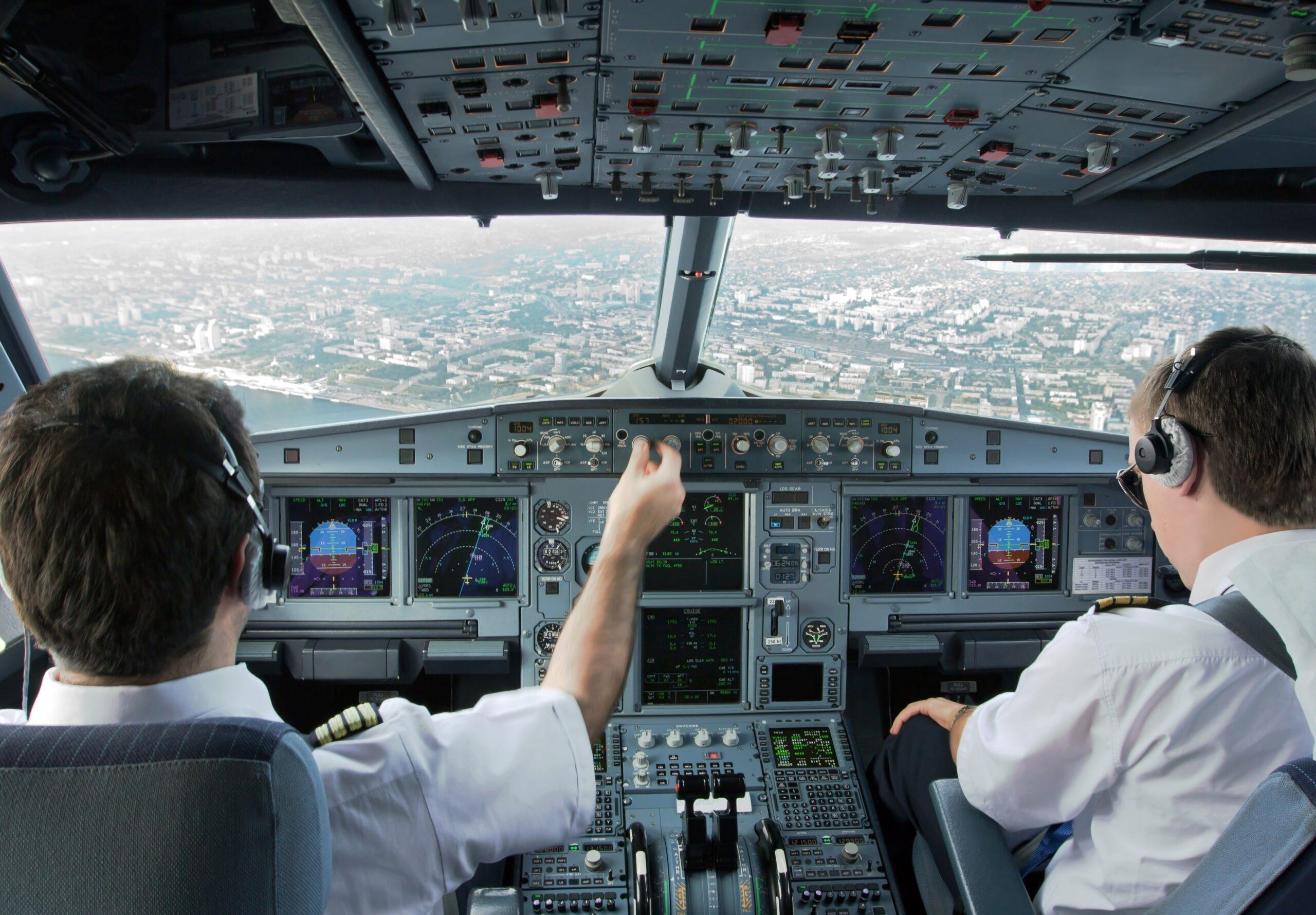
Airbus UpNext Selects Aeva 4D LiDAR for Optimate Project
Advanced Sensing Technology for Aviation Automation
Aeva, a leader in advanced sensing and perception systems, has been chosen by Airbus UpNext to supply its state-of-the-art 4D LiDAR technology for the Optimate smart automation demonstrator. Airbus UpNext, a subsidiary focused on pioneering new aerospace technologies, aims to leverage Aeva’s Frequency Modulated Continuous Wave (FMCW) LiDAR, which simultaneously measures precise distance and velocity for every point in a scene. This technology represents a significant advancement over traditional LiDAR systems by delivering high-resolution data at ranges up to 500 meters. Such capabilities are particularly critical in the complex and dynamic environments of airports, including runways and taxiways, where accurate and timely perception is essential.
The Optimate Project and Its Objectives
The Optimate initiative seeks to improve pilot assistance and decision-making through the integration of advanced automation technologies. As part of this effort, Airbus is conducting extensive testing of multiple Aeva 4D LiDAR units installed on an Airbus A350-1000 flight test aircraft and an electric truck. These trials are taking place during taxi operations at Toulouse-Blagnac airport as well as at a larger international airport, exposing the technology to a broad range of operational conditions. Soroush Salehian, Co-founder and CEO of Aeva, emphasized the significance of the partnership, noting Airbus’s strong track record of innovation and the opportunity to demonstrate the transformative potential of 4D LiDAR in aviation.
Implications for Aviation and Beyond
Aeva’s 4D LiDAR sensors distinguish themselves by detecting instantaneous velocity alongside three-dimensional positioning, all within a compact module that integrates key components onto a silicon photonics chip. This innovation enables autonomous systems—from vehicles to industrial robots—to make more informed and safer decisions. The adoption of Aeva’s technology in Airbus’s Optimate project reflects a broader industry trend toward smarter, more autonomous aviation systems. While the collaboration has been met with enthusiasm, it also underscores challenges such as the technical complexities of integrating new sensor systems into existing aircraft and ground vehicles, as well as the stringent regulatory standards governing aviation.
As Airbus and Aeva advance their partnership, competitors in the sensing and perception market are likely to accelerate their own development efforts, intensifying the race to deliver more capable and reliable automation solutions. The Optimate project thus sets a new benchmark for smart automation in aviation, illustrating how next-generation sensing technologies can enhance safety, efficiency, and decision-making in increasingly complex operational environments.

Etihad Airways Suspends Airbus A380 Flights on Key Route

Aditya Birla Group Seeks Approval for Aircraft Leasing in GIFT City

Qatar Airways Highlights Innovation and Connectivity at Arabian Travel Market 2026

Hong Kong's Five-Year Plan Includes Andrew Fan's Aircraft Parts Processing Hub Proposal

ACIA Aero Leasing Delivers ATR72-600 to Air Nostrum

RTX Appoints Jill Albertelli as Head of Pratt & Whitney

TAT Technologies Joins Beyond Aero Hydrogen Aircraft Program

AURAK Study Highlights Barriers to Air Taxi Adoption in Emerging Economies

Xiamen Air Selects Altitude for 787 Maintenance at Heathrow

Etihad and Swissport Extend Global Partnership
