
Orquestre insights de IA em ações

Tendências
Categories
Astro Mechanica Partners with Helix to Develop Hybrid Supersonic Engines
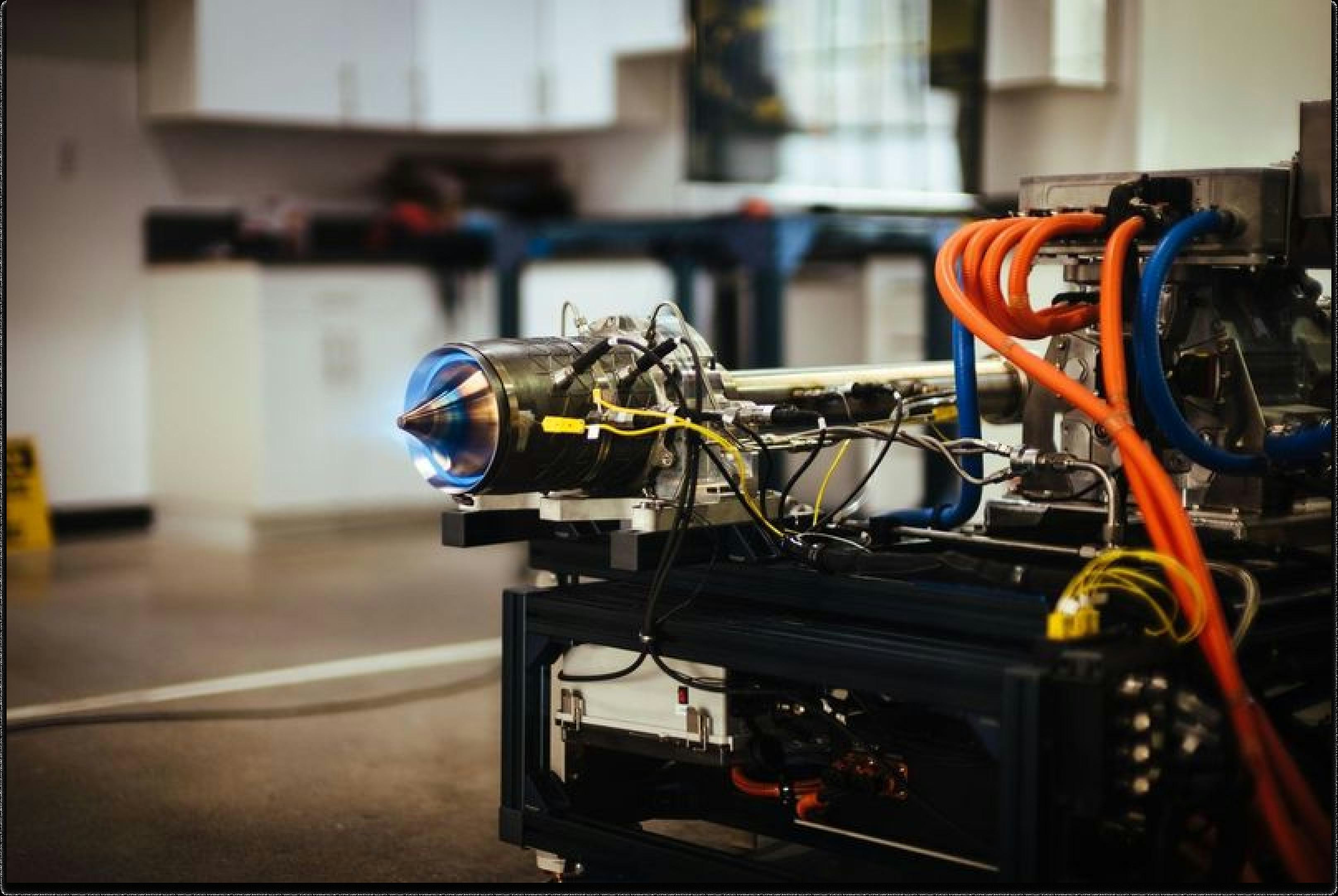
Astro Mechanica and Helix Collaborate on Hybrid Supersonic Engine Development
The aviation industry’s longstanding ambition to revive commercially viable supersonic travel faces significant challenges, particularly in developing propulsion systems that effectively balance speed, efficiency, and operational cost. The demise of the Concorde underscored these difficulties, highlighting the need for innovative engine designs. In response, California-based startup Astro Mechanica has partnered with UK engineering firm Helix to develop a groundbreaking propulsion system known as Duality™, which aims to enable efficient, long-range supersonic flight through a radically adaptive hybrid engine.
A Revolutionary Propulsion Architecture
At the heart of this innovation lies a turboelectric combined-cycle engine capable of functioning as three distinct powerplants without any hardware modifications. The engine operates as a turbofan during takeoff and climb, transitions to a turbojet at supersonic speeds, and shifts to a ramjet mode beyond Mach 2. This versatility is achieved by modularizing the traditional engine architecture. Unlike conventional designs that rely on a single turbine to drive all components, Duality™ employs a gas turbine exclusively for power generation, while Helix’s ultra-dense electric motors independently drive the compressor and fan.
Helix’s contribution is pivotal to the system’s performance. The fourth-generation Duality™ prototype integrates four Helix SPX242-94 electric motors, each capable of delivering 400 kW of peak power and 470 Nm of torque, yet weighing only 31.3 kilograms. This exceptional power-to-weight ratio transforms theoretical concepts into practical, flight-ready engines. Derek Jordanou-Bailey, Aerospace Chief Engineer at Helix, emphasized the significance of this advancement, stating, “Duality™ shows what becomes possible when you remove weight as the limiting factor. For decades, we’ve pushed electric powertrain performance to its limits, and now that same technology is enabling the next generation of high-speed flight.”
Astro Mechanica has already demonstrated the viability of this architecture through hot-fire testing of its third-generation engine, with the current system undergoing active evaluation. The companies plan to develop a flight demonstrator within the next three years.
Addressing Efficiency and Market Challenges
The combined-cycle design directly tackles one of Concorde’s critical shortcomings: excessive fuel consumption. By allowing the electric motors to independently control airflow separate from the turbine, the engine maintains optimal compression across all flight regimes, thereby reducing drag and fuel burn. Drawing on advances from electric automotive technology, the design employs high-efficiency motors to spin lightweight blisks and compressors, circumventing the fuel penalties typically associated with conventional turbojets.
Despite these promising developments, significant challenges remain on the path to commercial deployment. Integrating advanced electric and turbine technologies presents complex engineering obstacles, while regulatory approval for novel propulsion architectures continues to be a demanding process. Furthermore, the competitive landscape is intensifying, with established engine manufacturers and automotive companies such as Honda accelerating their own hybrid propulsion programs. Honda’s development of new V-6 and four-cylinder engines for large hybrid vehicles exemplifies this trend, prompting increased investment and research in hybrid technologies across the industry.
Looking ahead, Helix is advancing next-generation motors for Duality™ that will deliver 900 kW of continuous power—nearly triple the current output—operating at 20,000 rpm. As competition in hybrid engine technology escalates, the partnership between Astro Mechanica and Helix represents a potentially transformative step toward making supersonic travel both practical and sustainable.

Etihad Airways Suspends Airbus A380 Flights on Key Route

Aditya Birla Group Seeks Approval for Aircraft Leasing in GIFT City

Qatar Airways Highlights Innovation and Connectivity at Arabian Travel Market 2026

Hong Kong's Five-Year Plan Includes Andrew Fan's Aircraft Parts Processing Hub Proposal

ACIA Aero Leasing Delivers ATR72-600 to Air Nostrum

RTX Appoints Jill Albertelli as Head of Pratt & Whitney

TAT Technologies Joins Beyond Aero Hydrogen Aircraft Program

AURAK Study Highlights Barriers to Air Taxi Adoption in Emerging Economies

Xiamen Air Selects Altitude for 787 Maintenance at Heathrow

Etihad and Swissport Extend Global Partnership
