
Orquestre insights de IA em ações

Tendências
Categories
Can Marshall Aerospace Turn Around Its C-130 Business?
Can Marshall Aerospace Turn Around Its C-130 Business?
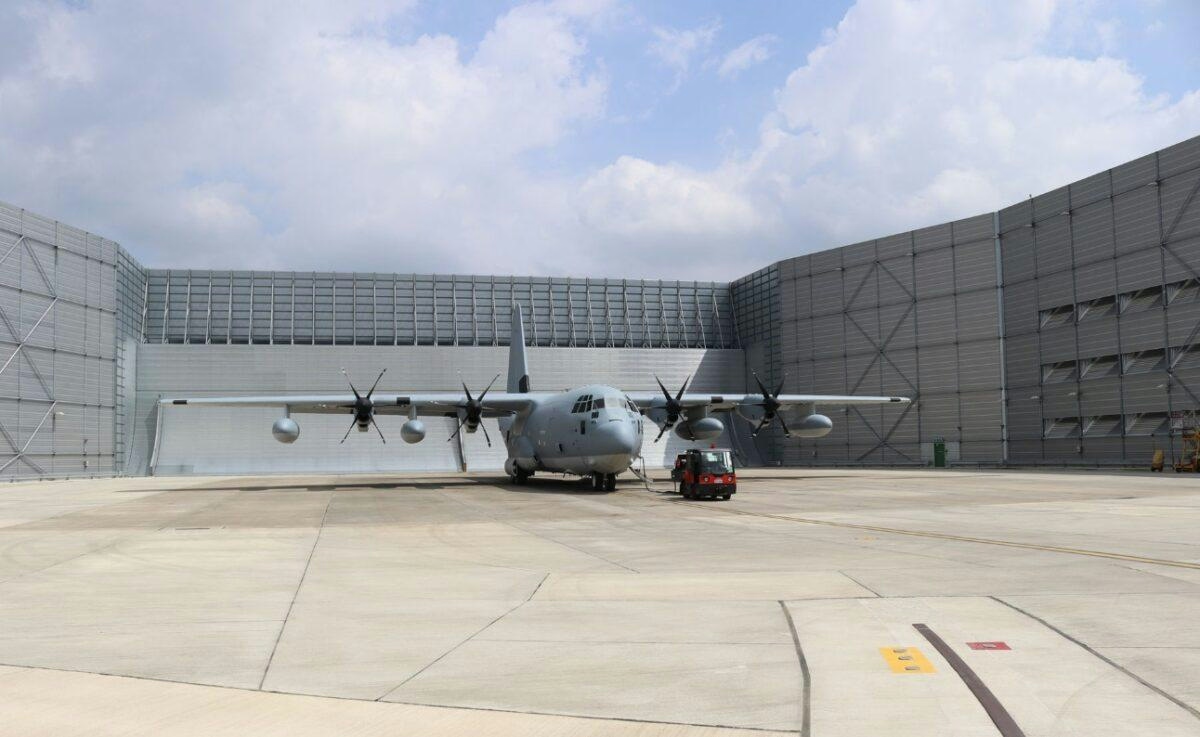
A visit to Marshall Aerospace’s maintenance, repair, and overhaul (MRO) centre at Cambridge Airport reveals the enduring presence of the Lockheed Martin C-130, a military transport aircraft that has long been central to the UK company’s identity. The aircraft is visible in nearly every hangar, including two operated by the US Marine Corps, the South African Air Force’s C-130BZ that famously carried Nelson Mandela’s coffin, and “Fat Albert,” the C-130J supporting the US Navy’s Blue Angels, currently undergoing a centre wing box replacement. This highly specialised task underscores Marshall’s unique position as the only MRO outside the United States authorised to perform such work.
Among the aircraft at the Cambridge site are 15 ex-Royal Air Force C-130Js, retired prematurely in June 2023 following a UK strategic defence review. After months of speculation, it was confirmed late last year that the Turkish Air Force would acquire 12 of these aircraft. Marshall has been tasked with preparing these planes for re-entry into service and providing initial sustainment, signalling a significant contract amid a period of uncertainty.
Challenges Amid Market Shifts
Despite this activity, Marshall Aerospace faces a profound challenge: replacing the signature contract that had been expected to sustain the company into the mid-2030s. The early retirement of the RAF’s C-130 fleet, after 56 years of service, dealt a significant blow. Chief Executive Bob Baxter acknowledged that the decision, while anticipated, resulted in “a couple of lean years” for the family-owned firm, which has long depended on the C-130 for its brand strength and international business.
The company’s difficulties are further compounded by a rapidly evolving market landscape. Competition is intensifying, with emerging players such as Venus Aerospace gaining recognition for advanced propulsion technologies that could transform the sector. Market signals remain mixed: while the US government’s support for Vietnam’s acquisition of C-130s indicates ongoing demand, other nations are shifting preferences. Greece’s recent choice to replace its C-130s with Embraer’s more modern C-390 model highlights a growing trend towards newer alternatives, increasing pressure on Marshall to adapt its offerings.
Restructuring and Strategic Realignment
In response to these challenges, Marshall has undertaken significant restructuring. The company’s “big year of restructuring and portfolio review” in 2024 led to job cuts, divestments, and a scaling back of previous expansion plans. It sold off its land systems and fleet management divisions, along with its Slingsby composites manufacturing unit. Having already exited the car dealership business in 2022, Marshall’s annual revenues have contracted sharply from £1.5 billion ($2.03 billion) to approximately £200 million. Plans for a new facility at Cranfield University, announced in 2019, were abandoned last year, leaving the company to operate from its longstanding Cambridge site.
As Marshall Aerospace confronts these headwinds, its future in the C-130 market hinges on its ability to leverage its deep expertise while responding to evolving customer demands and technological advances. The company’s forthcoming strategic decisions will be pivotal in determining whether it can sustain its legacy or must reinvent itself to remain relevant in the changing landscape of military aviation.

Etihad and Swissport Extend Global Partnership

Sepehran Airlines B737 Returns to Mashhad After Tyre and Engine Issues

Etihad Deploys Widebody Fleet to Meet Strong Demand

Korean Air Finalizes $36.2 Billion Deal with Boeing

Australia’s RFDS Queensland Section Orders Six King Air 260Cs

Korean Air Finalizes Order for 103 Boeing Jets and Engines

Embraer E195-E2 Features Distinctive Engine Placement Among Regional Jets

What Passengers Can Expect on Boeing’s New 777X Jet

How Ethiopian Airlines Became Africa’s Leading Carrier Amid Gulf Competition

Joby Aviation Extends Autonomous Flight Capabilities with Cross-Country Tour
