
Orquestre insights de IA em ações

Tendências
Categories
Challenges Faced by Lockheed in Designing the L-1011 TriStar
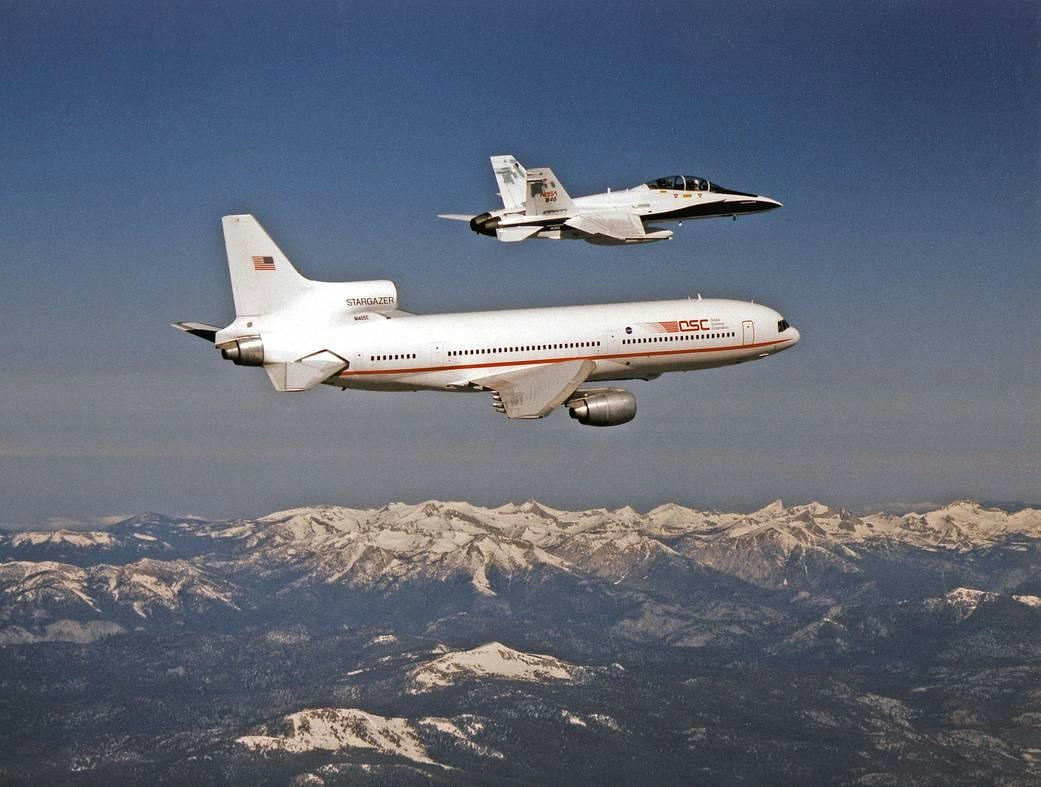
Challenges Faced by Lockheed in Designing the L-1011 TriStar
Historical Context and Lockheed’s Commercial Aviation Legacy
The contemporary commercial aircraft market is largely dominated by a handful of manufacturers, with Boeing and Airbus leading the narrowbody and widebody sectors, while regional players such as Embraer and ATR serve smaller market segments. This contrasts sharply with the more diverse landscape of previous decades, when companies like McDonnell Douglas and Lockheed were significant contributors to the development of commercial aviation. Over time, McDonnell Douglas merged with Boeing, and Lockheed eventually withdrew from the passenger aircraft market altogether.
Lockheed’s departure from commercial aviation was not due to a lack of expertise. Established in 1926, the company quickly earned a reputation for innovation, producing aircraft such as the Vega, which was favored by pioneering aviators including Amelia Earhart and Wiley Post. In the 1930s, Lockheed expanded its portfolio with the Electra series, notably the Model 10 Electra and Model 14 Super Electra, the latter serving as the foundation for the Hudson bomber during World War II. Despite wartime demands, Lockheed maintained a commercial presence, most prominently through its collaboration with Trans World Airlines (TWA) on the L-049 Constellation. The Constellation, distinguished by its triple-tail design, long range, and higher cruising speeds, set new standards for passenger comfort and performance, solidifying Lockheed’s standing in civil aviation.
Post-War Challenges and the L-1011 TriStar Program
The post-war period introduced new challenges for Lockheed as the commercial aviation market grew increasingly competitive. The company’s L-188 Electra, launched in the late 1950s, suffered from early structural failures that severely damaged its reputation and sales prospects. By the early 1960s, Lockheed had become more dependent on military contracts to maintain financial stability, though it continued to pursue commercial ambitions. These ambitions culminated in the development of the L-1011 TriStar, a widebody airliner designed to reestablish Lockheed’s foothold in the passenger aircraft sector.
Designing the L-1011 TriStar proved to be a complex and demanding endeavor. Lockheed confronted significant logistical and financial obstacles, many of which were influenced by broader industry dynamics. U.S. protectionist policies and escalating trade tensions between the United States and China created an unpredictable business environment, raising concerns about supply chain reliability and market access—issues that remain pertinent for aerospace manufacturers today, as underscored by recent statements from Airbus leadership. Furthermore, Lockheed grappled with rising supply chain costs and increased production support expenses, challenges that have similarly affected competitors such as Boeing, which recently reported a $565 million loss on its KC-46 program due to comparable pressures.
These combined factors fostered a highly competitive and financially constrained environment for Lockheed. Despite its history of innovation and prior commercial achievements, the company struggled to reconcile the demands of developing a cutting-edge aircraft with the realities of a shifting global market. The difficulties encountered during the L-1011 TriStar program highlighted the profound challenges facing aerospace manufacturers—challenges that continue to influence the industry today.
Why Widebody Pilots Lose Speed Authority Over Oceanic Airspace
Antonov An-22: The Largest Turboprop Ever Built
Centre Approves Aviation University Expansion, Directs UP Government to Provide Land
Delta 737-900ER Returns to Atlanta After Engine Issue
Demand for Widebody Aircraft Increases
The Dawn of Aviation Over Madras

Delta Air Lines CEO Says AI Could Boost Profits by 50%

Aircraft Engine Company Leases Miami-Dade Headquarters Amid Industrial Growth

Adobe Warns AI-Driven Trip Planning Challenges Travel Sites

The Global Parts Shortage
