
Orquestre insights de IA em ações

Tendências
Categories
Chroma and Partner Mark Long-Standing Collaboration
Chroma and Partner Mark Long-Standing Collaboration
Advancing Cost-Effective Solutions for V2500 SelectOne Engines
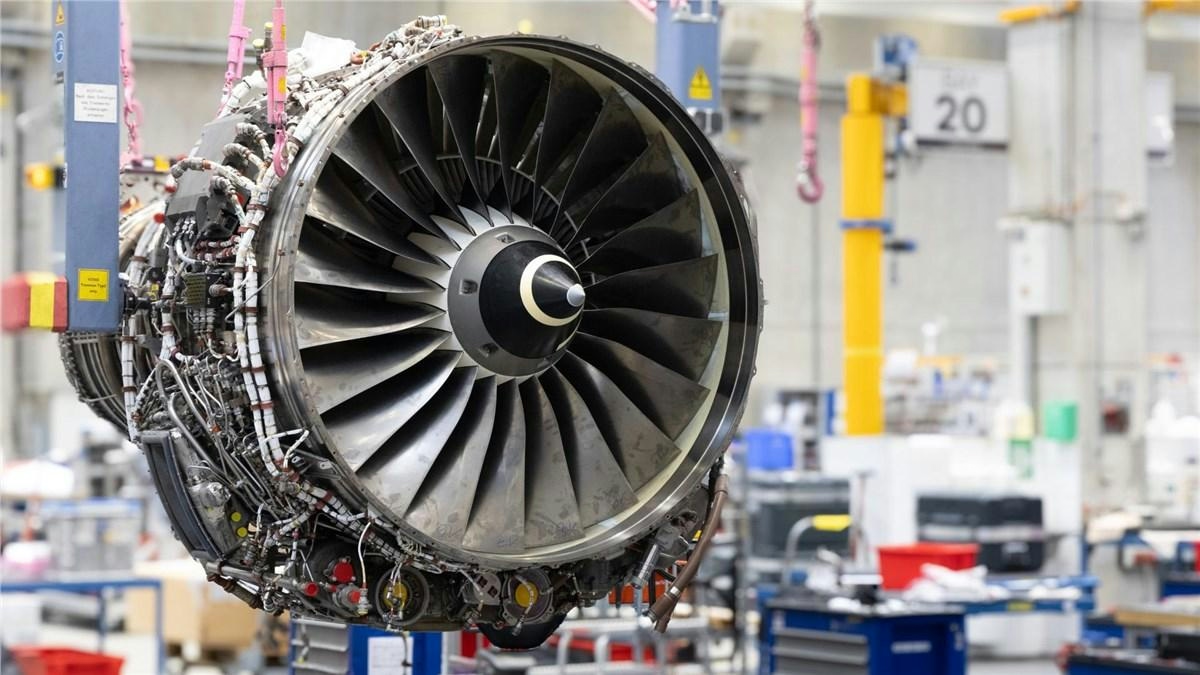
Airlines operating V2500 SelectOne engines, produced by International Aero Engines (IAE), now have access to cost-effective Parts Manufacturer Approval (PMA) components supplied by Lufthansa Technik through its enduring collaboration with Chromalloy, a prominent engine component manufacturer. Together, the two companies have developed six distinct turbine blade types for the V2500 SelectOne engine. Among these, the second stage High Pressure Turbine (HPT) blade and the seventh stage High Pressure Compressor (HPC) blade have already received certification from the Federal Aviation Administration (FAA) and have been in operational service for several months across multiple Lufthansa Group airlines.
This partnership and its future trajectory were detailed at MRO Europe in London, underscoring the increasing adoption of PMA components as a financially attractive alternative to original equipment manufacturer (OEM) parts. Although PMA components are not produced by the OEM, they are approved by aviation authorities such as the FAA and meet the same stringent safety and quality standards, ensuring equivalence in form, fit, and function. For airlines, these components represent significant cost savings without compromising safety or performance.
Operational Performance and Emerging Challenges
Lufthansa Technik has successfully installed the FAA-approved PMA blades in a double-digit number of V2500 SelectOne engines, which power the Airbus A320ceo family. These engines have collectively accumulated approximately 1,800 flight hours and over 1,100 flight cycles, demonstrating the reliability and operational viability of the PMA components in active service.
Despite these successes, the collaboration faces several operational challenges as it expands. Both Chromalloy and Lufthansa Technik must address potential yield issues associated with new manufacturing lines and the risk of underutilizing engineering resources. Furthermore, broader market dynamics present additional complexities. Financial risks, exemplified by companies such as Precision Optics Corporation—which has experienced losses and may require further funding—highlight the critical importance of financial stability in sustaining innovation and growth within the sector.
Competitive pressures are also intensifying. Recent strategic realignments, including Intel’s partnership with Nvidia, signal shifts that may prompt competitors like AMD and Qualcomm to reevaluate their strategies. These developments could reshape the competitive landscape for engine component manufacturers and maintenance providers, potentially influencing future collaborations and market opportunities.
Sustaining Collaboration Amid Industry Evolution
Despite these challenges, the Chromalloy-Lufthansa Technik partnership continues to provide tangible benefits to airlines by delivering cost-effective, certified alternatives to OEM parts. This collaboration supports the operational efficiency of V2500 SelectOne engines and exemplifies the potential of PMA components in commercial aviation. As the industry evolves, the ability to navigate operational, financial, and competitive pressures will be essential for maintaining long-term collaboration and fostering continued innovation.

Etihad Airways Suspends Airbus A380 Flights on Key Route

Aditya Birla Group Seeks Approval for Aircraft Leasing in GIFT City

Qatar Airways Highlights Innovation and Connectivity at Arabian Travel Market 2026

Hong Kong's Five-Year Plan Includes Andrew Fan's Aircraft Parts Processing Hub Proposal

ACIA Aero Leasing Delivers ATR72-600 to Air Nostrum

RTX Appoints Jill Albertelli as Head of Pratt & Whitney

TAT Technologies Joins Beyond Aero Hydrogen Aircraft Program

AURAK Study Highlights Barriers to Air Taxi Adoption in Emerging Economies

Xiamen Air Selects Altitude for 787 Maintenance at Heathrow

Etihad and Swissport Extend Global Partnership
