
Orquestre insights de IA em ações

Tendências
Categories
Rob Fyfe Calls Christopher Luxon’s Criticism of Air New Zealand ‘Uncool’
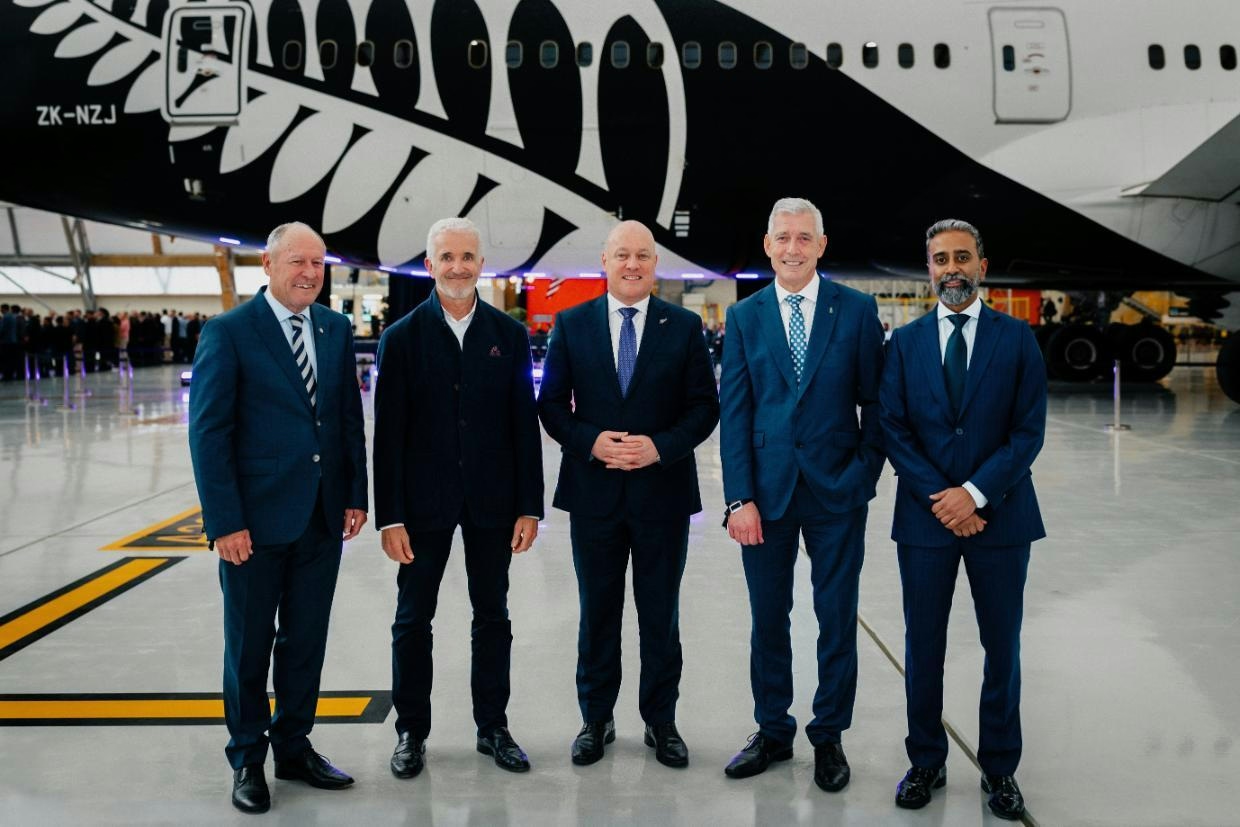
Rob Fyfe Responds to Christopher Luxon’s Criticism of Air New Zealand’s Losses
Former Air New Zealand chief executive Rob Fyfe has publicly challenged Prime Minister Christopher Luxon’s recent critique of the airline’s $242 million loss, describing the remarks as “uncool” and urging caution against attributing the airline’s difficulties solely to current management. Fyfe emphasized the long-standing nature of the issues, noting that decisions made during his and Luxon’s respective tenures contributed to the challenges faced today.
“If I’m brutally honest, I suspect the engines that have been causing Air New Zealand so much grief are engines that ... either it was Christopher or me that made the decision to buy them,” Fyfe stated. Having led the airline from 2005 to 2012, Fyfe was succeeded by Luxon, who served as CEO from 2013 to 2019.
Underlying Causes of Air New Zealand’s Financial Loss
Air New Zealand’s latest annual report, released on Friday, attributed the substantial loss to a combination of factors including elevated jet fuel prices, persistent engine availability problems, lifecycle maintenance expenses, additional maintenance on leased engines, and broader systemic costs within the aviation sector. Notably, multi-year engine issues alone accounted for $190 million of the pre-tax loss.
Prime Minister Luxon described the financial outcome as a “pretty poor performance,” calling on the airline to provide clarity on the loss and to outline measures for improvement. Despite his criticism, Luxon commended the airline’s current CEO, Nikhil Ravishankar, who assumed leadership in October.
A spokesperson for the Prime Minister’s office clarified that Luxon’s comments were made in his capacity as a representative of taxpayers, who are the airline’s majority shareholders, and that his remarks reflected their interests.
Historical Context of Engine Problems
The engine troubles plaguing Air New Zealand have roots extending over a decade. In 2015, under Luxon’s leadership, the airline selected Pratt & Whitney PurePower PW1100G-JM engines for its Airbus narrowbody fleet. Earlier, during Fyfe’s tenure, Air New Zealand opted for Rolls-Royce Trent 1000 engines for its Boeing 787 Dreamliners—a decision initially made in 2004 and reaffirmed in 2009. At the time, the alternative was the General Electric GEnx-1B engine.
Luxon’s successor, Greg Foran, later expressed relief that the airline had chosen General Electric engines for its newer Dreamliners, given the ongoing difficulties with the Trent 1000s. Rolls-Royce has since prioritized addressing these issues, establishing a dedicated task force to expedite solutions.
Public and Political Reactions
Public relations expert Trish Sherson commented that Luxon’s remarks appeared to be “punching down on Air New Zealand,” highlighting that Fyfe had acknowledged responsibility for some of the airline’s challenges. Former Labour Party leader Phil Goff also criticized Luxon’s statements as unfair, remarking, “People who live in glass houses shouldn’t throw stones. He shouldn’t be talking his organisation down.”
Fyfe’s response underscores the delicate position former leaders occupy in public debates, particularly when reputational risks and market perceptions are involved. The controversy arises amid increased scrutiny of Air New Zealand by stakeholders and potential competitive pressures, as rival airlines may seek to exploit the company’s difficulties.
Meanwhile, Luxon’s own leadership is facing challenges, with a recent confidence vote raising questions about his capacity to concentrate on broader policy initiatives, including his proposed social media ban for children under 16.
Air New Zealand’s Ongoing Efforts
Air New Zealand has stated that it is collaborating closely with Rolls-Royce and Pratt & Whitney to accelerate engine recovery efforts. The airline now anticipates that no more than one widebody and up to two narrowbody aircraft will remain grounded due to ongoing engine issues.

Etihad Airways Suspends Airbus A380 Flights on Key Route

Aditya Birla Group Seeks Approval for Aircraft Leasing in GIFT City

Qatar Airways Highlights Innovation and Connectivity at Arabian Travel Market 2026

Hong Kong's Five-Year Plan Includes Andrew Fan's Aircraft Parts Processing Hub Proposal

ACIA Aero Leasing Delivers ATR72-600 to Air Nostrum

RTX Appoints Jill Albertelli as Head of Pratt & Whitney

TAT Technologies Joins Beyond Aero Hydrogen Aircraft Program

AURAK Study Highlights Barriers to Air Taxi Adoption in Emerging Economies

Xiamen Air Selects Altitude for 787 Maintenance at Heathrow

Etihad and Swissport Extend Global Partnership
