
Orquestre insights de IA em ações

Tendências
Categories
Commercial Aircraft Emergency Generators: Market Trends and Forecasts Through 2035
Commercial Aircraft Emergency Generators: Market Trends and Forecasts Through 2035
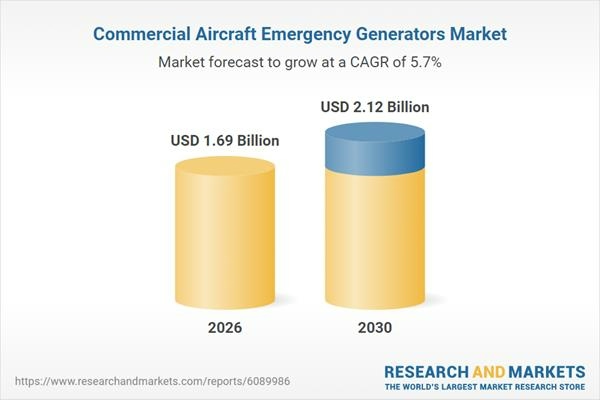
The global market for commercial aircraft emergency generators is set to experience steady growth over the coming decade. Valued at $1.6 billion in 2025, the market is projected to increase to $1.69 billion in 2026, representing a compound annual growth rate (CAGR) of 5.7%. By 2030, this figure is expected to reach $2.12 billion, driven by continuous advancements in aviation safety, stringent regulatory requirements, and the expansion of commercial aircraft fleets worldwide.
Key Growth Drivers and Market Dynamics
The expansion of the commercial aircraft emergency generator market is underpinned by several critical factors. A heightened emphasis on aviation safety and evolving regulatory frameworks are compelling airlines to invest in more reliable and efficient backup power systems. Technological innovations, particularly in auxiliary power units (APUs) and emergency generators, have led to lighter, more efficient designs that enhance operational reliability and reduce maintenance costs.
Additionally, the growth of the global commercial aircraft fleet, coupled with the need to retrofit aging aircraft with advanced emergency power systems, is significantly boosting demand. Emerging markets, especially in the Asia-Pacific region, are witnessing increased air travel fueled by rising incomes, improved connectivity, and expanding tourism sectors, further propelling market growth.
Innovation and Competitive Landscape
Industry leaders are focusing on the development of smart monitoring and predictive maintenance technologies, alongside low-emission backup power solutions. Notable trends include the adoption of hybrid and variable frequency generators, compact auxiliary power systems, and advanced battery technologies with higher energy densities. These innovations aim to improve efficiency, reduce environmental impact, and enhance the reliability of emergency power systems.
Recent technological advancements underscore this trend. For instance, NSK Ltd. has introduced gas turbine generator bearings designed for electric vertical takeoff and landing vehicles (eVTOLs) and large drones, which significantly improve efficiency and flight duration. In a strategic move to bolster its position in aviation electrification and decarbonization, Safran Electrical & Power acquired Thales Group’s aeronautical electrical systems business in October 2023.
Key market players include RTX Corporation, The Boeing Company, Honeywell International Inc., GE Aerospace, and Safran S.A. While North America led the market in 2025, the Asia-Pacific region is anticipated to be the fastest-growing market through 2030, reflecting broader regional economic and aviation sector growth.
Challenges and Strategic Responses
Despite the positive growth trajectory, the market faces several challenges. Supply chain disruptions, evolving regulatory landscapes, and the rapid pace of technological change present ongoing risks. In response, airlines and manufacturers are accelerating retrofitting programs and increasing investments in research and development to produce more efficient and reliable emergency generators. Strategic partnerships are also emerging as companies seek to secure critical raw materials and stabilize supply chains.
Moreover, the broader adoption of AI-enabled avionics-grade computing systems is expected to influence the emergency generator market indirectly. Enhanced aircraft computing capabilities improve overall safety and performance, thereby increasing the demand for advanced and dependable emergency power solutions.
Regional and Market Outlook
The commercial aircraft emergency generator market is geographically diverse, encompassing Asia-Pacific, Europe, and North America. Global trade relations and tariff policies continue to impact production costs and influence local manufacturing strategies. Nevertheless, demand for advanced power systems remains robust, supported by a stable and growing global aviation industry.
Market Segmentation
The market comprises a variety of generator types, including alternating current (AC), direct current (DC), and hybrid systems, with power outputs ranging from below 50 kilowatts to above 200 kilowatts. These generators serve applications across narrow-body, wide-body, and regional aircraft, catering primarily to commercial airlines and other aviation end-users.
This comprehensive market analysis offers vital insights for stakeholders, detailing emerging trends, forecasts, and competitive strategies within this dynamic sector.

Etihad Airways Suspends Airbus A380 Flights on Key Route

Aditya Birla Group Seeks Approval for Aircraft Leasing in GIFT City

Qatar Airways Highlights Innovation and Connectivity at Arabian Travel Market 2026

Hong Kong's Five-Year Plan Includes Andrew Fan's Aircraft Parts Processing Hub Proposal

ACIA Aero Leasing Delivers ATR72-600 to Air Nostrum

RTX Appoints Jill Albertelli as Head of Pratt & Whitney

TAT Technologies Joins Beyond Aero Hydrogen Aircraft Program

AURAK Study Highlights Barriers to Air Taxi Adoption in Emerging Economies

Xiamen Air Selects Altitude for 787 Maintenance at Heathrow

Etihad and Swissport Extend Global Partnership
