
Orquestre insights de IA em ações

Tendências
Categories
Does the B-36 Require 336 Spark Plugs Replaced at Every Service?
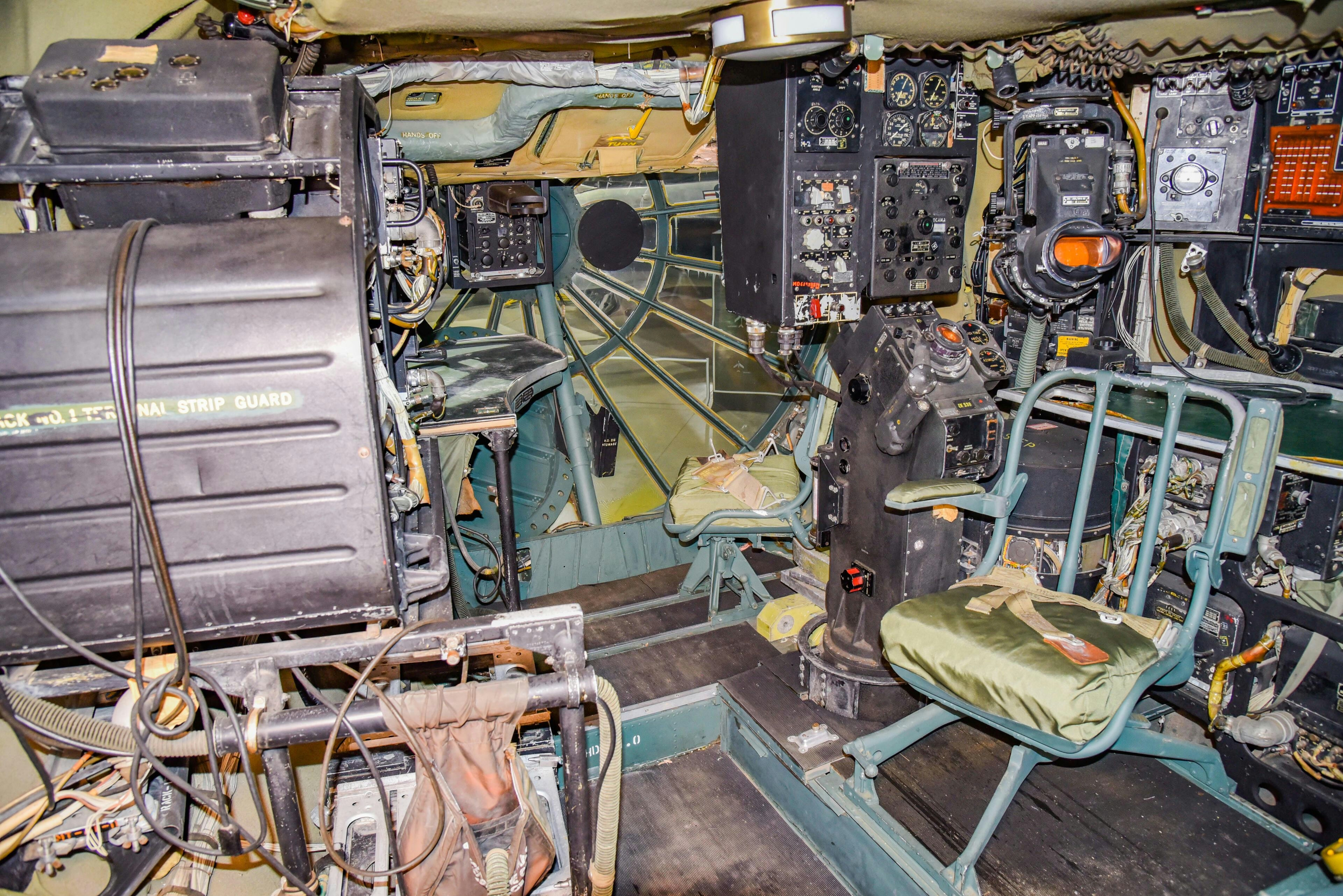
Does the B-36 Require 336 Spark Plugs Replaced at Every Service?
The Convair B-36 Peacemaker remains a landmark in military aviation history, recognized as the largest mass-produced piston-engine aircraft ever constructed. Powered by six colossal Pratt & Whitney R-4360 Wasp Major radial engines arranged in a distinctive backward-facing pusher configuration, the B-36 boasted an extraordinary range of 10,000 miles. This capability allowed it to conduct strategic missions without dependence on forward airfields. However, alongside its engineering prowess came a persistent maintenance question: did the aircraft truly require all 336 spark plugs to be replaced after every flight?
The Spark Plug Myth: Separating Fact from Fiction
The figure of 336 spark plugs is accurate when broken down mathematically. Each of the six R-4360 engines contained 28 cylinders, with two spark plugs per cylinder, resulting in 56 plugs per engine. Multiplied by six engines, the total reaches 336 spark plugs. Despite this, the widespread belief that every spark plug was swapped after each landing is more myth than standard procedure.
Official Strategic Air Command maintenance protocols did not call for a complete replacement of spark plugs following routine or short training flights. Historical records, including analyses from the National Interest, indicate that full ignition overhauls were typically reserved for extended missions lasting between 24 and 40 hours. During such long flights, severe lead buildup and heat stress would degrade spark plug performance, necessitating comprehensive replacement to maintain engine reliability for subsequent sorties.
Operational and Engineering Factors Behind Maintenance Demands
The B-36’s maintenance challenges were rooted in both its engine design and operational environment. The R-4360 engine was particularly sensitive to temperature fluctuations and fuel quality. Its rearward pusher configuration, with engines mounted behind the wing’s trailing edge, subjected the rear cylinder banks to turbulent and less effective cooling airflow. This, combined with the use of high-octane, leaded aviation gasoline, accelerated fouling and overheating of spark plug electrodes, especially during prolonged, low-power cruising at high altitudes.
Rather than following a rigid replacement schedule, ground crews based spark plug maintenance on operational indicators such as airflow restrictions, engine starting difficulties, contamination, and the severity of the mission profile. Consequently, during the B-36’s peak operational period in the late 1940s and early 1950s, the line between necessary maintenance and legend often became blurred.
Maintenance Challenges: Historical Context and Modern Parallels
The demanding upkeep of the B-36 underscores a broader, ongoing challenge in sustaining America’s strategic bomber fleet. Today, the U.S. Air Force confronts similar difficulties with the B-52 bomber upgrade program. Managed by Boeing, this modernization effort has been plagued by significant cost overruns and delays. A recent Government Accountability Office report revealed that ten of thirteen upgrade projects are experiencing setbacks, with the engine upgrade’s development cost escalating from $11 billion in 2018 to approximately $15 billion. Additionally, the initial operational capability has been postponed by 15 months, now expected in 2033. These issues highlight the complexities involved in maintaining and modernizing aging yet essential aircraft for future strategic needs.

Etihad Airways Suspends Airbus A380 Flights on Key Route

Aditya Birla Group Seeks Approval for Aircraft Leasing in GIFT City

Qatar Airways Highlights Innovation and Connectivity at Arabian Travel Market 2026

Hong Kong's Five-Year Plan Includes Andrew Fan's Aircraft Parts Processing Hub Proposal

ACIA Aero Leasing Delivers ATR72-600 to Air Nostrum

RTX Appoints Jill Albertelli as Head of Pratt & Whitney

TAT Technologies Joins Beyond Aero Hydrogen Aircraft Program

AURAK Study Highlights Barriers to Air Taxi Adoption in Emerging Economies

Xiamen Air Selects Altitude for 787 Maintenance at Heathrow

Etihad and Swissport Extend Global Partnership
