Imagem

AeroGenie — Seu Copiloto Inteligente.

Pergunte qualquer coisa. Analise tudo. Aja imediatamente.

Tendências

Categories

Engine Fire on Turkish Airlines A330 En Route to Istanbul
February 4, 2026By ePlane AI
Engine Fire on Turkish Airlines A330 En Route to Istanbul
0
0
Turkish Airlines
Airbus A330
Engine Fire

Engine Fire Forces Turkish Airlines A330 to Divert to Kolkata

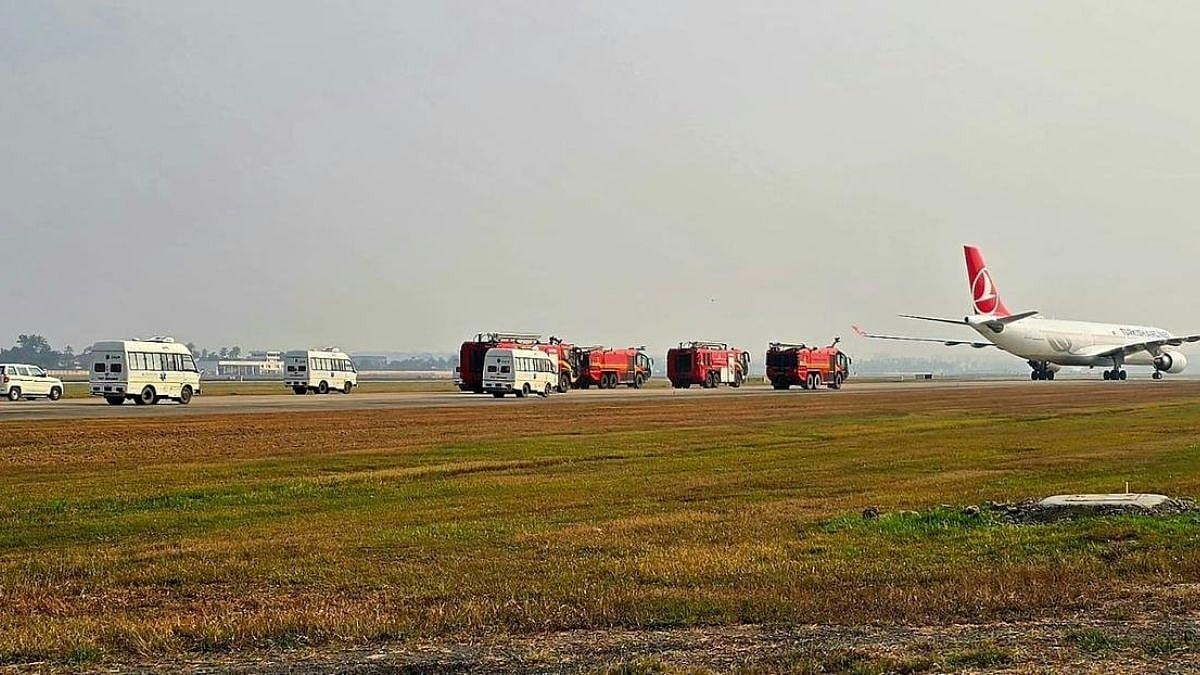
On February 4, 2026, a Turkish Airlines Airbus A330-303 (registration TC-LNG) en route from Kathmandu to Istanbul experienced an engine fire shortly after takeoff, necessitating an emergency diversion to Kolkata. The flight, TK727, had departed Kathmandu at 13:28 local time with 225 passengers and 11 crew members on board. The aircraft was scheduled to cover approximately 5,317 kilometers to Istanbul in just under eight hours.

Flight tracking data from Flightradar24 revealed that soon after departure, the crew detected a fire in the right engine, a Rolls-Royce Trent model. Responding promptly, the pilots shut down the affected engine and informed the Kathmandu control tower. With one engine inoperative, the decision was made to divert to Netaji Subhas Chandra Bose International Airport in Kolkata. Airport authorities declared a full emergency, and the aircraft landed safely at 15:03 local time. There were no injuries reported among passengers or crew.

Industry Implications and Ongoing Investigations

Gyanendra Bhul, Deputy Spokesperson for Nepal’s Civil Aviation Authority, emphasized that the pilot’s swift actions and the aircraft’s adequate fuel reserves were critical in ensuring a controlled and safe diversion. While the incident concluded without casualties, it has intensified scrutiny on the reliability of the Rolls-Royce Trent engine series, which powers numerous wide-body aircraft globally.

Aviation industry analysts suggest that Turkish Airlines may face heightened regulatory oversight and potential delays in maintenance operations, particularly at Turkish Technic’s recently inaugurated engine maintenance facility. The incident could also exert short-term pressure on Turkish Airlines’ stock price as investors respond to emerging safety concerns.

Competitors in the aviation sector may leverage this event to underscore the reliability of their own engine technologies, seeking to attract passengers and airline partners concerned about similar risks. The episode is likely to prompt airlines worldwide to reevaluate their engine maintenance strategies and partnerships, potentially reshaping market dynamics within the engine maintenance and repair industry.

As investigations proceed, Turkish Airlines and relevant regulatory bodies are expected to conduct thorough reviews of maintenance protocols and operational procedures to mitigate the risk of future occurrences.

More news
Boeing Delivers 100th 787 Landing Gear Exchange to ANA

Boeing Delivers 100th 787 Landing Gear Exchange to ANA

Boeing Marks Milestone with 100th 787 Landing Gear Exchange Delivery to ANA Boeing has achieved a significant milestone with the delivery of its 100th 787 Landing Gear Exchange (LGE) assembly, reinforcing the company’s dedication to enhancing operational efficiency and safety within the aviation sector. This landmark delivery was made to All Nippon Airways (ANA), a longstanding partner in the LGE program, underscoring Boeing’s commitment to supporting and optimizing airline fleets worldwide. Enhancing Fleet Efficiency Through the Landing Gear Exchange Program The 787 Landing Gear Exchange program is a pivotal component of Boeing’s maintenance solutions, designed to enable airlines to replace landing gear assemblies both efficiently and safely. By supplying overhauled and certified landing gear, the program alleviates the complexities and expenses associated with purchasing and managing these critical components independently, as well as the challenges inherent in conducting in-house overhauls. This approach significantly maximizes fleet availability and reduces aircraft downtime, delivering tangible benefits to both airlines and their passengers. ANA has received landing gear assemblies for 30 of its 787 aircraft through this program, highlighting the partnership’s positive impact on its operations. Yukifumi Ueda, ANA’s vice president and general manager of Engine, Component & Supply Chain, emphasized the program’s vital role in upholding the airline’s stringent safety and reliability standards. Ueda remarked, “This delivery is a testament to the continued strength of our partnership with Boeing,” noting that the LGE program enables ANA to streamline maintenance processes, minimize downtime, and maintain a consistently safe flying experience for its customers. Boeing’s Broader Industry Position and Challenges This milestone coincides with Boeing’s efforts to accelerate the production and delivery of its commercial jets, contributing to increased sales and revenue. Airlines such as ANA and Japan Airlines (JAL) have recently confirmed their initial orders for the 737 Max 8, with deliveries scheduled to begin in 2026, reflecting robust market demand and favorable industry reception. Nevertheless, Boeing continues to face challenges, including potential delivery delays for models such as the 737 Max and 777-9, alongside intensifying competition from other aircraft manufacturers striving to meet the sector’s expanding needs. Over the past two decades, Boeing’s LGE program has established a global presence, with more than 480 787 aircraft from 34 airlines contracted for exchanges. This widespread adoption underscores the confidence airlines place in Boeing’s services and the program’s effectiveness in addressing diverse operational requirements. As the aviation industry evolves, Boeing’s emphasis on innovative maintenance solutions like the Landing Gear Exchange program remains central to its strategic vision. The 100th delivery to ANA not only marks a significant achievement for both companies but also reinforces Boeing’s pivotal role in advancing airline safety, efficiency, and reliability on a global scale.
SATS CEO Kerry Mok Urges Aviation to Match Formula 1’s Pace of Innovation

SATS CEO Kerry Mok Urges Aviation to Match Formula 1’s Pace of Innovation

SATS CEO Kerry Mok Urges Aviation to Match Formula 1’s Pace of Innovation Embracing a Race-by-Race Innovation Cycle At the Singapore Airshow 2026, Kerry Mok, president and CEO of SATS, emphasized the urgent need for the aviation industry to accelerate its innovation cycle, drawing a direct comparison to the rapid technological advancements seen in Formula 1 (F1). Speaking at the International Centre for Aviation Innovation (ICAI) symposium, Mok highlighted that the sector must adopt a relentless, race-by-race approach to innovation if it is to address growing workforce shortages and maintain global competitiveness. Mok pointed out that the traditional, protracted development timelines in aviation have become a liability in an environment that demands agility. “At the start of the F1 season, the car performs at a certain level. If they don’t continue to innovate, by the end of the season, your car will be several seconds behind. They innovate just to keep up,” he explained. This model of continuous, incremental improvement, he argued, offers valuable lessons for aviation, where technology deployment on the tarmac must be fundamentally rethought. Innovation Inspired by Formula 1 The influence of F1’s innovation model extends beyond motorsport. Mok referenced past instances where F1’s rapid communication, teamwork, and operational efficiency have been adapted in healthcare settings. For example, the Williams F1 team collaborated with the University Hospital of Wales in 2016 to enhance neonatal resuscitation procedures, while London’s Great Ormond Street Hospital improved neonatal intensive care handovers by studying F1 pit stop dynamics. In aviation, the pressure to innovate is intensified by a shrinking manual workforce and heightened global competition. Mok described how SATS is transitioning from static rostering systems to dynamic, AI-driven task assignments. Ground staff are now managed more like gig workers, with algorithms allocating tasks individually rather than tying employees to specific flights. This shift reduces idle time for both personnel and equipment, thereby boosting operational efficiency. Challenges and Industry Response Despite the clear benefits of adopting an F1-style innovation pace, the aviation sector faces significant challenges. Increased competition, geopolitical uncertainties, and the imperative to invest in sustainability and advanced technologies complicate the path forward. Airlines and aviation companies are responding by ramping up research and development budgets, accelerating innovation efforts, and pursuing strategic partnerships to remain relevant in a rapidly evolving market. Mok’s call to action reflects a broader transformation within the industry, where automation and process innovation have become critical not only for efficiency but also for sustaining airport operations under unprecedented pressures. The aviation sector’s ability to innovate at the speed of Formula 1 may well determine its future viability in an increasingly competitive global landscape.
CDB Aviation Announces $500 Million Senior Unsecured Notes Offering

CDB Aviation Announces $500 Million Senior Unsecured Notes Offering

CDB Aviation Announces $500 Million Senior Unsecured Notes Offering Successful Pricing of Senior Unsecured Notes Dublin-based CDB Aviation, a wholly owned Irish subsidiary of China Development Bank Financial Leasing Co., Ltd. (CDB Leasing), has successfully priced a $500 million senior unsecured notes offering through its subsidiary, CDBL FUNDING 1. The single-tranche notes, maturing on February 4, 2026, were issued under the company’s $3 billion Medium Term Note Program, which holds credit ratings of A2 from Moody’s and A from Fitch. The five-year fixed-rate notes were priced at Treasury 5-year plus 50 basis points, with a coupon rate of 4.25 percent. This pricing reflects a 45 basis point tightening from the initial guidance. The offering, conducted in Regulation S format and fully supported by both CDB Aviation and CDB Leasing, attracted strong demand from global investors. The order book peaked at over $2.36 billion, with participation from approximately 100 institutional accounts. Jie Chen, Chief Executive Officer of CDB Aviation, described the issuance as “another resounding success” following the company’s return to the international bond market in 2025. He emphasized that the transaction aligns with CDB Aviation’s ongoing efforts to optimize its capital structure and enhance competitiveness, highlighting the team’s commitment to the company’s long-term strategic vision. Market Context and Strategic Implications The transaction was led by a consortium of prominent financial institutions, including Standard Chartered Bank, China CITIC Bank International, HSBC, Goldman Sachs (Asia) L.L.C., Bank of Communications, and China Securities International, serving as Joint Global Coordinators, Lead Managers, and Bookrunners. Additional Joint Lead Managers and Bookrunners comprised Bank of China Limited, Shanghai Pudong Development Bank Hong Kong Branch, Industrial Bank Co., Ltd. Hong Kong Branch, Deutsche Bank, and Huaxia Bank Co. Limited Hong Kong Branch. This latest offering occurs amid a dynamic market environment influenced by global economic conditions, interest rate trends, and investor sentiment. CDB Aviation’s creditworthiness and proactive capital management are under close observation, particularly as competitors in the aviation leasing sector may pursue similar financing strategies or other competitive responses. In recent months, CDB Aviation has demonstrated a strategic focus on strengthening its financial position, as evidenced by its $3 billion senior unsecured notes program and the securing of a $710 million sustainability loan. These initiatives underscore the company’s commitment to efficient debt management and operational funding, factors that may shape investor perceptions and broader market dynamics. Forward-Looking Statements This announcement contains forward-looking statements concerning CDB Aviation’s business, financial condition, and future plans. Such statements involve significant risks and uncertainties, and actual outcomes may differ materially from those anticipated. Readers are advised not to place undue reliance on these statements, which reflect current management expectations and are not guarantees of future performance. CDB Aviation undertakes no obligation to update forward-looking statements except as required by law.
Korean Air Launches Generative AI Chatbot to Enhance Customer Support

Korean Air Launches Generative AI Chatbot to Enhance Customer Support

Korean Air Launches Generative AI Chatbot to Enhance Customer Support Korean Air has introduced the “Korean Air AI Chatbot,” a generative AI-powered service designed to revolutionize customer support across its website and mobile application. Utilizing advanced natural language processing (NLP) and trained on extensive datasets encompassing airline regulations and operational policies, the chatbot aims to provide accurate, real-time responses tailored to the specific needs of individual customers. Personalized and Transparent Customer Interaction Unlike traditional scripted customer service systems, the AI chatbot interprets user intent through conversational language. For instance, a query such as, “I’m flying economy from Incheon to Paris. How many bags can I check in?” generates a personalized response based on the traveler’s itinerary. Each answer is supplemented with source citations and direct links to relevant information, enhancing both transparency and reliability. To further reduce the risk of errors, Korean Air has implemented a specialized verification database, ensuring that users receive trustworthy and up-to-date guidance. The chatbot’s language capabilities have expanded significantly, now supporting 13 languages. This marks a considerable increase from the initial four—Korean, English, Simplified Chinese, and Japanese—to include Traditional Chinese, French, German, Italian, Portuguese, Russian, Spanish, Thai, and Vietnamese. For more complex inquiries, users can easily transition to human assistance by typing “connect to an agent,” a feature currently available in English and Korean. Industry Implications and Future Developments Korean Air’s deployment of generative AI reflects a wider industry trend, as airlines increasingly adopt advanced chatbot solutions to improve operational efficiency and enhance the customer experience. However, integrating such technology with existing systems while maintaining high service standards remains a challenge. This initiative is expected to intensify competition within the sector, encouraging rival carriers to accelerate their own AI developments to remain competitive. Amid a global race to deliver more sophisticated and reliable chatbot services, Korean Air’s move could significantly influence its strategic positioning in the market. Looking ahead, the airline plans to introduce additional functionalities, including ticket purchasing and reservation management, to further streamline the digital travel experience. A company representative emphasized the commitment to innovation, stating, “With the launch of this AI chatbot, Korean Air remains committed to providing faster and more accurate support for our customers. We will continue to integrate smart technologies to ensure a more convenient and intuitive digital travel experience.”
Fly Alliance Seeks San Marino Air Operator Certificate in First Quarter 2026

Fly Alliance Seeks San Marino Air Operator Certificate in First Quarter 2026

Fly Alliance Pursues San Marino Air Operator Certificate Amid Regulatory and Market Challenges Fly Alliance, headquartered in Wilmington, Delaware, is aiming to secure a San Marino air operator’s certificate (AOC) by the end of the first quarter of 2026. The company intends to utilize a Global Express aircraft for the certification process, although specific details such as the aircraft’s registration and manufacturer serial number have not been disclosed. This strategic move reflects Fly Alliance’s efforts to adapt to an evolving regulatory environment and intensifying competition within the business aviation sector. Expanding Fleet and Certification Strategy Currently operating under Part 135 certification, Fly Alliance manages a diverse charter fleet that includes three Global Express jets, a Citation Jet 4 Gen2 recently added to the lineup, and multiple Citation Excels and XLS Gen2s. The fleet also features several Hawker models, including the 800XP and 900XP variants, as well as a BAe-125-800A. Additional aircraft such as Citation Latitudes, Falcon 2000, and various Gulfstream models (GIV, GIV-G300, and GIV-SP) further diversify the company’s operational capabilities. Several new aircraft are scheduled to join the fleet throughout 2025, underscoring Fly Alliance’s commitment to growth and modernization. The pursuit of a San Marino AOC comes amid heightened regulatory scrutiny in business aviation. This follows recent political developments, including former President Donald Trump’s calls to revoke all Bombardier Global certificates until Canada approves Gulfstream’s large-cabin models. Such regulatory pressures could complicate certification processes for operators relying on Bombardier aircraft, presenting potential challenges for Fly Alliance as it seeks approval for its Global Express operations under San Marino jurisdiction. Navigating a Shifting Market Landscape The broader business aviation market is undergoing significant transformation in 2026. Major manufacturers like Airbus and Boeing are contending with increased production demands and strategic decisions regarding future aircraft programs. Competitors are adopting varied approaches: Embraer is focusing on boosting sales of its E2 series rather than launching new airliner projects, while Airbus is advancing innovation with the A321XLR, which is influencing market dynamics and production methodologies. Gulfstream continues to report record business jet deliveries, and Textron Aviation has demonstrated a strong recovery in the fourth quarter, intensifying competition across the business jet segment. In addition to its fleet expansion and certification initiatives, Fly Alliance recently secured approval as a Foreign Approved Maintenance Organization (FAMO) from India’s Directorate General of Civil Aviation. This authorization enables the company to perform maintenance on Indian-registered aircraft. Fly Alliance also maintains maintenance approvals from the United States Federal Aviation Administration (FAA), the European Union Aviation Safety Agency (EASA), and San Marino, reinforcing its global operational capabilities. As Fly Alliance advances its application for the San Marino AOC, it confronts a complex and rapidly evolving environment shaped by regulatory developments and shifting market forces. The company’s efforts to expand and certify its fleet occur against a backdrop of intense competition and ongoing industry transformation.
Delta Flight Turns Back Midair After Engine Smoke Reported

Delta Flight Turns Back Midair After Engine Smoke Reported

Delta Flight Returns Safely After Engine Smoke Reported Midair A Delta Air Lines flight was compelled to return to San Antonio International Airport on Tuesday morning after smoke was detected emanating from one of its engines shortly after takeoff, officials confirmed. Delta flight 1676, operated by an Airbus A320 and carrying 136 passengers alongside six crew members, had departed for Hartsfield-Jackson Atlanta International Airport in Georgia when the crew identified a potential engine problem. According to the San Antonio Fire Department (SAFD), emergency responders were alerted to the presence of smoke from the engine, prompting a precautionary mobilization. The aircraft remained airborne for approximately 20 minutes before safely returning to San Antonio, landing around 11:15 a.m. Flight tracking data corroborated the timeline. Delta emphasized that safety was the paramount concern, stating that the flight returned after the crew received an indication of a possible engine issue. Although the flight crew declared an emergency to secure priority handling from Air Traffic Control, airport officials clarified that the landing was not officially classified as an emergency. Emergency Response and Ongoing Investigation SAFD initially dispatched additional units anticipating a potential aircraft fire; however, upon inspection, no fire or further hazards were found. Consequently, the extra response teams were stood down before arriving on site. There were no injuries or other incidents reported, and airport operations continued without disruption. The Federal Aviation Administration (FAA) confirmed the safe return of the aircraft and announced that it would conduct an investigation into the incident. Meanwhile, Delta’s maintenance teams are actively assessing the aircraft to determine the cause of the engine smoke. Passengers affected by the disruption were rebooked on alternative Delta flights to reach their destinations. In a statement, Delta expressed regret for the inconvenience caused, underscoring the airline’s commitment to customer service despite the delay. This event occurs amid heightened scrutiny of airline safety protocols, following recent high-profile incidents such as Air Force One returning due to a minor electrical fault. These occurrences highlight the aviation industry’s rigorous safety standards and the intense public and regulatory attention airlines face. Delta itself has recently been in the spotlight for both commendable passenger interactions and challenges related to onboard behavior, reflecting the complex dynamics of public perception in air travel. Market responses to such incidents often depend on how effectively airlines manage operational disruptions and communicate with their customers. Delta’s prompt and transparent handling of this situation may serve to bolster passenger confidence as the airline continues to navigate a competitive and demanding industry environment. The FAA’s investigation into the engine issue remains ongoing.
Rolls-Royce Pushes Trent 1000 XE to Win Back 787 Customers

Rolls-Royce Pushes Trent 1000 XE to Win Back 787 Customers

Rolls-Royce Advances Trent 1000 XE to Reclaim 787 Market Share Rolls-Royce Holdings Plc is intensifying its efforts to regain a stronger foothold in Boeing’s 787 Dreamliner program by actively promoting its upgraded Trent 1000 XE engine. At the Singapore Airshow, Rob Watson, head of civil aerospace at Rolls-Royce, emphasized the company’s commitment to winning back customers and securing new contracts after years of trailing GE Aerospace, whose GEnx-1B engine has dominated the 787 market. Enhancing Durability and Market Presence The Trent 1000 XE, which entered production in late 2023, is marketed primarily for its improved durability—a critical factor as Rolls-Royce seeks to restore confidence among airlines. The engine’s recent introduction into Lufthansa’s fleet marks a significant milestone in the company’s campaign to increase its share of the 787 market. Despite this progress, Watson cautioned that it remains too early to determine whether the engine is fully meeting all performance targets. Historically, Rolls-Royce has held a minority position on the 787, with over 1,200 aircraft in service predominantly powered by GE’s GEnx-1B. The company’s renewed sales push includes targeting carriers such as Malaysia Airlines, aiming to rebuild momentum after losing key customers like British Airways, which opted for GE engines in its latest 787 deliveries. Broader Durability Initiatives and Industry Challenges This sales initiative is part of a wider £1 billion program focused on enhancing durability across Rolls-Royce’s largest engine families, including the Trent XWB series that powers Airbus’s A350 widebody jets. Durability issues, particularly with the larger XWB-97 variant, have posed challenges in recent years. Public criticism from Emirates President Tim Clark notably influenced the airline’s decision to forgo orders for Airbus’s largest production aircraft. Rolls-Royce’s efforts to upgrade the Trent 1000 XE come amid broader industry challenges such as supply chain disruptions and geopolitical uncertainties. The company has defended recent price increases as necessary to maintain competitiveness in this complex environment. Market response has been cautiously optimistic, with Lufthansa’s adoption of the upgraded engine viewed as a positive development. However, GE Aerospace is expected to respond by enhancing its own engine offerings to counter Rolls-Royce’s advances, particularly as the latter invests heavily in improving Trent engine durability. Strategic Outlook and Future Prospects Following its exit from the single-aisle market in 2012, Rolls-Royce has concentrated on widebody and business jet segments while exploring potential re-entry into narrowbody aircraft through strategic partnerships. Under CEO Tufan Erginbilgic, the company’s financial performance has improved significantly, with shares nearly quadrupling since early 2024. Rolls-Royce continues to develop its Ultrafan platform, integrating durability-focused technologies into existing Trent engines as it strives to reclaim a competitive position in the widebody engine market.
Rolls-Royce’s Trent 1000 XE Engine Aims to Revive 787 Performance

Rolls-Royce’s Trent 1000 XE Engine Aims to Revive 787 Performance

Rolls-Royce Unveils Trent 1000 XE to Enhance Boeing 787 Performance Rolls-Royce has introduced the Trent 1000 XE, its latest production-standard engine designed to power all future Boeing 787 Dreamliner deliveries. This launch arrives amid heightened market expectations for improved engine reliability and efficiency, following a series of challenges encountered with earlier Trent 1000 variants. Technical Advancements and Investment Central to the Trent 1000 XE is a new Durability Enhancement package, which Rolls-Royce asserts will substantially increase engine time on-wing (TOW) while reducing emissions relative to the previous Trent 1000 TEN model. This advancement stems from a significant £1 billion investment aimed at addressing durability concerns and restoring confidence among customers in the Trent 1000 program. The upgrade reflects Rolls-Royce’s commitment to overcoming past technical difficulties and delivering a more robust powerplant for the 787 fleet. Competitive Landscape and Market Response The Trent 1000 XE enters a competitive environment dominated by GE Aerospace’s GEnx-1B, the alternative engine option for the Boeing 787. To maintain a competitive advantage, Rolls-Royce must secure regulatory approvals and achieve broad customer acceptance of the new durability features. Industry analysts anticipate that GE Aerospace may respond by enhancing its own engine offerings to match or exceed the improvements introduced by the Trent 1000 XE. Market reception to the new engine has been notably positive. Lufthansa has become the first airline to deploy the upgraded Trent 1000 XE, signaling strong confidence in Rolls-Royce’s efforts to resolve previous issues and deliver enhanced performance. This development aligns with Boeing’s strategy to offer higher maximum take-off weight variants of the 787, potentially expanding the market for more capable engines such as the Trent 1000 XE. Outlook and Challenges Ahead As Rolls-Royce advances the Trent 1000 XE program, the company faces the complex task of balancing ongoing investment requirements, regulatory scrutiny, and competitive pressures. The forthcoming months will be pivotal as airlines and industry stakeholders evaluate whether the new engine fulfills expectations for reliability, efficiency, and environmental performance.
The Reason Behind Boeing’s Use of Engine Chevrons on the 737 MAX

The Reason Behind Boeing’s Use of Engine Chevrons on the 737 MAX

The Reason Behind Boeing’s Use of Engine Chevrons on the 737 MAX Evolution of Noise Regulations and Aircraft Design Commercial aviation has undergone significant transformation over the decades, shifting from an emphasis on raw performance to a more balanced focus on efficiency, environmental impact, and noise reduction. Early jetliners, while groundbreaking in their ability to provide extended range and speed, were notoriously loud. This noise became a growing concern as airports expanded and nearby communities increasingly demanded quieter operations. In response, regulatory bodies introduced progressively stricter noise limits. During the era of aircraft such as the Boeing 727 and McDonnell Douglas DC-9, compliance with Stage 2 noise standards was sufficient. However, by the late 1970s, Stage 3 regulations imposed tougher maximum noise levels for takeoff, approach, and runway operations. Today, the Federal Aviation Administration (FAA) requires all new jets and large turboprops to meet even more stringent Stage 5 standards. This tightening of noise regulations has spurred innovation in both aircraft and engine design. Among the most notable advancements is the introduction of chevrons—distinctive jagged edges located at the rear of some modern jet engines, including those on the Boeing 737 MAX. These features are not merely aesthetic; they serve a critical function in noise reduction. The Role of Chevrons in Noise Reduction The underlying science of chevrons is rooted in the dynamics of jet engine exhaust. Traditional engines generated significant noise as hot exhaust gases exited at high velocity, mixing turbulently with cooler bypass air and the surrounding atmosphere. This interaction created vortices and turbulence, which were primary contributors to the characteristic jet roar. The development of high-bypass ratio engines, which use large fans to move greater volumes of air at lower speeds, had already reduced noise levels by up to 50% compared to earlier designs. Nevertheless, as noise regulations became more stringent, further innovations were necessary. Chevrons mitigate noise by smoothing the mixing process between hot and cold air streams at the engine’s exhaust. This reduces turbulence and weakens the vortices responsible for much of the noise. By incorporating chevrons, aircraft like the 737 MAX can comply with the latest regulatory requirements without incurring significant weight penalties or compromising engine performance. Industry Context and Boeing’s Challenges Boeing’s integration of chevrons on the 737 MAX reflects a broader industry trend toward quieter and more efficient aircraft. However, the MAX program has encountered considerable challenges, including ongoing safety concerns and intensified regulatory scrutiny that have complicated its certification process. Although the FAA has recently approved the 737 MAX 10 for the next stage of certification, several obstacles remain before the aircraft can enter widespread service. Simultaneously, engine manufacturers such as GE Aerospace have seen increased demand for their LEAP and GE9X engines, driven by Boeing’s ramped-up 737 MAX production and efforts to certify the 777X. Despite these hurdles, Boeing’s renewed emphasis on safety and its so-called “industrial reset” have contributed to stabilizing its position within the global aviation market. The adoption of chevrons on the 737 MAX thus exemplifies the intersection of regulatory pressure, technological innovation, and market dynamics that continue to shape the future of commercial aviation, enabling the delivery of quieter, more efficient, and safer aircraft for airlines and communities worldwide.
Osaka Introduces Electric Air Taxis to Reduce Travel Times

Osaka Introduces Electric Air Taxis to Reduce Travel Times

Osaka Launches Electric Air Taxis to Transform Urban Mobility Osaka is poised to become a leader in advanced air mobility with the introduction of electric air taxi services aimed at significantly reducing travel times for both tourists and residents. Spearheaded by Vertical Aerospace in collaboration with Marubeni Corporation, the initiative seeks to establish a network of zero-emission air taxi routes throughout Japan’s Kansai region. Key connections will include Osaka, Awaji Island, and other prominent destinations, marking a major step forward in sustainable transportation. Enhancing Tourism and Regional Connectivity The deployment of electric air taxis is expected to revolutionize travel experiences across the region. A flagship route linking Osaka and Awaji Island promises to cut travel times by as much as 80 percent compared to conventional ground transportation. By circumventing congested roadways, these air taxis will provide direct access to scenic locations such as Shodoshima and nearby islands, appealing to premium tourists and visitors attending major international events, including the forthcoming Osaka World Expo. In addition to boosting tourism, the service will improve airport connectivity. Planned routes will connect Osaka’s Izumisano Airport with the city center and Kobe, facilitating smoother first- and last-mile travel for international travelers while alleviating congestion at busy terminals. Expanding Applications and Commitment to Sustainability Beyond passenger transport, Vertical Aerospace and Marubeni are exploring the use of electric air taxis for essential services such as medical emergencies and logistics. The ability to rapidly reach remote or densely populated areas could enhance emergency response capabilities and streamline supply deliveries, thereby strengthening the region’s overall mobility infrastructure. The aircraft, named Valo, is engineered for zero-emission operation, aligning with Japan’s broader environmental objectives. Vertical Aerospace aims to secure regulatory certification from both the U.S. Federal Aviation Administration and UK authorities by 2028, reflecting a strong commitment to safety and environmental responsibility. Challenges and Competitive Dynamics Despite the promising outlook, the introduction of electric air taxis in Osaka faces considerable challenges. Regulatory approval remains a complex and rigorous process, with authorities closely examining safety standards and operational procedures. Public concerns regarding noise pollution, low-altitude flights, and potential disruptions echo skepticism observed in other cities such as Los Angeles, where similar projects have encountered resistance. The competitive environment is intensifying as well. While Vertical Aerospace advances its plans in Japan, competitors like Archer Aviation and Joby Aviation are actively pursuing opportunities in other global markets. Archer is positioning itself as a leading transit provider in Los Angeles, whereas Joby continues to navigate regulatory and safety hurdles. Legal disputes over trade secrets among these companies underscore the high stakes and rapid pace of innovation within the sector. Market Perspectives Reactions to electric air taxis remain mixed. Industry proponents emphasize the advantages of reduced travel times and environmentally sustainable transport, while critics and some local residents question the feasibility and broader impact of widespread air taxi adoption. As Osaka prepares to host major international events and accommodate increased tourism, the success of this initiative will hinge on effectively balancing technological innovation with regulatory compliance, community engagement, and stringent safety protocols. If realized successfully, Osaka’s electric air taxi network could establish a new benchmark for urban mobility, offering a forward-looking model for sustainable and efficient travel in Japan and beyond.
line










