
Orquestre insights de IA em ações

Tendências
Categories
Jeppesen ForeFlight Introduces AI Strategy and Engine for Aviation
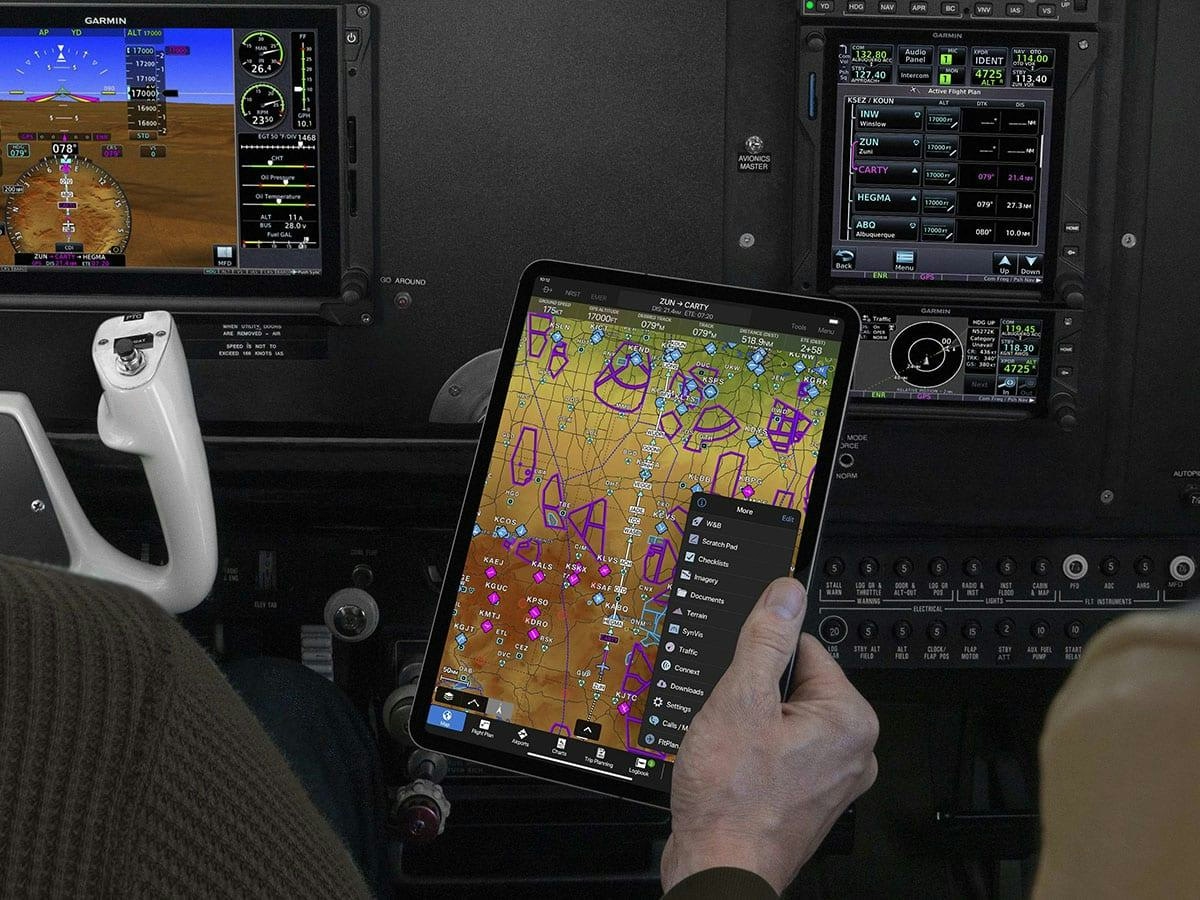
Jeppesen ForeFlight Launches Airflow™: A New AI Engine Tailored for Aviation
AUSTIN, Texas, July 1, 2026 — Jeppesen ForeFlight has introduced Airflow™, an artificial intelligence engine specifically designed for the aviation industry. This launch represents a pivotal advancement in the company’s commitment to embedding responsible AI across all facets of aviation. Developed over several years and grounded in extensive industry expertise, Airflow™ is intended to optimize a wide range of operations, from crew and fleet planning to day-of-flight management and flight deck solutions.
A Flexible, Aviation-Centric AI Platform
Airflow™ forms the core AI engine for Jeppesen ForeFlight, integrating commercial data, proprietary customer information, and deep domain knowledge in safety, certification, and contextual reasoning. Its open, model-agnostic architecture provides customers with the flexibility to incorporate their own AI agents, utilize third-party solutions, or deploy Jeppesen ForeFlight’s native agents. This modular approach enables organizations to adopt AI technologies at a pace that suits their operational needs, with customizable levels of human oversight and reduced costs compared to previous technology transitions.
The company has already previewed its initial product for the General Aviation market: the ForeFlight AI Connector. This MCP server connects ForeFlight Mobile to a customer’s existing OpenAI ChatGPT environment, allowing users to query AI for flight planning, refueling options, and to develop AI-driven workflows using their own data. Jeppesen ForeFlight plans to extend compatibility to other AI platforms, including Google’s Gemini and Anthropic’s Claude, thereby offering users the freedom to select their preferred AI experience.
Later in the year, Airflow™ will expand its offerings to serve the Commercial and Business aviation sectors, with military-specific capabilities anticipated to follow.
Addressing Industry Challenges with Aviation Intelligence
Brad Surak, CEO of Jeppesen ForeFlight, emphasized the critical need for domain-specific AI in aviation. “General AI is confident, but often wrong. In our industry, these mistakes can lead to costly or even catastrophic outcomes,” he stated. Surak underscored that artificial intelligence alone is insufficient; what is required is “aviation intelligence” — the assurance that accurate data, contextual understanding, and rigorous reasoning are consistently applied and cross-checked against industry safety and governance standards. Airflow™ is positioned as a differentiated AI solution that customers can deploy according to their own timelines and operational requirements.
Despite its potential, Jeppesen ForeFlight faces significant challenges in implementing its AI strategy. The company must navigate competition from other aviation technology providers, maintain stringent data quality and security standards, and overcome market skepticism regarding AI reliability. Industry reports have highlighted increasing concerns about AI transparency and user control, issues that may affect adoption rates and invite regulatory scrutiny.
Market response to Airflow™ is expected to be marked by strong interest from users seeking advanced AI capabilities, while competitors may accelerate enhancements to their own AI offerings. Jeppesen ForeFlight’s extensive presence across crew, fleet, operations, and flight deck performance gives it a competitive advantage over generic AI platforms and single-point solutions.
Airflow™ distinguishes itself through its ability to reason within the specific context of aviation, delivering trusted workflows that reflect operational realities and prioritize safety and governance. As the aviation sector continues to evolve, Jeppesen ForeFlight’s AI initiative aims to establish a new benchmark for intelligent and responsible technology in the skies.

Etihad and Swissport Extend Global Partnership

Sepehran Airlines B737 Returns to Mashhad After Tyre and Engine Issues

Etihad Deploys Widebody Fleet to Meet Strong Demand

Korean Air Finalizes $36.2 Billion Deal with Boeing

Australia’s RFDS Queensland Section Orders Six King Air 260Cs

Korean Air Finalizes Order for 103 Boeing Jets and Engines

Embraer E195-E2 Features Distinctive Engine Placement Among Regional Jets

What Passengers Can Expect on Boeing’s New 777X Jet

How Ethiopian Airlines Became Africa’s Leading Carrier Amid Gulf Competition

Joby Aviation Extends Autonomous Flight Capabilities with Cross-Country Tour
