
Orquestre insights de IA em ações

Tendências
Categories
JNCASR and Dreamfly Innovations Sign MoU on Aviation Battery Research
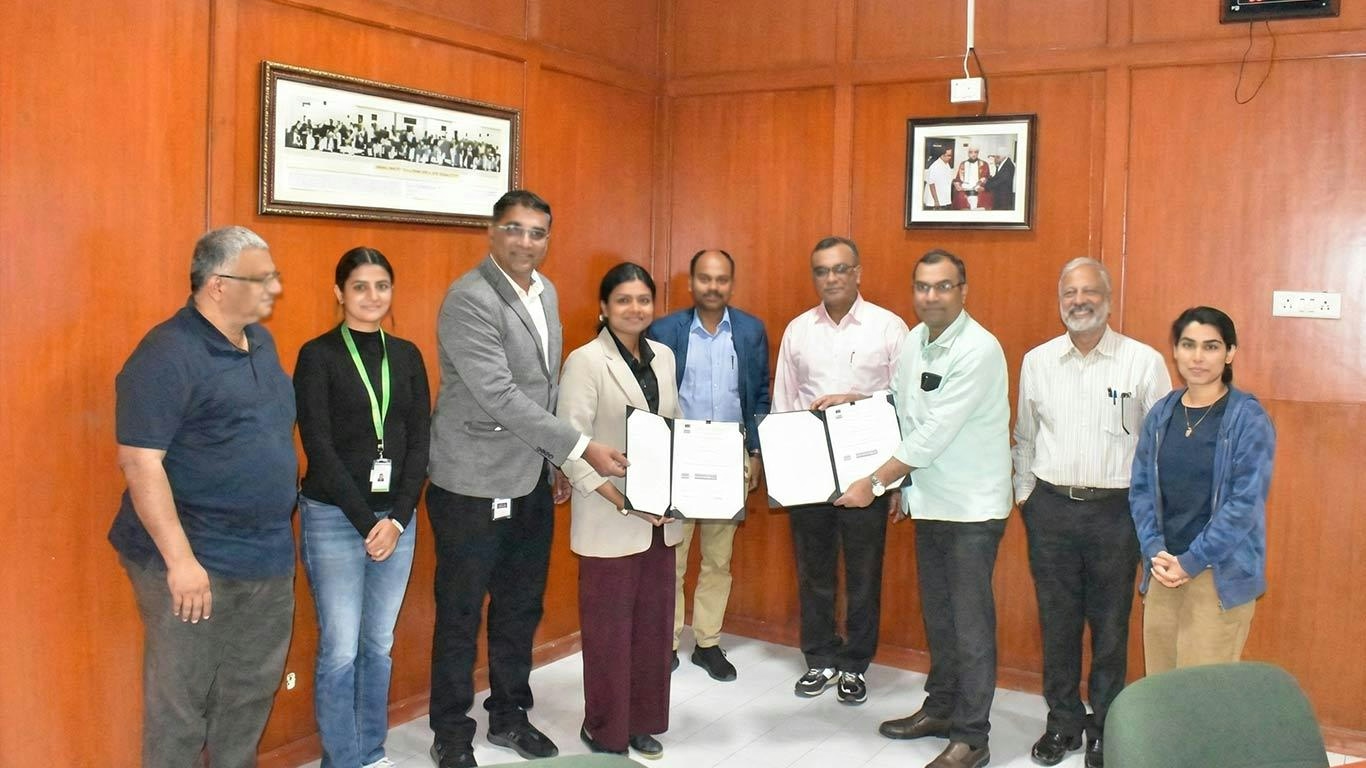
JNCASR and Dreamfly Innovations Sign MoU on Aviation Battery Research
Partnership to Advance Thermal Management in Aviation Batteries
The Jawaharlal Nehru Centre for Advanced Scientific Research (JNCASR), an autonomous institute under India’s Department of Science and Technology (DST), has formalized a collaboration with Bengaluru-based Dreamfly Innovations Pvt. Ltd. through a Memorandum of Understanding (MoU). This partnership aims to jointly develop advanced thermal materials and thermoelectric devices designed to enhance the cooling of aviation batteries, a critical component in the rapidly evolving aerospace sector.
As the aviation industry increasingly depends on high-energy-density lithium-based batteries, effective thermal management has emerged as a significant challenge. Excessive heat generated during high-power operations can degrade battery efficiency, reduce lifespan, and raise safety concerns, particularly in applications such as drones and unmanned aerial vehicles. While passive thermal management systems, including phase change materials (PCMs), offer benefits like low weight and zero power consumption, their widespread adoption has been limited by the inherently low thermal conductivity of conventional PCMs. Efforts to improve these materials by incorporating high-conductivity fillers have encountered difficulties, notably the long-term instability caused by additive agglomeration during repeated thermal cycling.
Combining Expertise to Overcome Technical Barriers
Under the terms of the MoU, JNCASR, led by Professor Kanishka Biswas’s laboratory, will contribute its expertise in materials design, synthesis, advanced characterization, and thermal transport measurements. Dreamfly Innovations will bring its experience in aviation battery engineering and system-level integration to the collaboration. Together, the partners intend to develop lightweight, durable thermal materials with enhanced conductivity capable of rapid heat absorption during high-load conditions, thereby maintaining batteries within optimal temperature ranges without compromising performance.
This collaboration is particularly timely given the current challenges facing the global battery technology landscape. Recent export restrictions imposed by China on lithium batteries have heightened concerns over supply chain stability, potentially impacting major Indian initiatives such as Reliance’s battery cell manufacturing plans. The JNCASR–Dreamfly Innovations partnership is poised to attract attention as a strategic effort to bolster India’s clean-energy ambitions and reduce the aviation sector’s vulnerability to external supply constraints.
Market analysts suggest that this alliance may prompt competitors to intensify their research and development activities in aviation battery technologies to sustain a competitive advantage. By integrating cutting-edge materials science with practical industry expertise, the partnership is expected to enhance the performance, safety, and operational endurance of aviation systems, while reinforcing India’s position in the global battery technology market.
The collaboration between JNCASR and Dreamfly Innovations exemplifies the critical role of industry–academia partnerships in driving innovation for next-generation aviation platforms, addressing both technical challenges and broader strategic imperatives.

Etihad Airways Suspends Airbus A380 Flights on Key Route

Aditya Birla Group Seeks Approval for Aircraft Leasing in GIFT City

Qatar Airways Highlights Innovation and Connectivity at Arabian Travel Market 2026

Hong Kong's Five-Year Plan Includes Andrew Fan's Aircraft Parts Processing Hub Proposal

ACIA Aero Leasing Delivers ATR72-600 to Air Nostrum

RTX Appoints Jill Albertelli as Head of Pratt & Whitney

TAT Technologies Joins Beyond Aero Hydrogen Aircraft Program

AURAK Study Highlights Barriers to Air Taxi Adoption in Emerging Economies

Xiamen Air Selects Altitude for 787 Maintenance at Heathrow

Etihad and Swissport Extend Global Partnership
