
Orquestre insights de IA em ações

Tendências
Categories
NASA Takes Delivery of Modified Boeing 777 Flying Laboratory Ahead of Schedule
NASA Takes Delivery of Modified Boeing 777 Flying Laboratory Ahead of Schedule
Advanced Modifications Enhance Research Capabilities
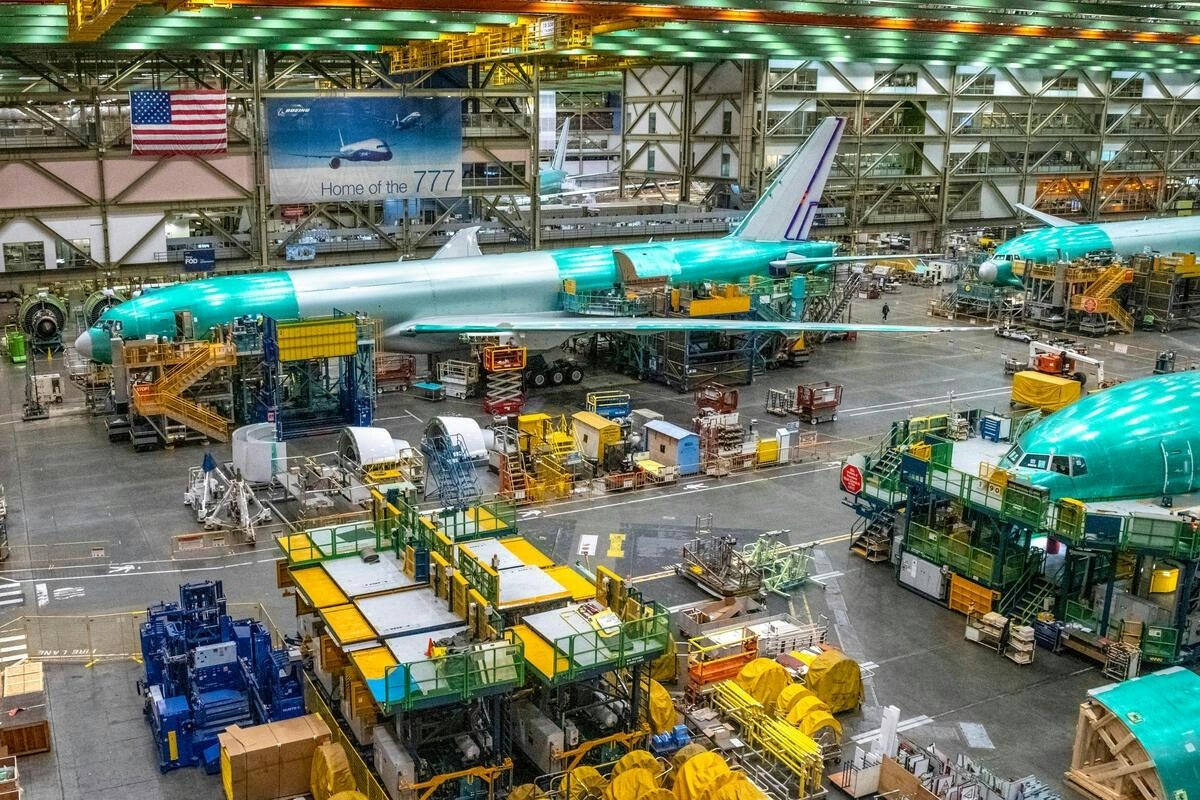
NASA has officially taken delivery of its newly modified Boeing 777-200ER flying laboratory at the Langley Research Center in Hampton, Virginia, marking a significant enhancement to the agency’s airborne research capabilities. The aircraft, previously operated by Japan Airlines as JA704J, arrived ahead of schedule following a successful check flight and a three-hour ferry from Waco, Texas. This widebody jet underwent extensive structural modifications at L3Harris’s Waco facility, in collaboration with Yulista, employing advanced engineering techniques such as 3D scanning and specialized installation tooling to accelerate the conversion process.
The modifications involved drilling nearly 35,000 precision holes in the fuselage to accommodate remote-sensing instruments, enlarging cabin windows to fit scientific sensors, and installing new wiring harnesses to connect operator workstations with sophisticated equipment including LIDAR and infrared imaging spectrometers. Additional upgrades encompassed new power, data, and communications systems, alongside dedicated research stations designed to support complex scientific missions. While L3Harris and Yulista focused on the structural transformation, NASA and Huntington Ingalls Industries (HII) are now integrating the research stations and upgrading the cabin wiring. Yulista’s expertise in modernization and mission support was instrumental in ensuring the aircraft meets the rigorous demands of airborne scientific research.
A New Era for NASA’s Airborne Science Fleet
Registered as N577NA, the 777-200ER replaces NASA’s retired Douglas DC-8 and becomes the largest airborne research platform in the agency’s fleet. This new aircraft represents a substantial leap in capability, accommodating between 50 and 100 onboard operators—more than double the DC-8’s typical complement—and offering a useful payload capacity of 75,000 pounds, compared to the DC-8’s 30,000 pounds. Mission endurance is also significantly enhanced, with the 777 capable of flying up to 18 hours at a maximum altitude of 43,000 feet, enabling longer and more comprehensive data-gathering campaigns.
NASA acquired the aircraft in December 2022 for under $30 million after it had been stored in Southern California since 2020. Its inaugural science mission is scheduled for January 2027 as part of the North American Upstream Feature-Resolving and Tropopause Uncertainty Reconnaissance Experiment (NURTURE). This campaign aims to investigate high-impact winter weather events across North America, Europe, Greenland, and the Arctic and North Atlantic Oceans.
Implications for Aerospace and Research Communities
As NASA prepares the 777 for operational service, the agency faces the challenge of ensuring the aircraft complies with all safety and operational standards required for complex research missions. The delivery has attracted interest from other research institutions considering similar airborne science platforms. Meanwhile, competitors in the aircraft conversion market, such as Mammoth Freighters—which is developing converted 777 freighters—may respond by positioning their own solutions for research and cargo applications.
NASA’s initiative is expected to drive further advancements in aviation technology and propulsion, potentially influencing the broader aerospace sector and establishing new benchmarks for airborne research platforms worldwide.

Etihad Airways Suspends Airbus A380 Flights on Key Route

Aditya Birla Group Seeks Approval for Aircraft Leasing in GIFT City

Qatar Airways Highlights Innovation and Connectivity at Arabian Travel Market 2026

Hong Kong's Five-Year Plan Includes Andrew Fan's Aircraft Parts Processing Hub Proposal

ACIA Aero Leasing Delivers ATR72-600 to Air Nostrum

RTX Appoints Jill Albertelli as Head of Pratt & Whitney

TAT Technologies Joins Beyond Aero Hydrogen Aircraft Program

AURAK Study Highlights Barriers to Air Taxi Adoption in Emerging Economies

Xiamen Air Selects Altitude for 787 Maintenance at Heathrow

Etihad and Swissport Extend Global Partnership
