
Orquestre insights de IA em ações

Tendências
Categories
Norwegian Group Transports 2.7 Million Passengers in September
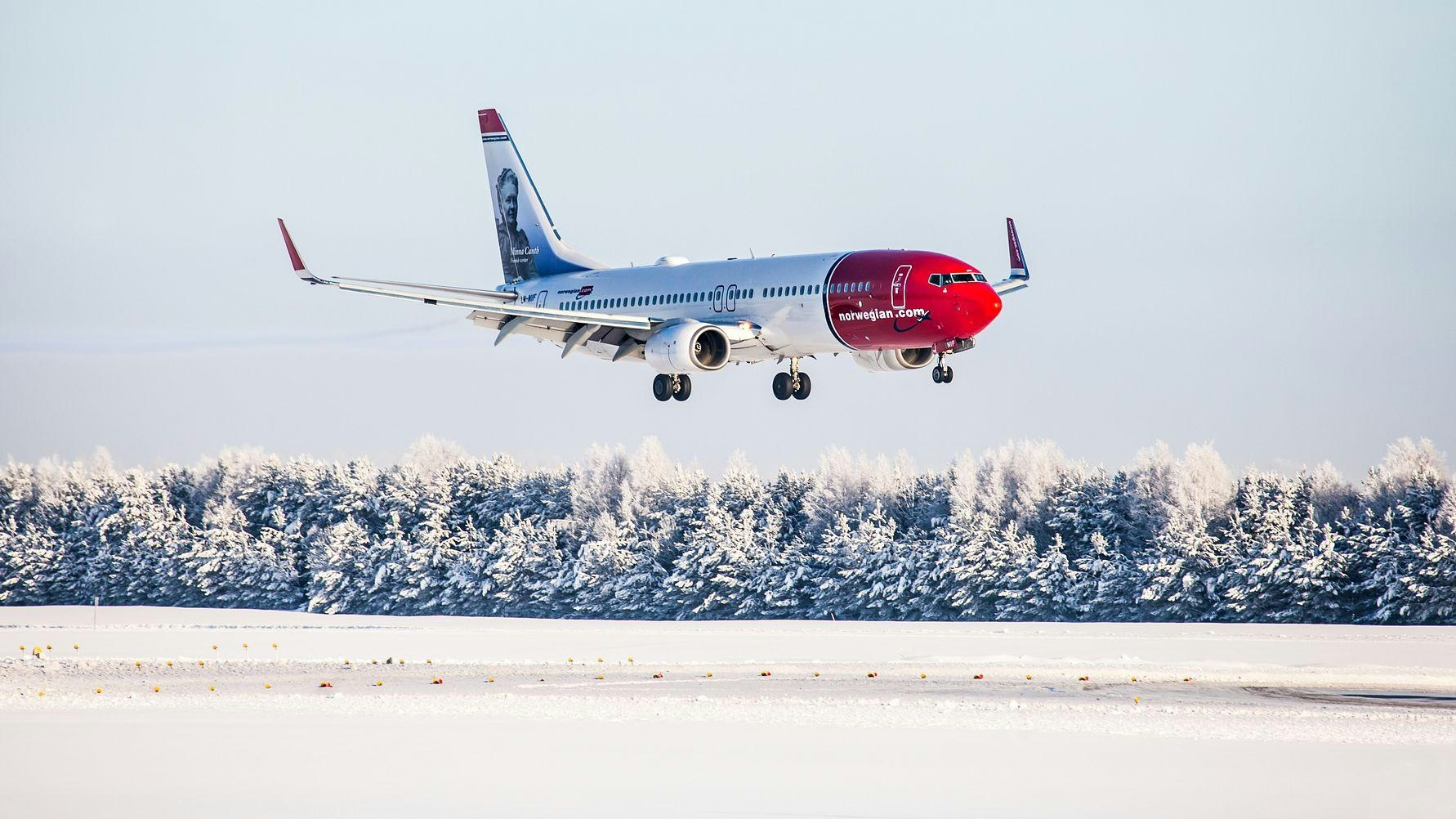
Norwegian Group Transports 2.7 Million Passengers in September
Norwegian Group, encompassing both Norwegian and its regional affiliate Widerøe, transported a total of 2,698,173 passengers in September, reinforcing its strong foothold in the European aviation market. Norwegian itself carried 2,302,536 passengers, while Widerøe accounted for 395,637. This performance underscores the group’s continued appeal and operational strength amid a competitive landscape.
Operational Performance and Capacity Growth
Chief Executive Geir Karlsen characterized September as a robust month, marked by solid passenger numbers and an improved load factor. He emphasized that the group’s network remains well aligned with customer travel demands, noting Widerøe’s consistent operational performance and reliability. Norwegian reported a capacity of 3,603 million available seat kilometres (ASK) for the month, representing a 2% increase compared to the previous year. Revenue passenger kilometres (RPK) rose by 3% year-on-year to 3,118 million, while the load factor improved by 1.4 percentage points to 86.6%. The airline operated an average fleet of 89 aircraft throughout the month.
Widerøe experienced an 11% increase in capacity, reaching 202 million seat kilometres, with passenger traffic at 148 million seat kilometres. The regional carrier maintained a steady load factor of 73.4%, consistent with the previous year’s performance.
Despite operational challenges, the group maintained high punctuality and regularity rates. Norwegian achieved a punctuality rate of 78.9%, while Widerøe’s punctuality stood at an impressive 94.0%. Regularity, defined as the proportion of scheduled flights operated, was 99.1% for Norwegian and 98.4% for Widerøe. Both airlines encountered disruptions due to temporary airspace closures in Denmark and Norway following suspected drone activity, with nearly 40% of Norwegian’s cancellations linked to closures at Copenhagen and Oslo airports.
Industry Context and Competitive Landscape
Norwegian Group’s strong September results come amid intensified competition and shifting dynamics within the global aviation sector. Turkish Airlines recently announced an order for up to 75 Boeing 787 Dreamliners and 737 MAX aircraft, a strategic move that will double its Boeing fleet and heighten competition across key markets. Concurrently, Singapore Airlines Group reported a 9.4% year-on-year increase in passenger numbers, reflecting sustained robust demand for air travel in Asia.
Conversely, some industry players are confronting significant challenges. Tata Group, which operates multiple airlines in India, has experienced a $73 billion decline in market value, affected by US visa restrictions and a recent cyberattack.
In this complex environment, Norwegian Group’s September performance highlights its resilience and adaptability as it navigates a rapidly evolving aviation industry.

Etihad Airways Suspends Airbus A380 Flights on Key Route

Aditya Birla Group Seeks Approval for Aircraft Leasing in GIFT City

Qatar Airways Highlights Innovation and Connectivity at Arabian Travel Market 2026

Hong Kong's Five-Year Plan Includes Andrew Fan's Aircraft Parts Processing Hub Proposal

ACIA Aero Leasing Delivers ATR72-600 to Air Nostrum

RTX Appoints Jill Albertelli as Head of Pratt & Whitney

TAT Technologies Joins Beyond Aero Hydrogen Aircraft Program

AURAK Study Highlights Barriers to Air Taxi Adoption in Emerging Economies

Xiamen Air Selects Altitude for 787 Maintenance at Heathrow

Etihad and Swissport Extend Global Partnership
