
Orquestre insights de IA em ações

Tendências
Categories
Pratt & Whitney Unveils Valox Small Engine for Uncrewed Fighters
Pratt & Whitney Unveils Valox Small Engine for Uncrewed Fighters
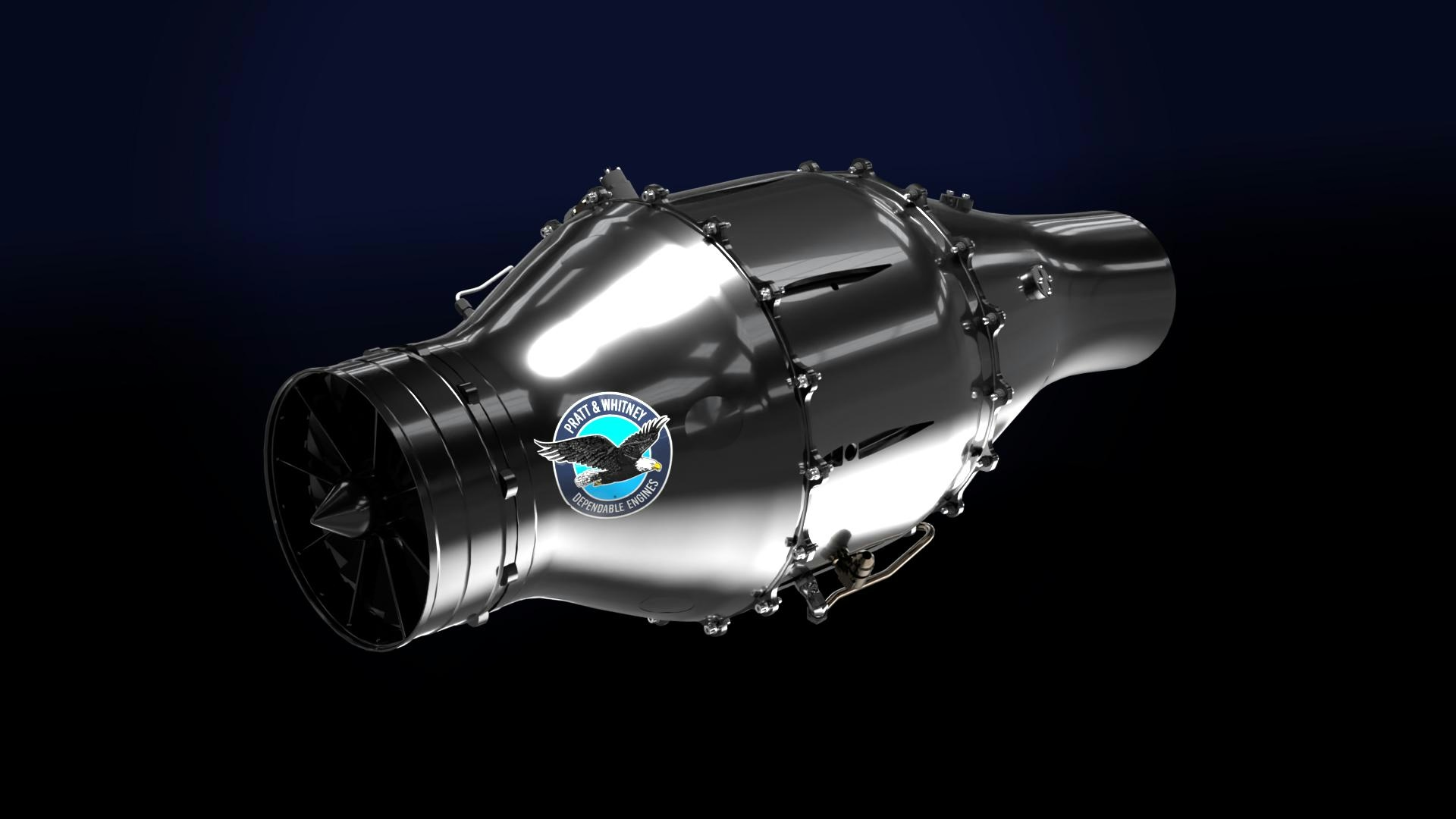
Pratt & Whitney (P&W) has introduced the Valox 1500, a new developmental turbofan engine designed specifically to power the emerging class of uncrewed fighter jets. The announcement was made at the 2026 Farnborough Airshow in the United Kingdom. The Valox family targets a thrust range of 800 to 1,500 pounds-force (3.6 to 6.7 kilonewtons), aligning closely with the United States Air Force’s (USAF) requirements for its forthcoming “FQ” class of Collaborative Combat Aircraft (CCAs).
Jill Albertelli, head of P&W’s military engines business, emphasized the engine’s tailored design, stating, “The Pratt & Whitney Valox engine will really be purpose-built for the different missions, for high-performance propulsion, at the speed and the scale that our customers are asking for.”
Competitive Landscape and Development Efforts
The Valox 1500 enters a competitive market, contending with Honeywell’s SkyShot 1600 and the GEK1500, a product of a partnership between GE Aerospace and Kratos. These engines are all competing for propulsion contracts within the USAF’s CCA program, which has seen tens of millions of dollars awarded to various engine manufacturers over the past year. Pratt & Whitney’s Gatorworks unit has received $10 million to advance the Valox 1500 design, while Honeywell, GE, and Kratos have also secured funding to develop their respective concepts.
In addition to the Valox 1500, Pratt & Whitney is independently funding the development of the smaller Valox 700 engine, intended to power effectors such as small cruise missiles and drones. Albertelli noted significant progress on this engine family. Meanwhile, Northrop Grumman’s YFQ-48 Talon Blue prototype CCA currently operates with one of P&W’s PW500 commercial business jet engines.
Growing Market and Industry Challenges
The market for propulsion systems tailored to uncrewed fighters is expanding rapidly. The US Air Force, Navy, and Marine Corps all plan to deploy substantial numbers of these aircraft over the next decade. International interest is also increasing, particularly across Europe, Asia, and Australia.
Despite the promising outlook, Pratt & Whitney faces considerable challenges in meeting the stringent performance and reliability standards demanded by the USAF’s CCA program. The company must demonstrate that the Valox engine can deliver both the high performance and operational dependability required for these next-generation platforms.
Market reactions to the Valox announcement have been marked by heightened interest from defense contractors and potential customers within the uncrewed fighter and effector sectors. The competitive environment is intensifying, with rivals such as Rolls-Royce and Safran accelerating their own small turbofan engine developments to capture market share. Rolls-Royce is leveraging its AE series to target a larger class of medium-thrust turbofans, while GE is developing the GE426 engine, which aims to produce thrust outputs between 4,000 and 6,000 pounds-force for the USAF’s CCA Increment 2 initiative.
Despite the crowded field, Albertelli remains optimistic about the market’s potential, affirming, “Demand is significant, and we want to be there for our customers any way we can.”

Etihad and Swissport Extend Global Partnership

Sepehran Airlines B737 Returns to Mashhad After Tyre and Engine Issues

Etihad Deploys Widebody Fleet to Meet Strong Demand

Korean Air Finalizes $36.2 Billion Deal with Boeing

Australia’s RFDS Queensland Section Orders Six King Air 260Cs

Korean Air Finalizes Order for 103 Boeing Jets and Engines

Embraer E195-E2 Features Distinctive Engine Placement Among Regional Jets

What Passengers Can Expect on Boeing’s New 777X Jet

How Ethiopian Airlines Became Africa’s Leading Carrier Amid Gulf Competition

Joby Aviation Extends Autonomous Flight Capabilities with Cross-Country Tour
