
Orquestre insights de IA em ações

Tendências
Categories
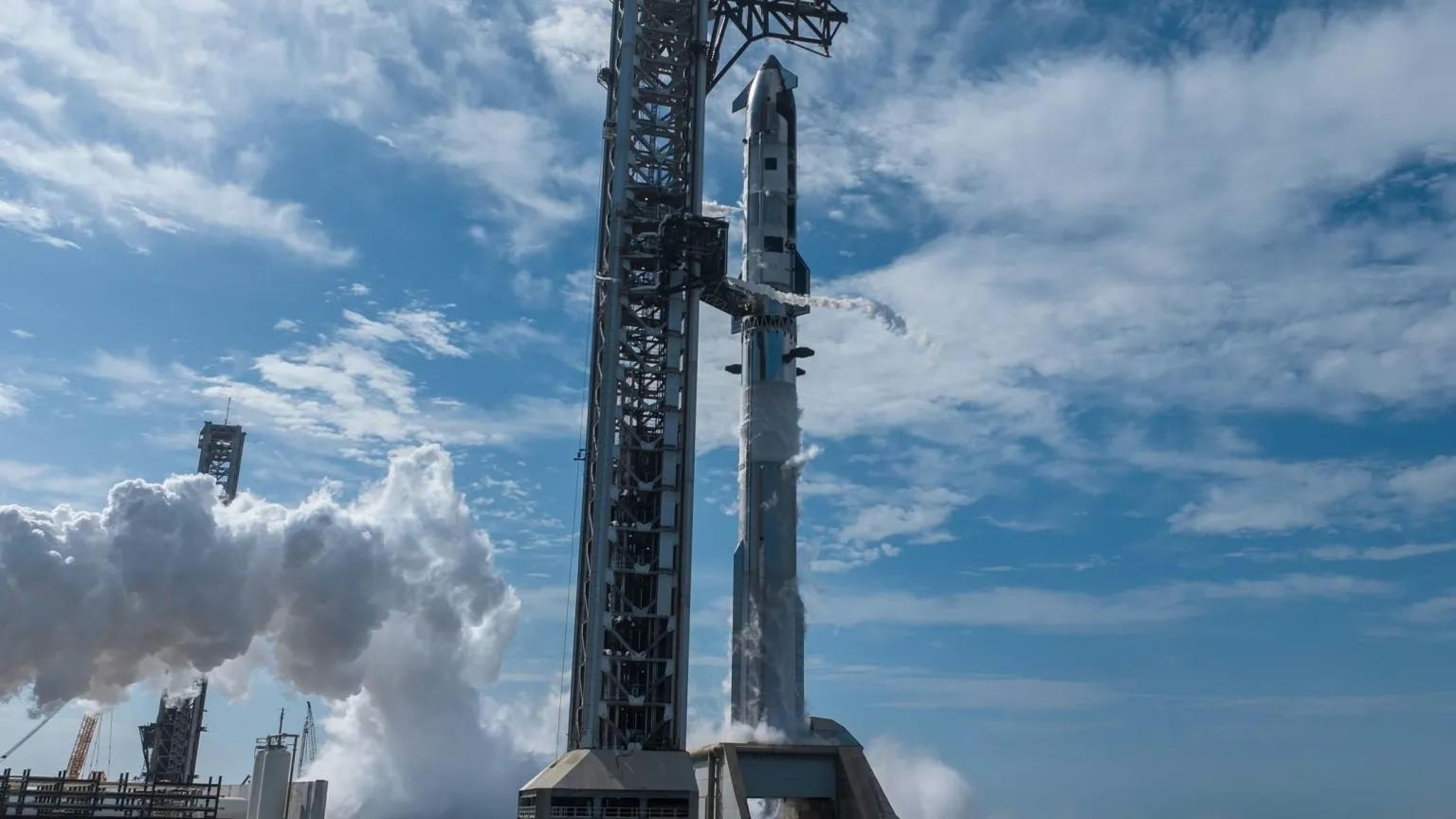
Raptor 3 Engines Fail Seconds Into Starship Boostback Burn, Prompting Federal Review
Raptor 3 Engines Fail Seconds Into Starship Boostback Burn, Prompting Federal Review
Critical Engine Failures During Boostback Burn
SpaceX’s latest Raptor 3 engine, introduced as a simpler and more reliable successor to the problematic Raptor 2, experienced multiple failures during its inaugural flight, raising significant concerns about its operational readiness. The malfunction occurred during the boostback burn, a crucial and high-stress phase designed to test the engine’s performance under demanding conditions. Mere seconds after ignition, several Raptor 3 engines on the Super Heavy booster failed to ignite properly, resulting in a loss of thrust that prevented the booster from reversing its trajectory as intended. Consequently, the stage descended uncontrollably through the atmosphere and impacted the Gulf of Mexico at high velocity.
The Federal Aviation Administration (FAA) has since grounded the Starship program pending a formal mishap investigation. The agency confirmed that all debris fell within a designated hazard zone, with no injuries or damage to public property reported. In its post-flight statement, the FAA noted that the incident caused six departure delays and five airborne holding patterns, although no flights were diverted. Such disruptions have become increasingly common as Starship’s launch frequency intensifies.
Debut of Starship Version 3 and Engine Performance Issues
This flight marked the debut of Starship version 3, representing the most substantial redesign of the vehicle to date. Central to this upgrade was the Raptor 3 engine, which SpaceX promoted as a higher-thrust, more robust model featuring fewer parts and welds, intended to eliminate many failure modes observed in earlier iterations. Despite these assurances, the boostback burn, planned to last approximately one minute, was cut short after less than 20 seconds, according to telemetry data from SpaceX’s webcast.
The booster’s failure was not the sole anomaly during the mission. One of the 33 Raptor engines on the Super Heavy booster shut down about one minute and 42 seconds into ascent, and one of the six engines on the upper stage also ceased operation prematurely. Nevertheless, the upper stage performed nearly nominally, successfully reaching space, deploying Starlink mass simulators as scheduled, and achieving a controlled splashdown in the Indian Ocean.
Federal Investigation and Industry Implications
The FAA’s classification of the event as a mishap has initiated a federally supervised root-cause investigation. SpaceX is required to complete this inquiry and obtain FAA approval before resuming any Starship launches from its Texas Starbase facility. This suspension of test flights underscores the gravity of the failure and the heightened scrutiny facing the Raptor 3 program.
The incident has also cast doubt on the reliability and performance enhancements promised by the Raptor 3 design. While Starship’s architecture is built around engine-out tolerance—allowing the vehicle to withstand the loss of a single engine during ascent—the simultaneous failure of multiple Raptor 3 engines during a critical maneuver highlights persistent challenges.
As the investigation proceeds, responses from competitors and the broader aerospace market have remained subdued, with industry focus concentrated on determining the root cause of the failure and assessing the future trajectory of SpaceX’s ambitious Starship program.

Etihad Airways Suspends Airbus A380 Flights on Key Route

Aditya Birla Group Seeks Approval for Aircraft Leasing in GIFT City

Qatar Airways Highlights Innovation and Connectivity at Arabian Travel Market 2026

Hong Kong's Five-Year Plan Includes Andrew Fan's Aircraft Parts Processing Hub Proposal

ACIA Aero Leasing Delivers ATR72-600 to Air Nostrum

RTX Appoints Jill Albertelli as Head of Pratt & Whitney

TAT Technologies Joins Beyond Aero Hydrogen Aircraft Program

AURAK Study Highlights Barriers to Air Taxi Adoption in Emerging Economies

Xiamen Air Selects Altitude for 787 Maintenance at Heathrow

Etihad and Swissport Extend Global Partnership
