
Orquestre insights de IA em ações

Tendências
Categories
Seven Aircraft Poised to Transform Aviation by 2035
Seven Aircraft Poised to Transform Aviation by 2035
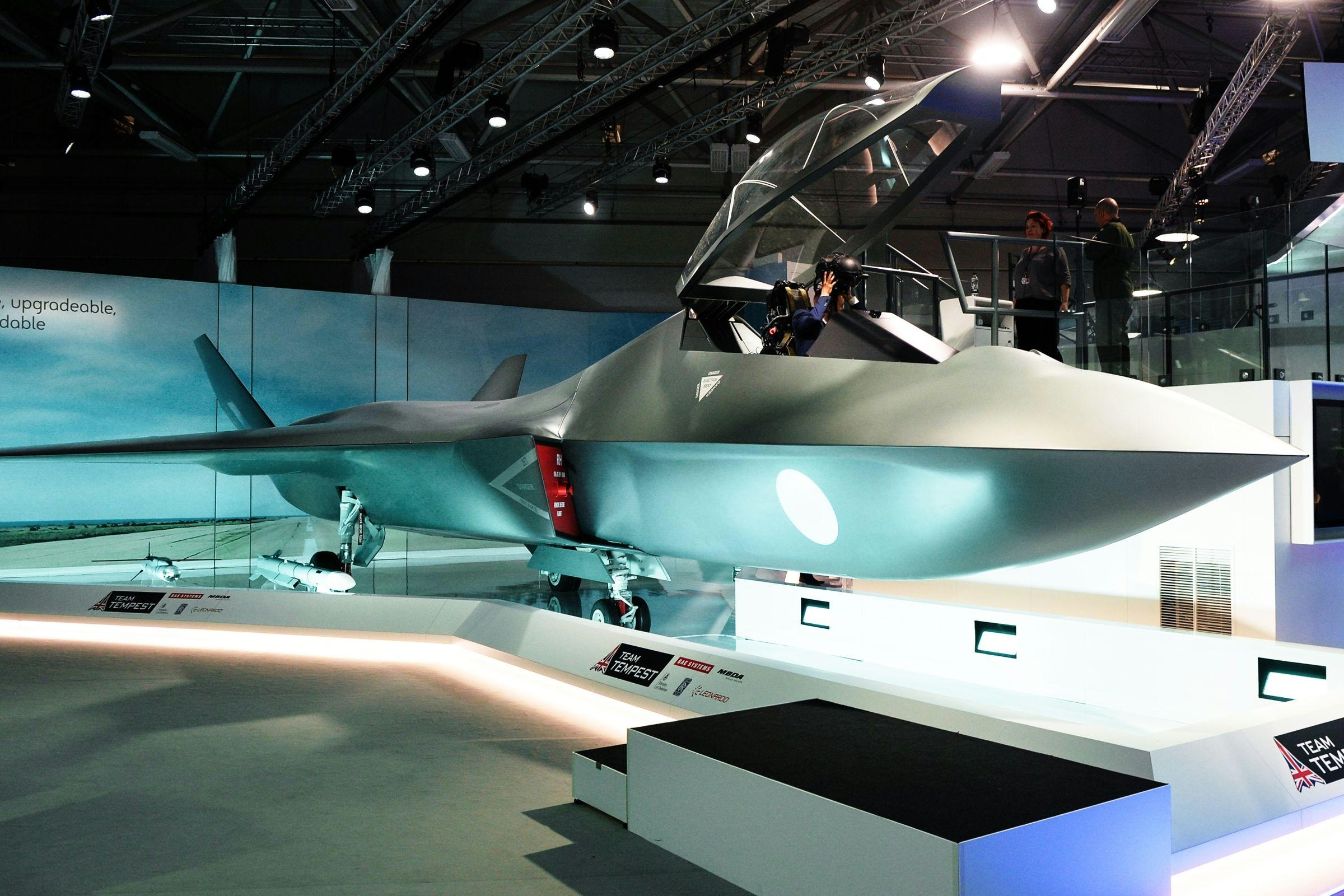
Aviation stands on the threshold of a profound transformation, the most significant since the advent of the jet age. After decades of gradual improvements, a new generation of aircraft is emerging that promises to redefine air travel. Supersonic airliners aim to halve journey times, hydrogen-powered planes offer emissions limited to water vapor, blended-wing designs propose substantial fuel savings, and electric aircraft are already taking to the skies. What was once confined to the realm of science fiction is now materializing through active development, rigorous testing, and initial operational flights.
Supersonic Flight: A New Era
The return of commercial supersonic travel marks a pivotal moment in aviation history, coming more than two decades after the Concorde’s retirement in 2003. Two prominent programs are spearheading this revival, each addressing the challenge of supersonic speeds without the disruptive sonic booms that previously limited overland routes.
Boom Supersonic’s XB-1 demonstrator achieved a milestone on January 28, 2025, by reaching Mach 1.12 at 35,290 feet over the Mojave Desert. This flight represented the first privately developed civil supersonic jet to break the sound barrier without government support. Crucially, it demonstrated “boomless cruise” capability, employing Mach cutoff physics to prevent sonic booms from reaching the ground. The company’s full-scale Overture model is designed to cruise at Mach 1.7 at 60,000 feet, accommodating 64 to 80 passengers in an all-business-class configuration over distances up to 4,250 nautical miles. This would enable transatlantic flights, such as New York to London, in approximately four hours.
Boom has secured around 130 orders and options from major airlines including United, American, and Japan Airlines. The first Overture prototype is expected by 2027, with Federal Aviation Administration (FAA) certification targeted between 2029 and 2030. However, industry analysts caution that this timeline may be optimistic, particularly given the need for extensive certification of Boom’s in-house Symphony engine. Consequently, commercial service may be delayed into the 2030s. In a strategic development, Boom announced in December 2025 that its supersonic engine technology would also be adapted to power artificial intelligence data centers. The company’s Superpower turbine, a 42-megawatt natural gas engine designed for waterless operation, has already attracted a $1.25 billion order from Crusoe, an AI infrastructure firm, illustrating the broader applications of aviation-derived engineering.
Meanwhile, NASA’s X-59 QueSST completed its inaugural flight in October 2025, reaching Mach 1.4 at 55,000 feet. Its distinctive elongated nose and specialized fuselage are engineered to produce a soft “thump” rather than a disruptive sonic boom. If this technology proves successful, it could lead regulators to lift the longstanding 50-year ban on supersonic flight over land, thereby opening the majority of global air routes to supersonic travel.
Challenges and the Path Forward
Despite these promising advances, significant challenges remain. Regulatory frameworks must evolve to accommodate emerging technologies, as exemplified by the UK Civil Aviation Authority’s roadmap for hydrogen flight operations by 2035. The integration of cutting-edge systems will require rigorous attention to safety, efficiency, and environmental compliance. Market acceptance will depend heavily on airlines’ willingness to adopt these innovations and on meeting stringent certification standards.
The competitive landscape is also shifting. China’s COMAC C919, for instance, seeks to challenge the Boeing-Airbus duopoly but continues to rely on foreign components and has yet to secure certification from major Western regulators. This underscores the complexities involved in entering the global aviation market.
As these seven transformative aircraft advance toward 2035, their ultimate success will depend not only on technological breakthroughs but also on overcoming regulatory, operational, and market barriers. The coming decade will be decisive in determining whether these ambitious visions can truly take flight.

Etihad Airways Suspends Airbus A380 Flights on Key Route

Aditya Birla Group Seeks Approval for Aircraft Leasing in GIFT City

Qatar Airways Highlights Innovation and Connectivity at Arabian Travel Market 2026

Hong Kong's Five-Year Plan Includes Andrew Fan's Aircraft Parts Processing Hub Proposal

ACIA Aero Leasing Delivers ATR72-600 to Air Nostrum

RTX Appoints Jill Albertelli as Head of Pratt & Whitney

TAT Technologies Joins Beyond Aero Hydrogen Aircraft Program

AURAK Study Highlights Barriers to Air Taxi Adoption in Emerging Economies

Xiamen Air Selects Altitude for 787 Maintenance at Heathrow

Etihad and Swissport Extend Global Partnership
